

On this page
When you put a glass of ice water on a table on a warm day, it takes only minutes for the outside of the glass to become slick with moisture. If you leave it long enough, a small puddle forms on the table.
For a child seeing this for the first time, the obvious conclusion is that the glass has tiny holes in it. They assume the water inside is somehow seeping through the solid wall. But glass is completely waterproof. The water on the outside did not come from inside the cup; it came from the air in the room.
Why does a glass of cold water get wet outside?
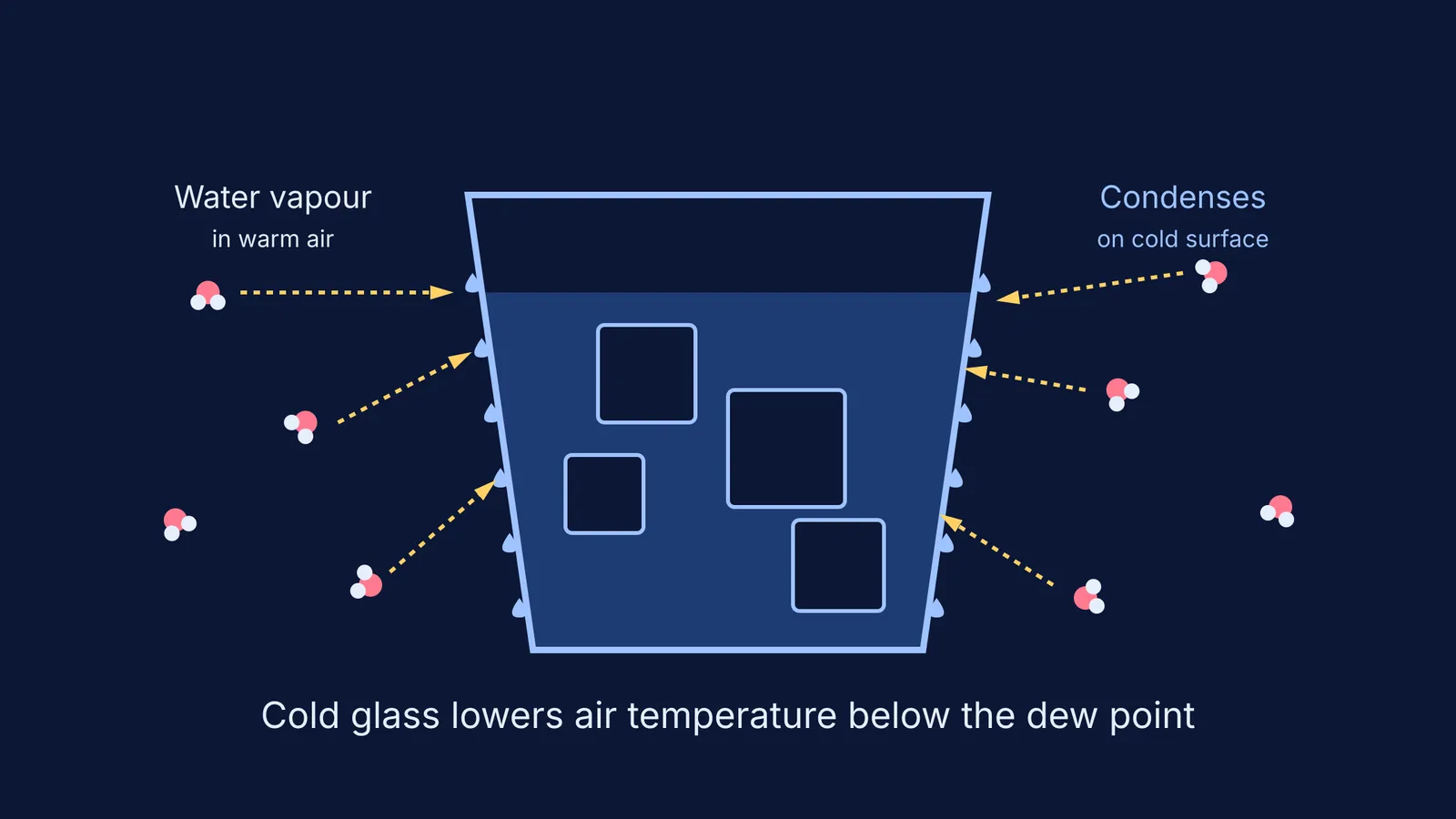
The air around us is never entirely dry. It contains water vapour, which is water in its invisible gas phase. Warm air has the capacity to hold a large amount of water vapour, while cold air can hold very little.
When you pour cold water into a glass, the glass itself becomes cold. This cold surface immediately chills the thin layer of air touching it. As that layer of air cools down, it loses its ability to hold the water vapour it was carrying. The gas undergoes a phase change — much like the enthalpies of atomisation, sublimation and phase change you study in chemistry — and turns back into liquid water. Those liquid droplets cling to the side of the glass.
We call this process condensation.
What does the dew point have to do with it?
Condensation only happens if the glass is cold enough. The exact temperature required depends on how much moisture is already in the air.
Meteorologists use a specific term for this threshold. The US National Weather Service defines the dew point as the temperature to which air must be cooled to become saturated with water vapour. If the temperature of the glass is above the dew point of the room, the glass stays dry. If the glass is colder than the dew point, the air touching it becomes saturated, and the excess water vapour condenses out as sweat.
This is why a glass sweats heavily on a humid July afternoon but stays perfectly dry on a cold, crisp January morning, even if the water inside is exactly the same temperature. On a dry day, the dew point is simply too low for the glass to reach it.
Does the water leak through the glass?
It is hard to shake the feeling that the water is leaking, especially for younger students. Rather than just telling them it is condensation, you can prove it with a simple active-learning experiment at home.
The coloured water test
Fill a clear glass with cold water and a few ice cubes.
Add a few drops of dark food colouring (such as blue or red) and stir it in.
Leave the glass on a table and wait for it to sweat.
Wipe the outside of the glass with a clean white paper towel.
The paper towel will be completely clean and wet, without a trace of blue or red dye. Because the condensation comes entirely from the surrounding air, it is pure, clear water.
If you find it hard to picture invisible water molecules colliding with a glass, the Fermi Simulation Lab lets you watch the process in slow motion. You can lower the temperature in the simulation and see the exact moment the vapour loses energy and turns into liquid drops.
Understanding condensation is a great stepping stone to other physics concepts, from how clouds form to why atmospheric refraction makes stars twinkle.


