

On this page
In short: Clothes dry through evaporation, a process that relies on the surrounding air absorbing moisture. A study by the Mackintosh Environmental Architecture Research Unit found a single load of laundry releases 2 litres of water; during the monsoon, the air's relative humidity is already so high that it cannot accept this volume, stalling the drying process.
When you hang wet clothes out on a dry winter day, they might be ready to fold by the afternoon. Do the same in the middle of July, and they might still be damp the next morning.
The difference is not just the lack of direct sunlight. It comes down to the physics of evaporation, and specifically the role of humidity, wind and surface area.
Why do clothes take so long to dry in monsoon?
Drying is a process of net evaporation. For a shirt to dry, water molecules must gain enough energy to break free from the liquid in the fabric and escape as a gas into the surrounding air.
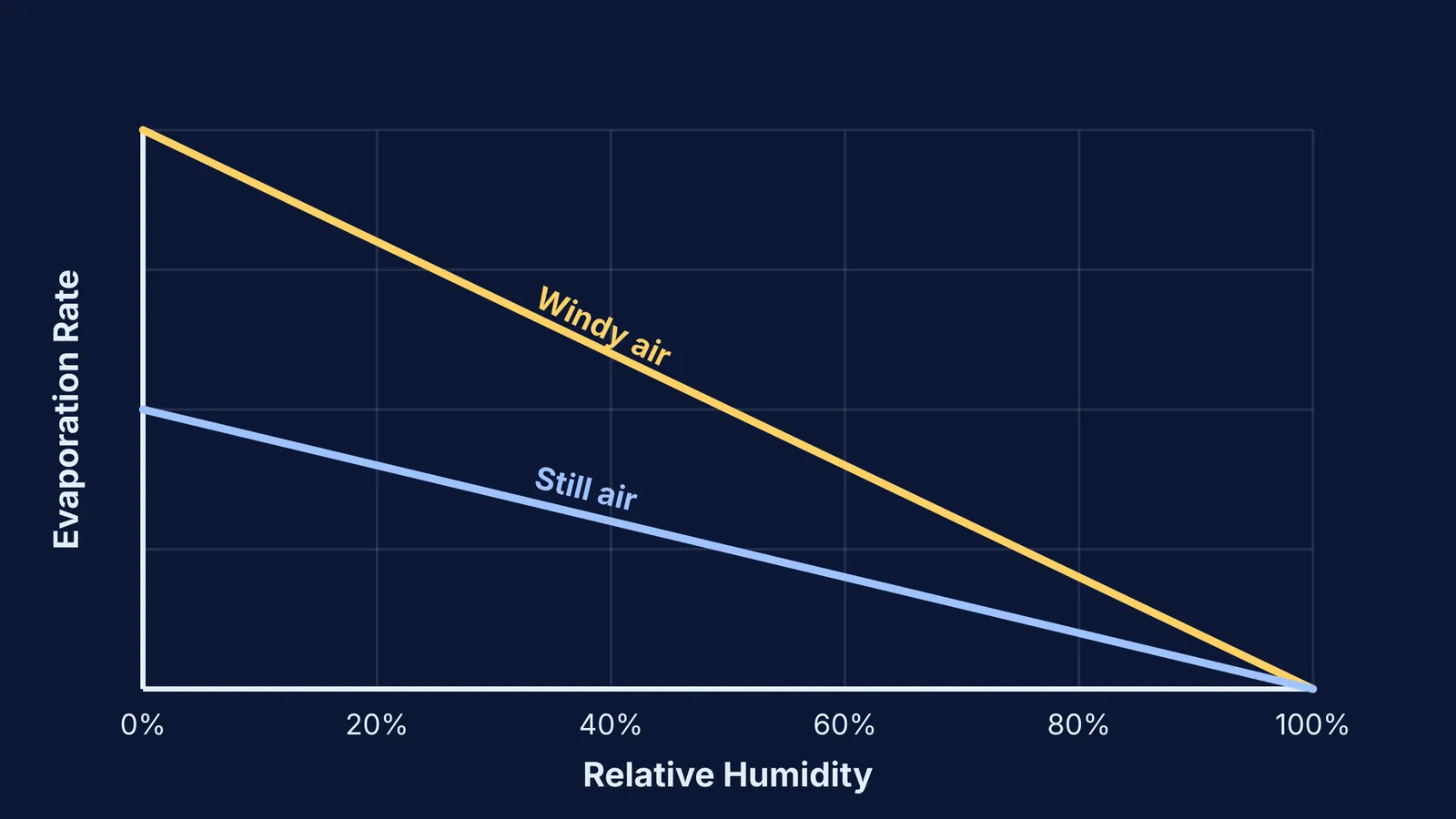
However, air can only hold a certain amount of water vapour at any given temperature. During the monsoon, the air is often near its saturation point. This leaves almost no "room" for new water molecules to enter.
Because the concentration of water vapour in the air is already so high, many molecules that do escape the cloth simply bounce back into it. The net rate of evaporation slows to a crawl, and the 2 litres of water trapped in a standard load of laundry have nowhere to go.
How do wind speed and temperature speed up evaporation?
Even if the air in the room is not completely saturated, clothes can stall while drying. This happens because the water evaporating from the fabric creates a microscopic layer of fully saturated air immediately surrounding the cloth — a "soggy halo."
If the air is still, this boundary layer acts as a wall. Wind sweeps this saturated layer away and replaces it with drier air, maintaining a steep concentration gradient that keeps the moisture flowing outward.
Temperature plays an equally critical role. Heat provides the kinetic energy water molecules need to overcome their intermolecular bonds. If your child struggles to picture how heat and wind change molecular behaviour, the Fermi Simulation Lab has interactive simulations for ideas that are easier to see than read. You can adjust the temperature and watch the rate of evaporation change in real time.
Why does spreading clothes out make a difference?
Evaporation is strictly a surface phenomenon. Molecules trapped deep inside a bundled-up towel must first travel to the surface before they can escape.
By spreading clothes out flat, you expose a much larger surface area to the air. This provides more direct escape routes for the water molecules. When studying enthalpies of atomisation and sublimation, students learn that breaking bonds always costs energy; in evaporation, doing so over a wider area prevents the available heat from being wasted on a bottleneck.
What do students learn about this in Class 9?
The physics of drying clothes is not just a household chore; it is exactly what the NCERT science syllabus covers in the chapter *Matter in Our Surroundings*.
Students are taught that the rate of evaporation increases with an increase in surface area, an increase in temperature, a decrease in humidity, and an increase in wind speed. Connecting these textbook facts to the damp laundry in the living room turns an abstract list of factors into active learning. When a student struggles to connect textbook rules to real-world problems, Fermi's AI tutor can work out what the student knows and build a plan for the session, holding a line of reasoning to help them bridge the gap.
A practical plan for monsoon laundry
When the outdoor air is too humid to help, you have to manipulate the other three variables inside your home:
Reduce the water first: Run an extra spin cycle in the washing machine. Mechanical force removes water much faster than waiting for phase changes.
Increase the wind: Dry clothes directly under a ceiling fan. The moving air continuously strips away the saturated boundary layer around the fabric.
Maximise surface area: Never fold or bunch wet clothes on the rack. Hang them completely flat and leave space between different garments so air can flow through.
For more ways to connect everyday phenomena to the syllabus, explore the Fermi Concept Library.


