

On this page
If you have pulled a packet of peas or a piece of chicken from the back of the freezer and found pale, dry, leathery patches, you have met freezer burn. Nothing burned. The food lost water, and it lost it through a change of state you meet in school science: sublimation, where a solid turns straight into a gas.
What is freezer burn, exactly?
Freezer burn is moisture loss from the surface of frozen food. In an article for The Conversation, University of Tennessee food scientist Tong Wang explains that tiny ice crystals on the food's surface evaporate directly into vapour without first becoming liquid water, leaving the surface dried out and discoloured.
What comes next is chemistry. A Texas A&M AgriLife Extension guide says that as water molecules escape from frozen food, oxygen seeps in, changing the food's colour and flavour. The same guide says meat, poultry and fish may develop dark brown or greyish-white leathery areas, and ice cream loses its creaminess and gains ice crystals.
Why does ice sublime inside a freezer?
Ice is never perfectly still. Water molecules at its surface keep breaking free, and some vapour molecules keep landing back. The pressure the vapour pushes back with, when the two rates balance, is the vapour pressure of ice. If the air around the food holds less water vapour than that, more molecules leave than return, and the ice shrinks without ever melting.
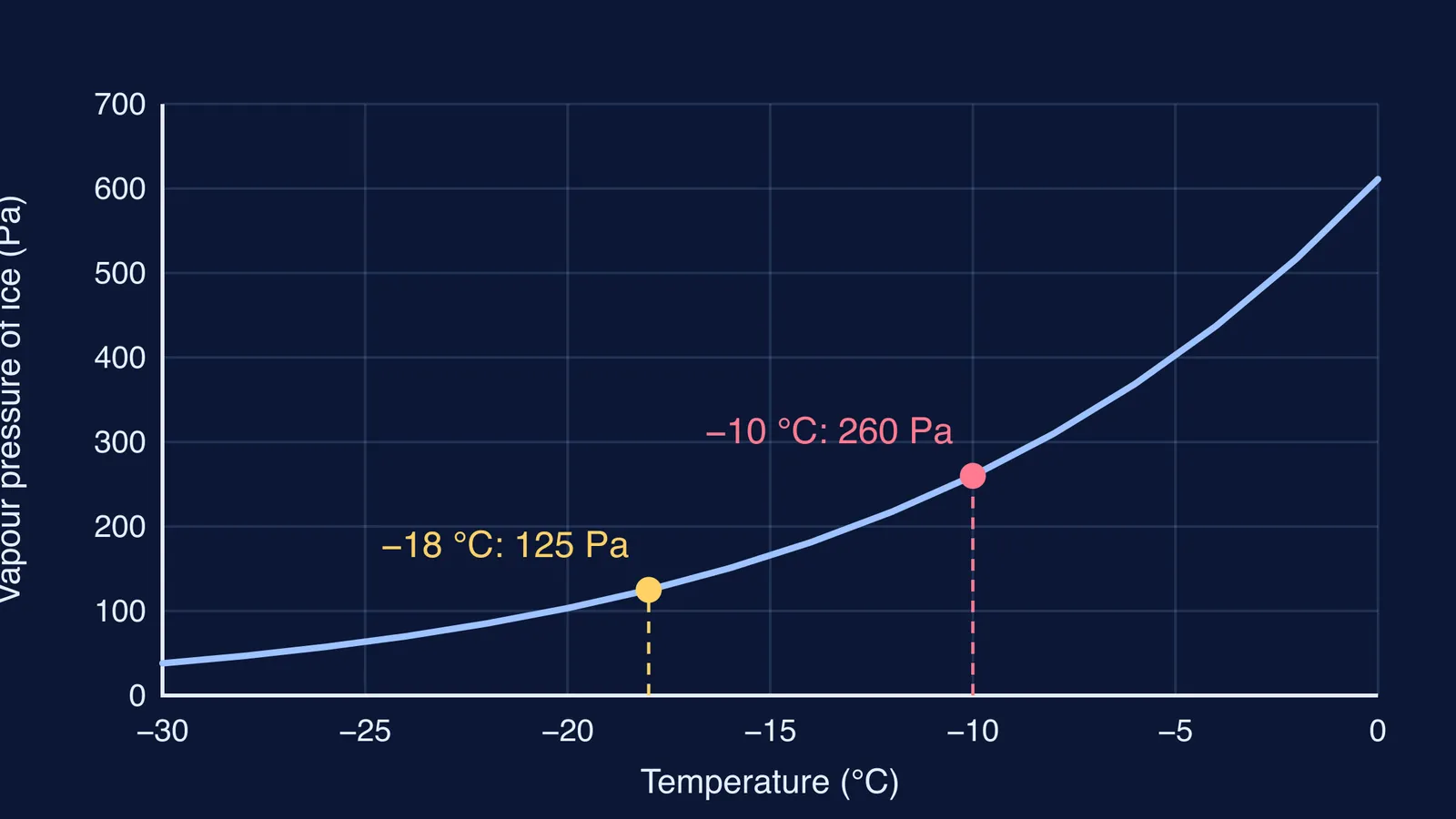
That vapour pressure climbs steeply with temperature. Arnold Wexler's tables, published by the US National Bureau of Standards in Journal of Research of the NBS (1977), give these values for ice:
At −18 °C: 124.9 Pa
At −10 °C: 259.9 Pa
At 0 °C: 611.2 Pa
Worked example: 259.9 ÷ 124.9 ≈ 2.1. So if food warms from −18 °C to −10 °C, say while the door is open or the freezer defrosts, the vapour pressure of its surface ice roughly doubles, and the push for that ice to sublime grows sharply.
Freezers do swing. Wang notes that freezers with automatic defrost turn the compressor on and off several times a day, and that this can partially melt and refreeze the ice in food, which may create larger, more damaging ice crystals. Each warm spell drives water out of the food. When the freezer cools again, that vapour deposits as frost on the coldest surface nearby, often the inside of the bag. Much of the frost in an old packet is water that used to be in your food.
If a graph of molecules leaving and returning is hard to picture, the Fermi Simulation Lab has interactive simulations for ideas that are easier to see than to read.
Is freezer-burned food safe to eat?
Yes. Hong Kong's Centre for Food Safety says that despite the quality changes, freezer burn does not affect food safety, and lists the signs as a dry and tough appearance, discolouration and ice crystals. The AgriLife guide adds that the texture and taste may be different. Safety still depends on how the food was handled before and after freezing, so follow your usual food hygiene.
How do you stop freezer burn?
Each tip attacks the air gap, the temperature or the swings. Tips 1 to 5 come from the AgriLife guide and the Centre for Food Safety; tip 6 follows from the physics above.
Keep the freezer at 0 °F (about −18 °C) or lower. Colder ice has a lower vapour pressure, and the AgriLife guide says food freezes faster there, forming smaller crystals.
Squeeze the air out of bags before sealing. Less air means less space for vapour to escape into.
Wrap meat, poultry or fish in layers: freezer paper or plastic wrap, then foil, then a freezer bag.
Freeze leftovers in small containers so there is little empty space above the food.
Press plastic wrap onto the surface of ice cream before closing the lid.
Keep the door shut and do not overfill with warm food. Fewer warm spells means less sublimation.
How would you explain freezer burn in an exam answer?
If a question links freezer burn to changes of state, a strong answer names the process, gives the condition, and states the result. Try this:
"Freezer burn is caused by sublimation. Ice crystals on the surface of the food change directly into water vapour because the surrounding freezer air holds less water vapour than the ice's vapour pressure. The surface loses water, so it becomes dry, tough and discoloured."
You can also test the idea at home. Put one ice cube in an open saucer and another in a sealed bag with the air squeezed out, leave both in the freezer for a couple of weeks, and compare. The open cube should look smaller and rounder, though it never melted. Write down your prediction before you look.
If changes of state still feel like a list to memorise, the Fermi Concept Library has a lesson for every concept in physics, chemistry, biology, mathematics and computing. Next time you see frost inside an old packet, you will know where it came from.


