

On this page
When you push a piece of chalk across a blackboard, it usually does not slide smoothly and quietly. Instead, it undergoes a complex mechanical process called stick-slip friction, which causes that unbearable noise.
What is stick-slip friction?
Friction is not a single, constant force. It is divided into two types: static friction, which resists the start of motion, and kinetic friction, which resists motion once an object is already sliding. Blackboards are designed with a specific microscopic roughness to catch chalk particles and leave a mark, which naturally creates high static friction.
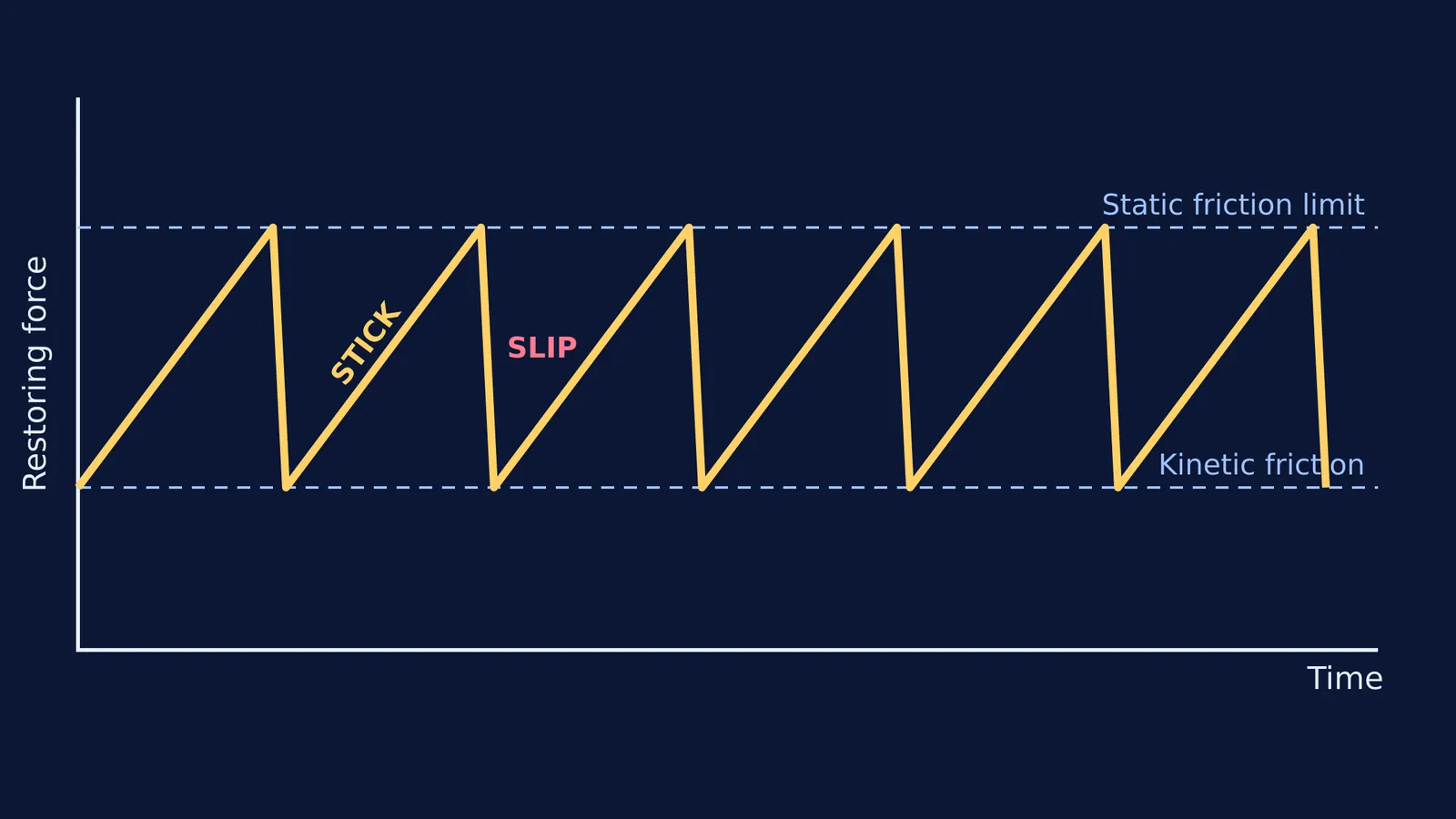
When you push a piece of chalk, this static friction initially grabs the tip and holds it in place. As your hand continues to push, the chalk bends slightly, storing elastic energy like a spring. Eventually, the pushing force overcomes the static friction threshold, and the chalk snaps forward into a slip phase.
Because kinetic friction is inherently lower than static friction, the stored energy is released quickly and the chalk jumps ahead. It then catches the board and sticks again. This violent cycle repeats hundreds or thousands of times per second, exciting the natural resonances of the chalk stick and causing it to vibrate.
Friction at this microscopic level can be hard to picture. In the Fermi Simulation Lab, you can adjust static and kinetic friction to see how they pull on a moving object and cause these rapid, microscopic jumps.
Stick-slip in the real world
Chalk on a blackboard is just one example of the stick-slip effect. The exact same physics governs several other everyday phenomena:
Bowed string instruments: When a violinist pulls a bow across a string, the sticky rosin on the bow hair catches and sticks to the string, pulling it sideways until the increasing string tension forces it to rapidly slip back. This high-frequency stick-slip cycle is exactly what creates the continuous musical note.
Earthquakes: Tectonic plates stick together at fault lines due to immense static friction. As the plates slowly move, strain builds up until they finally slip, releasing massive amounts of stored energy as seismic waves.
Squeaking doors: A door hinge that lacks lubrication will experience stick-slip friction between the pin and the barrel, causing it to vibrate and squeal as it opens.
Why is the sound so painful?
The rapid chattering of the stick-slip cycle creates a loud tonal squeal. Studies on the psychoacoustics of chalkboards show that the frequencies of this squeal peak between 2000 and 4000 Hz.
This is where biology turns an ordinary sound into an unbearable one. The human ear canal is a closed tube that naturally resonates and amplifies sounds in the exact same 2000 to 4000 Hz range. When the chalk squeaks, your ear acts as a physical megaphone, boosting the sound by 10 to 15 decibels before it reaches the inner ear.
How can you stop the squeal?
If you are writing on a board and the chalk starts to scream, you can break the feedback loop with three practical adjustments:
Snap the chalk in half: A shorter piece of chalk has a higher natural resonance frequency. Breaking it pushes the vibrations higher, often past the range your ear amplifies, and provides better mechanical damping since your fingers cover more of the stick.
Change the angle: Drag the chalk at a shallow angle rather than pushing it near perpendicular. A lower angle makes it harder for the tip to catch the microscopic bumps on the board, preventing the stick phase from ever occurring.
Press lighter: Lower pressure reduces the normal force and therefore the friction force, meaning the snap during the slip phase carries significantly less energy.
Whether you are drawing the angle of repose and angle of friction or plotting displacement and pressure waves in sound, you can spare your students the earache by keeping the chalk short and the angle low.


