

On this page
Class 10 numericals that ask for "units consumed" or "cost of energy" are easy marks if you track units. The physics is one line: energy = power × time. The usual wrong answer multiplies the right numbers in the wrong units.
What is one unit of electricity?
On an Indian electricity bill, one "unit" is one kilowatt-hour (kWh), the energy used when 1 kilowatt of power runs for 1 hour, as Tata Power's glossary explains. The same page gives an example: a 2 kW appliance running for 3 hours uses 6 units.
The kWh is not an SI unit, but it is built from SI pieces. The BIPM SI Brochure defines the watt as one joule per second, sets the hour at 3600 seconds and gives the prefix kilo as 10³. Put them together:
1 kWh = 1000 W × 3600 s = 3.6 × 10⁶ J.
How do you convert watts and hours into kWh?
Use this three-step routine for every appliance:
Write power in kilowatts: divide watts by 1000 (1200 W = 1.2 kW).
Write time in hours: divide minutes by 60 (10 min = 1/6 h).
Multiply: energy (kWh) = P (kW) × t (h) × number of appliances × number of days.
If the question gives voltage and current instead of power, find power first with P = VI. In the NCERT question about a motor that draws 5 A from a 220 V line, P = 1100 W = 1.1 kW, so running it for 2 hours uses 2.2 kWh, or 7.92 × 10⁶ J (question and worked solution).
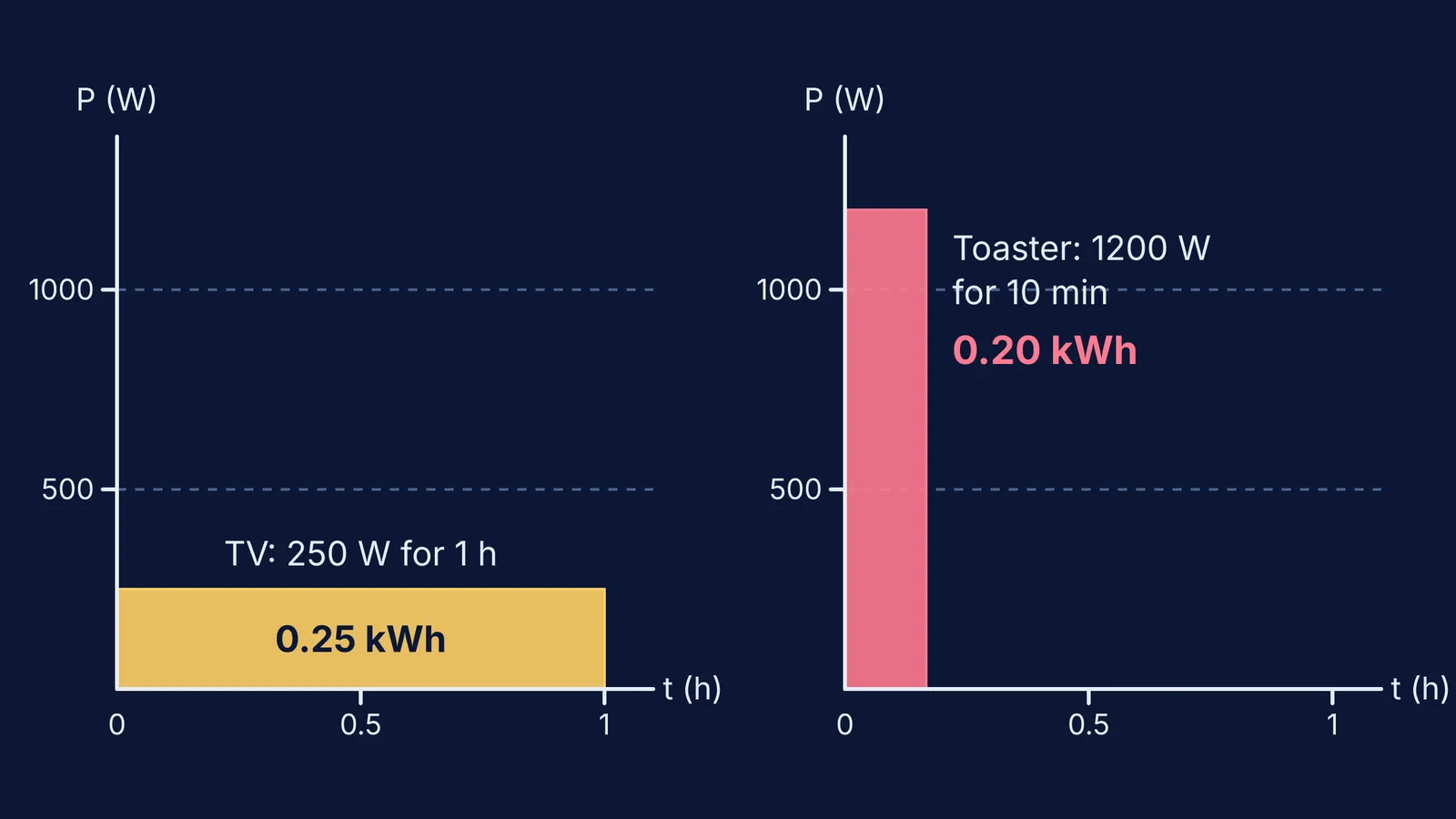
Another NCERT question asks: "Which uses more energy, a 250 W TV set in 1 hr, or a 1200 W toaster in 10 minutes?" (question and solution).
TV: 0.25 kW × 1 h = 0.25 kWh
Toaster: 1.2 kW × (10/60) h = 0.20 kWh
The TV uses more, even though the toaster's power rating is 4.8 times bigger. Power is how fast energy is used; energy also depends on running time. In the diagram at the top, height is power, width is time and area is energy.
How do you work out a monthly bill?
Suppose a question describes a home that uses, every day:
4 LED bulbs of 10 W for 6 hours: 4 × 0.01 kW × 6 h = 0.24 kWh
2 ceiling fans of 75 W for 10 hours: 2 × 0.075 kW × 10 h = 1.5 kWh
1 iron of 1000 W for 30 minutes: 1 kW × 0.5 h = 0.5 kWh
The daily total is 2.24 kWh. Over 30 days that is 2.24 × 30 = 67.2 kWh, or 67.2 units, since one unit on a bill is one kWh (Tata Power's glossary). If the question gives a rate of ₹6 per unit, the cost is 67.2 × 6 = ₹403.20. In an exam, use only the rate the question gives; a real bill follows your state's tariff.
Which unit mistakes cost the most marks?
The NCERT worked solutions flag unit mixing as a common error. Check your answer against these slips:
Watts left as watts. 1200 W × (1/6) h = 200 Wh, not 200 kWh. Divide by 1000 to get 0.2 kWh.
Minutes used as hours. 1.2 kW × 10 = 12 kWh is 60 times too big. Convert 10 min to 1/6 h first.
Joules multiplied by the rate. If you found energy in joules, divide by 3.6 × 10⁶ before multiplying by rupees per kWh.
A skipped conversion factor. kW to W is × 1000, hours to seconds is × 3600, and kWh to J is × 3.6 × 10⁶. Leave one out and your answer is off by exactly that factor.
"kW per hour". The kWh is kilowatts multiplied by hours, not divided. Everyday wording slips here too: one Delhi distributor's energy calculator describes a unit as "1000 Watts per hour". The quantity a meter counts is 1000 watt-hours.
A quick sense check: a 1 kW iron running for an hour uses exactly one unit.
How should you practise kWh numericals?
Solve five problems that give power in watts and time in minutes, so both conversions become automatic.
For each one, write the energy in kWh and in joules.
Reverse one: given the units used and the hours, find the power rating.
If your answer does not match, the Fermi Problem Library has worked problems with a step-by-step solver that explains the reasoning, so you can find the line where a unit went wrong. If the gap is the idea itself, power versus energy, the Fermi Concept Library gives each concept its own lesson.
For the rest of the chapter, read our guide to Ohm's law, resistors and electric power in Class 10, see how the heating effect of current links to fuses and energy bills, and practise comparing bulb brightness from power ratings.
Next time a question says "units", write kW × h before you do anything else.


