

On this page
Why is the latent heat of vaporisation so much greater than fusion?
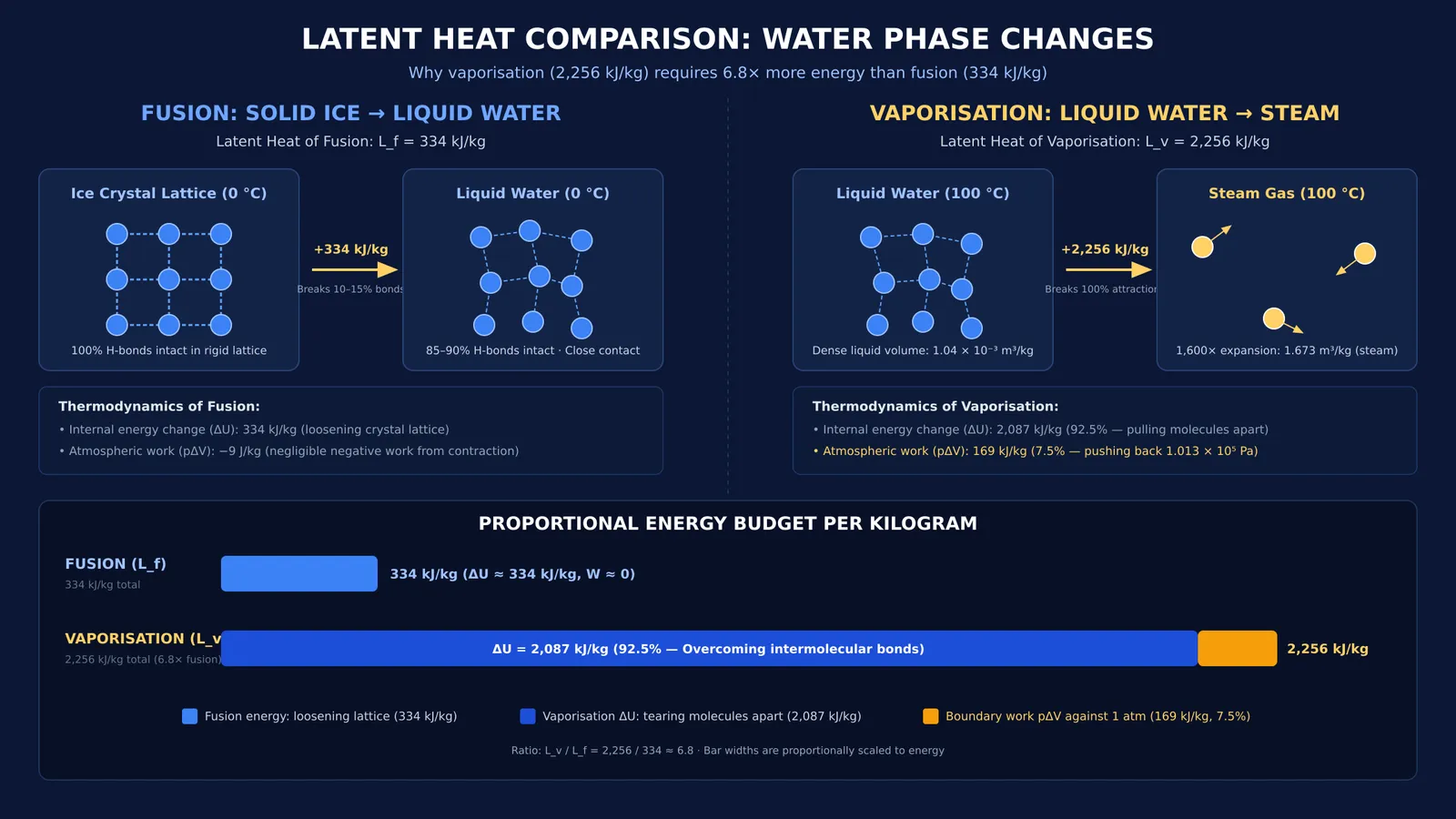
When a substance changes state, its temperature pauses even as heat enters. In thermodynamics, this absorbed energy is latent heat. Comparing the energy needed to melt ice with that needed to boil water reveals a dramatic contrast. According to OpenStax University Physics Volume 2, water's latent heat of fusion is 334 kJ/kg (or 3.33 × 10⁵ J/kg in standard NCERT tables), while its latent heat of vaporisation is 2,256 kJ/kg (2.26 × 10⁶ J/kg). Boiling water demands 6.8 times more heat than melting the same mass of ice.
This disparity reflects intermolecular behavior during each transition. In solid ice, water molecules form a rigid hexagonal lattice with four hydrogen bonds per molecule. Melting merely provides enough thermal agitation to overcome lattice rigidity so molecules can slide past each other. Spectroscopic measurements by Smith et al. (2005) in PNAS confirm that liquid water retains an extensive network where only 10% to 15% of the hydrogen bonds found in ice are broken at 0 °C. The molecules remain in close contact, with intermolecular distances nearly identical to the solid phase.
Boiling, by contrast, tears molecules completely apart. Liquid molecules must overcome all neighbouring attractions until separated by hundreds of molecular diameters, where intermolecular forces become negligible. Overcoming these deep potential wells requires enormous energy. As explored in our guide to matter in our surroundings and latent heat, this high energy absorption is why steam produces far more severe burns than boiling water at 100 °C.
How much energy goes into pushing back the atmosphere?
As outlined in OpenStax University Physics Volume 2 Section 3.3, the first law of thermodynamics dictates that heat added at constant atmospheric pressure (1.013 × 10⁵ Pa) satisfies ΔH = ΔU + pΔV, where ΔU is internal energy change and pΔV is boundary work against the air.
During fusion, volume changes are tiny. Because ice contracts upon melting, 1 kg of ice shrinks from 1.091 × 10⁻³ m³ to 1.000 × 10⁻³ m³ of water, producing slight negative work (-9 J/kg). Even for substances that expand on melting, volume increases rarely exceed 10%, keeping expansion work below 0.1% of the latent heat of fusion.
Vaporisation is vastly different. When 1 kg of water boils at 100 °C, it expands from 1.04 × 10⁻³ m³ to 1.673 m³ of steam—a 1,600-fold expansion. Pushing back atmospheric pressure requires boundary work:
W = pΔV = (1.013 × 10⁵ Pa) × (1.673 - 0.00104) m³ ≈ 169.4 kJ/kg
Subtracting this work gives the internal energy increase:
ΔU = L_v - W = 2,256 kJ/kg - 169.4 kJ/kg ≈ 2,086.6 kJ/kg
Expansion work consumes roughly 7.5% of the supplied heat, while 92.5% goes directly into pulling water molecules apart.
Is the vaporisation gap universal across all substances?
This asymmetry occurs across all substances. Reference data in the NIST Chemistry WebBook and Table 11.5 of the NCERT Class 11 Physics textbook confirm that L_v consistently exceeds L_f across diverse chemical classes:
Ethyl alcohol: L_f = 1.0 × 10⁵ J/kg; L_v = 8.5 × 10⁵ J/kg (ratio 8.5)
Mercury: L_f = 0.12 × 10⁵ J/kg; L_v = 2.7 × 10⁵ J/kg (ratio 22.5)
Nitrogen: L_f = 0.26 × 10⁵ J/kg; L_v = 2.0 × 10⁵ J/kg (ratio 7.7)
Oxygen: L_f = 0.14 × 10⁵ J/kg; L_v = 2.1 × 10⁵ J/kg (ratio 15.0)
Lead: L_f = 0.25 × 10⁵ J/kg; L_v = 8.67 × 10⁵ J/kg (ratio 34.7)
In molten lead, atoms remain in a metallic electron pool; boiling requires pulling atoms completely out of the melt. Non-polar nitrogen needs little energy to loosen its crystal packing, but much more to separate molecules against dispersion forces. On temperature-time graphs during phase change, the boiling plateau is therefore always substantially longer than the melting plateau.
How do you calculate work and internal energy during vaporisation?
Thermodynamic calculations frequently analyze the split between heat, work, and internal energy during state changes, as demonstrated in OpenStax University Physics Volume 2. Consider vaporising 0.500 kg of water at 100 °C and 1.013 × 10⁵ Pa, where L_v = 2.26 × 10⁶ J/kg, v_liq = 1.04 × 10⁻³ m³/kg, and v_steam = 1.673 m³/kg:
Heat added: Q = m × L_v = 0.500 kg × 2.26 × 10⁶ J/kg = 1,130 kJ.
Volume change: ΔV = 0.500 kg × (1.673 - 0.00104) m³/kg = 0.8360 m³.
External work: W = pΔV = (1.013 × 10⁵ Pa) × 0.8360 m³ ≈ 84.7 kJ.
Internal energy change: ΔU = Q - W = 1,130 kJ - 84.7 kJ = 1,045.3 kJ.
Expansion work accounts for (84.7 / 1,130) × 100% ≈ 7.5% of total heat, while 92.5% goes into internal energy.
In calorimetry and heat transfer problems, distinguishing sensible heat (Q = mcΔT) from latent transitions (Q = mL) prevents calculation errors. The Fermi Concept Library covers every concept in physics, chemistry, biology, mathematics and computing, each with its own lesson and its place in the map. For problems combining state changes with thermodynamic work, the Fermi Problem Library provides worked problems with a step-by-step solver that explains the reasoning rather than printing an answer. If you find particle separations difficult to picture, the Fermi Simulation Lab offers interactive simulations for ideas easier to see than to read.


