

On this page
A standard domestic LPG cylinder in India holds 14.2 kg of gas, the size the Petroleum Planning and Analysis Cell FAQ uses when it describes the cap on subsidised refills. Burn all of it and you release about 43 kg of carbon dioxide, three times the mass of the fuel. That makes it a good Class 11 stoichiometry problem.
What is LPG, and which equation should you use?
LPG is "a group of hydrocarbon gases, primarily propane, normal butane, and isobutane", according to the US Energy Information Administration glossary. We treat the whole 14.2 kg as butane, C4H10, and check propane afterwards.
The balanced equation for complete combustion of butane is:
2C4H10 + 13O2 → 8CO2 + 10H2O
Balance carbon first (4 per butane, so 4 CO2), then hydrogen (10 per butane, so 5 H2O), then oxygen: 4 × 2 + 5 = 13 oxygen atoms, which is 6.5 O2 per butane. Doubling removes the half. If balancing still feels shaky, our guide on how to balance the combustion of any hydrocarbon walks through the general formula.
How do you calculate the CO2 from 14.2 kg of LPG?
Use rounded atomic masses of C = 12, H = 1 and O = 16; the IUPAC Commission on Isotopic Abundances and Atomic Weights gives standard atomic weights that round to 12.011, 1.008 and 15.999, which change the final answer by less than 0.1 kg.
Molar mass of butane: 4 × 12 + 10 × 1 = 58 g/mol.
Moles in the cylinder: 14,200 g ÷ 58 g/mol ≈ 244.8 mol.
Mole ratio from the equation: 2 mol butane gives 8 mol CO2, so 1 gives 4. That is 244.8 × 4 ≈ 979 mol CO2.
Mass of CO2: 979 mol × 44 g/mol ≈ 43,090 g, or about 43.1 kg.
Per kilogram, the ratio is 176 g of CO2 for every 58 g of butane, which is 3.03 kg of CO2 per kg of fuel.
Why is there more CO2 than fuel?
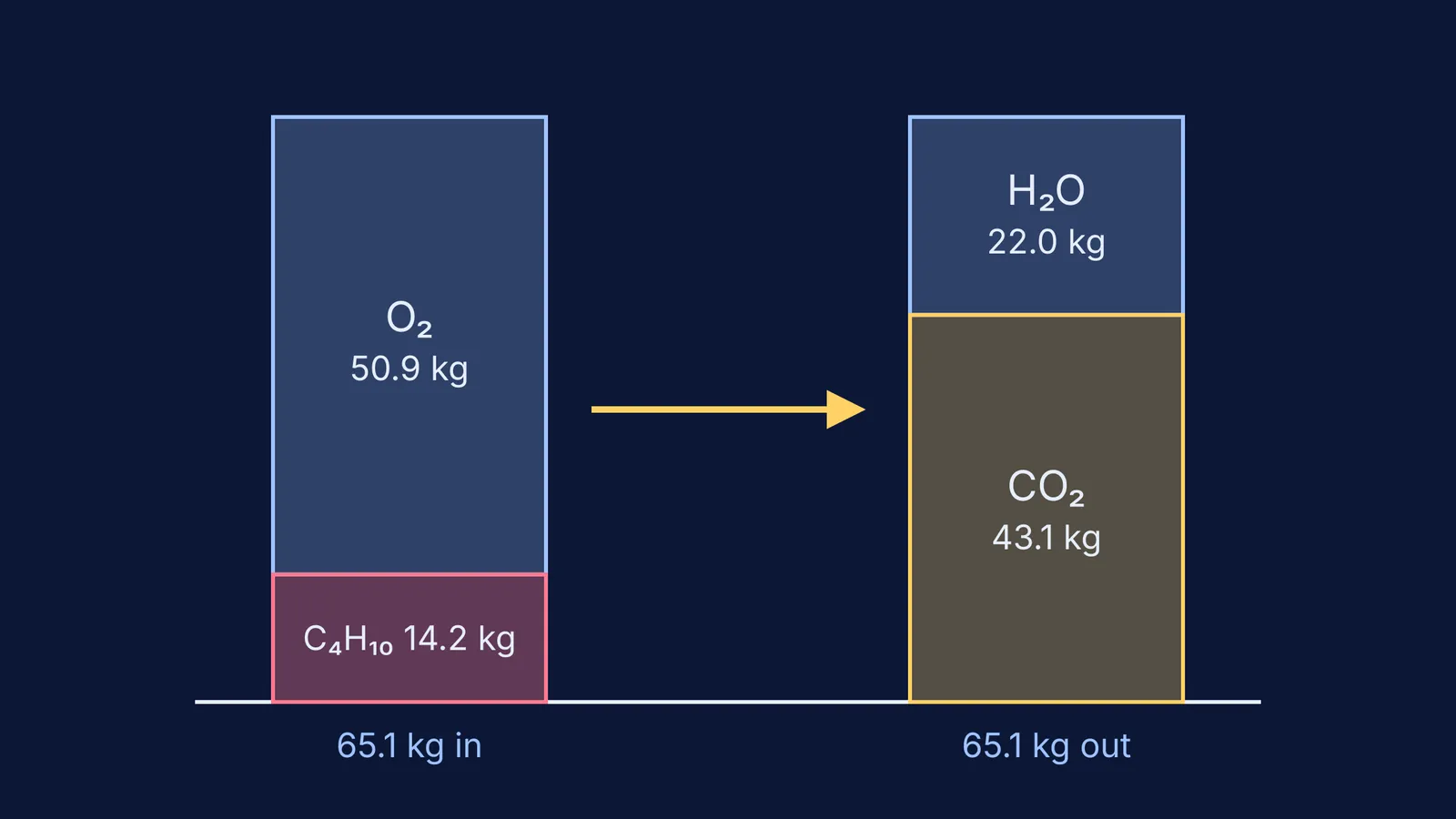
Mass is conserved, but the oxygen comes from the air, not the cylinder. 244.8 mol of butane needs 244.8 × 6.5 × 32 g ≈ 50.9 kg of oxygen and makes 244.8 × 5 × 18 g ≈ 22.0 kg of water. The left side is 14.2 + 50.9 = 65.1 kg, and the right side is 43.1 + 22.0 = 65.1 kg. Most of the mass of the CO2 is oxygen pulled from your kitchen air. For the air side, see how to calculate the volume of air needed to burn a fuel.
Does it matter that LPG is not pure butane?
Very little. For propane, C3H8 + 5O2 → 3CO2 + 4H2O, so 44 g of propane gives 3 × 44 = 132 g of CO2, exactly 3.00 kg per kg, or 42.6 kg per cylinder. Any mix of propane and butane therefore lands between about 42.6 and 43.1 kg.
The official inventory numbers agree. The 2006 IPCC Guidelines, Volume 2, Chapter 1 give LPG a default net calorific value of 47.3 TJ per Gg (that is, 47.3 MJ per kg). Chapter 2 of the same guidelines gives a default stationary-combustion emission factor of 63,100 kg of CO2 per TJ for LPG. Multiply them: 47.3 MJ/kg × 0.0631 kg CO2/MJ ≈ 2.98 kg of CO2 per kg, or about 42.4 kg per cylinder, within 2% of the butane estimate.
For a household picture: the PPAC FAQ notes a cap of 12 subsidised 14.2 kg cylinders a year for each household. A family using all 12 would release about 12 × 43.1 ≈ 517 kg of CO2 a year from cooking gas.
Where do students lose marks on this question?
Before you write the final number, check these:
You used the balanced equation. An unbalanced C4H10 → CO2 gives a 1:1 ratio and an answer four times too small.
You converted 14.2 kg to 14,200 g before dividing by 58 g/mol.
You used 44 g/mol for CO2, not 28 (that is CO) or 12 (that is just carbon).
You used the mole ratio: the 2:8 in the equation counts molecules, not grams.
Your answer is bigger than the fuel mass. If CO2 comes out smaller than 14.2 kg, something has gone wrong.
If you keep getting the method wrong rather than the arithmetic, the Fermi Problem Library has worked problems with a step-by-step solver that explains the reasoning rather than printing an answer. If the gap is the mole concept itself, the Fermi Concept Library gives each concept in chemistry its own lesson and its place in the map.
To practise the same method on a different fuel, try how much CO2 is produced by burning 1 kg of methane and compare the ratio you get with 3.03.


