

On this page
Hydrocarbon combustion drives our world. According to the Energy Institute's 2024 Statistical Review of World Energy, fossil fuels accounted for 81.5% of global primary energy consumption in 2023. At the heart of this massive energy transfer is a single type of chemical reaction: a hydrocarbon reacting with oxygen to produce carbon dioxide, water, and heat.
When you first learn about carbon compounds in Class 10, balancing combustion equations often involves trial and error. You tally up the carbons, fix the hydrogens, and then find yourself stuck with an odd number of oxygen atoms. This back-and-forth process is frustrating and wastes valuable time during exams. But you do not have to guess. By using a general formula, you can balance the combustion of any hydrocarbon systematically.
How to balance combustion of any hydrocarbon cxhy general formula?
A hydrocarbon contains only carbon (C) and hydrogen (H). We write its general formula as CxHy. In a complete combustion reaction, all the carbon turns into carbon dioxide (CO₂), and all the hydrogen turns into water (H₂O).
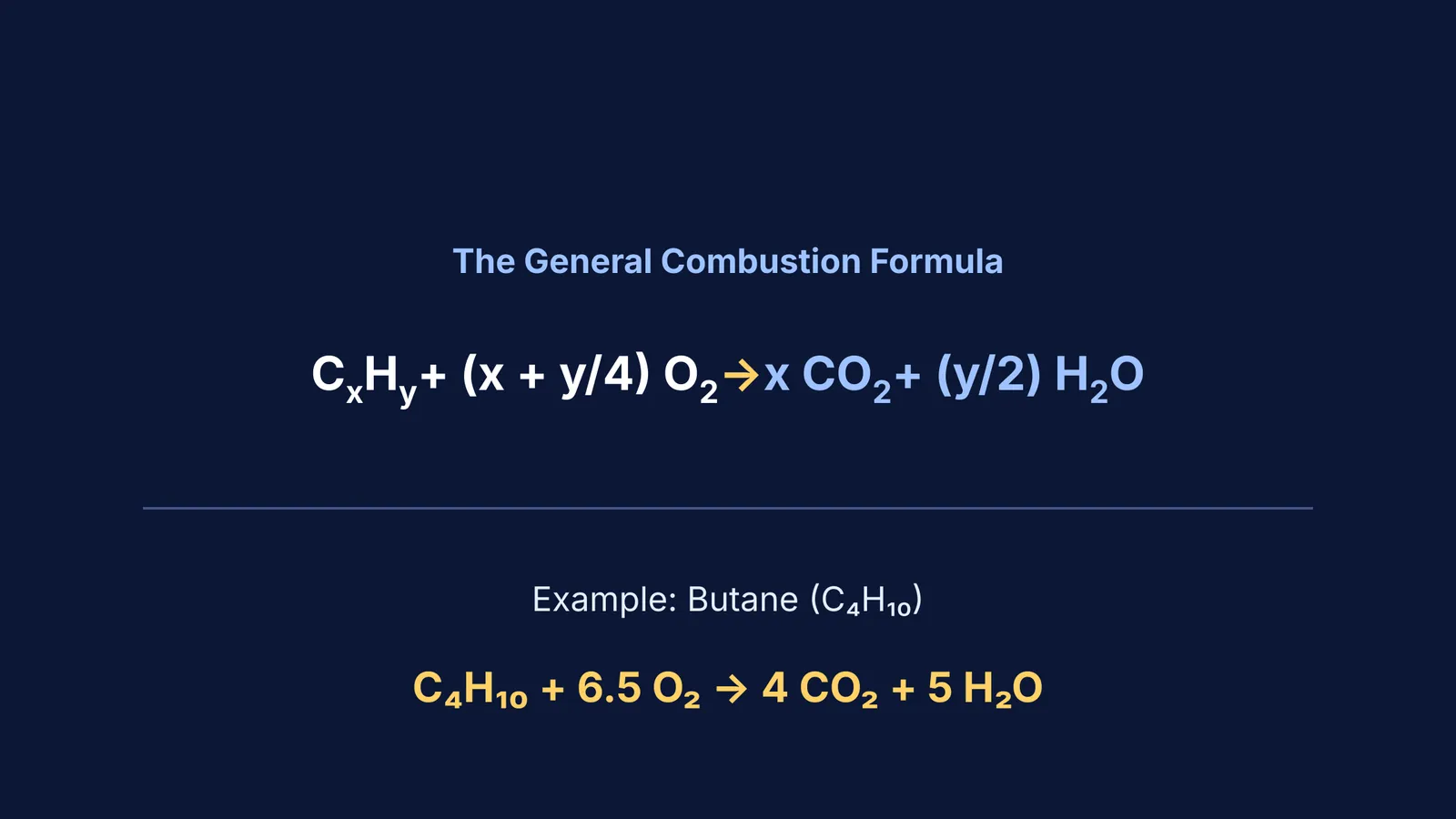
Because the products are entirely predictable, you can balance the equation algebraically once and for all. The resulting formula is:
CxHy + (x + y/4) O₂ → x CO₂ + (y/2) H₂O
Here is exactly how those coefficients are derived without any guesswork:
Carbon: You start with x atoms of carbon on the left side of the equation. To balance this, you need exactly x molecules of CO₂ on the right side.
Hydrogen: You start with y atoms of hydrogen. Because each individual water molecule (H₂O) holds two hydrogen atoms, you only need half as many water molecules as you have hydrogen atoms, giving you y/2 molecules of water.
Oxygen: On the product side, you now have 2x oxygen atoms from the CO₂ and y/2 oxygen atoms from the water. The total number of oxygen atoms is 2x + y/2. Since oxygen gas from the atmosphere comes as O₂ pairs, you divide that total by 2 to find the number of O₂ molecules needed: (2x + y/2) / 2, which simplifies to x + y/4.
Let's see it in action with propane (C₃H₈), a common fuel used in heating and cooking.
Set x = 3 and y = 8.
The CO₂ coefficient is x = 3.
The H₂O coefficient is y/2 = 4.
The O₂ coefficient is x + y/4 = 3 + 8/4 = 5.
The balanced equation is simply: C₃H₈ + 5 O₂ → 3 CO₂ + 4 H₂O
What if you get a fraction?
Sometimes the formula gives you a fraction for the oxygen coefficient. This happens when dividing y by 4 does not result in a whole number.
Take butane (C₄H₁₀), the liquid fuel found in typical lighters, as an example.
x = 4 and y = 10.
The CO₂ coefficient is x = 4.
The H₂O coefficient is y/2 = 5.
The O₂ coefficient is x + y/4 = 4 + 10/4 = 6.5.
Plugging these in gives: C₄H₁₀ + 6.5 O₂ → 4 CO₂ + 5 H₂O
Chemically, writing 6.5 O₂ (or 13/2 O₂) is perfectly valid, especially when doing enthalpy calculations where you might be tracking the combustion of exactly one mole of fuel. In thermochemistry, keeping the fuel at a coefficient of 1 is often required. However, many standard chemistry exams require whole-number coefficients. To clear the fraction and produce integer coefficients, simply multiply the entire equation by 2:
2 C₄H₁₀ + 13 O₂ → 8 CO₂ + 10 H₂O
How do you balance compounds that contain oxygen?
Many common fuels and biological molecules, such as alcohols, carbohydrates, or ethers, contain oxygen as well. The general trick remains the same, but you must account for the oxygen already present in the fuel molecule before adding oxygen from the air. If we write the oxygen-containing compound as CxHyOz, the general formula adapts to:
CxHyOz + (x + y/4 - z/2) O₂ → x CO₂ + (y/2) H₂O
The only difference is the O₂ coefficient on the reactant side. Because the fuel molecule itself supplies z atoms of oxygen to the reaction, you need z/2 fewer oxygen molecules from the surrounding air.
Let's balance the combustion of ethanol (C₂H₅OH, which groups together to C₂H₆O). When naming carbon compounds, keeping track of the total atoms is key.
x = 2, y = 6, z = 1.
CO₂ coefficient = x = 2.
H₂O coefficient = y/2 = 3.
O₂ coefficient = 2 + 6/4 - 1/2 = 2 + 1.5 - 0.5 = 3.
The balanced equation is: C₂H₆O + 3 O₂ → 2 CO₂ + 3 H₂O
What is the combustion balancing checklist?
When faced with a tricky combustion question, follow these strict steps instead of guessing:
Identify the fuel: Is it a straight hydrocarbon (CxHy) or does it contain oxygen (CxHyOz)?
Assign variables: Write down the exact values for x, y, and z based on the molecular formula.
Apply the formula: Calculate the O₂ coefficient using x + y/4 (or x + y/4 - z/2 for oxygenates).
Check for fractions: If the O₂ coefficient ends in .5, write down the fractional equation first, then double all the coefficients in your final answer.
Instead of counting atoms back and forth across the reaction arrow for minutes on end, using the algebraic method yields the correct answer directly. You can explore the theory behind these reactions further in the Fermi Concept Library, where every concept in physics, chemistry, biology, mathematics and computing has its own lesson and its place in the map.


