

On this page
When engineers design a burner or students solve combustion stoichiometry, one question recurs: how much air is needed for complete combustion? Gaseous fuels are simple to balance, but atmospheric air is not pure oxygen. Because dry air consists mostly of nitrogen, supplying the required stoichiometric oxygen demands drawing in a substantially larger volume of atmospheric air.
Why do combustion calculations divide oxygen volume by 0.21?
Chemical equations show reactions in moles, but for gases, volume is directly proportional to moles. Under Gay-Lussac's law of combining volumes and Avogadro's law, equal volumes of gases at the same temperature and pressure contain equal numbers of molecules. Stoichiometric coefficients therefore represent volume ratios directly. If a reaction consumes two moles of oxygen gas per mole of fuel, it consumes two litres of oxygen per litre of fuel at the same conditions.
Atmospheric air is a mixture. Data in the NASA Earth Fact Sheet show that dry air contains 20.95% oxygen (O₂) and 78.08% nitrogen (N₂) by volume, alongside 0.93% argon. In practical combustion calculations, this oxygen fraction is rounded to 21% by volume, giving a volume fraction of 0.21.
To supply a required oxygen volume, V(O₂), the total air volume, V(air), must satisfy:
V(O₂) = 0.21 × V(air)
Rearranging yields the core relation:
V(air) = V(O₂) / 0.21
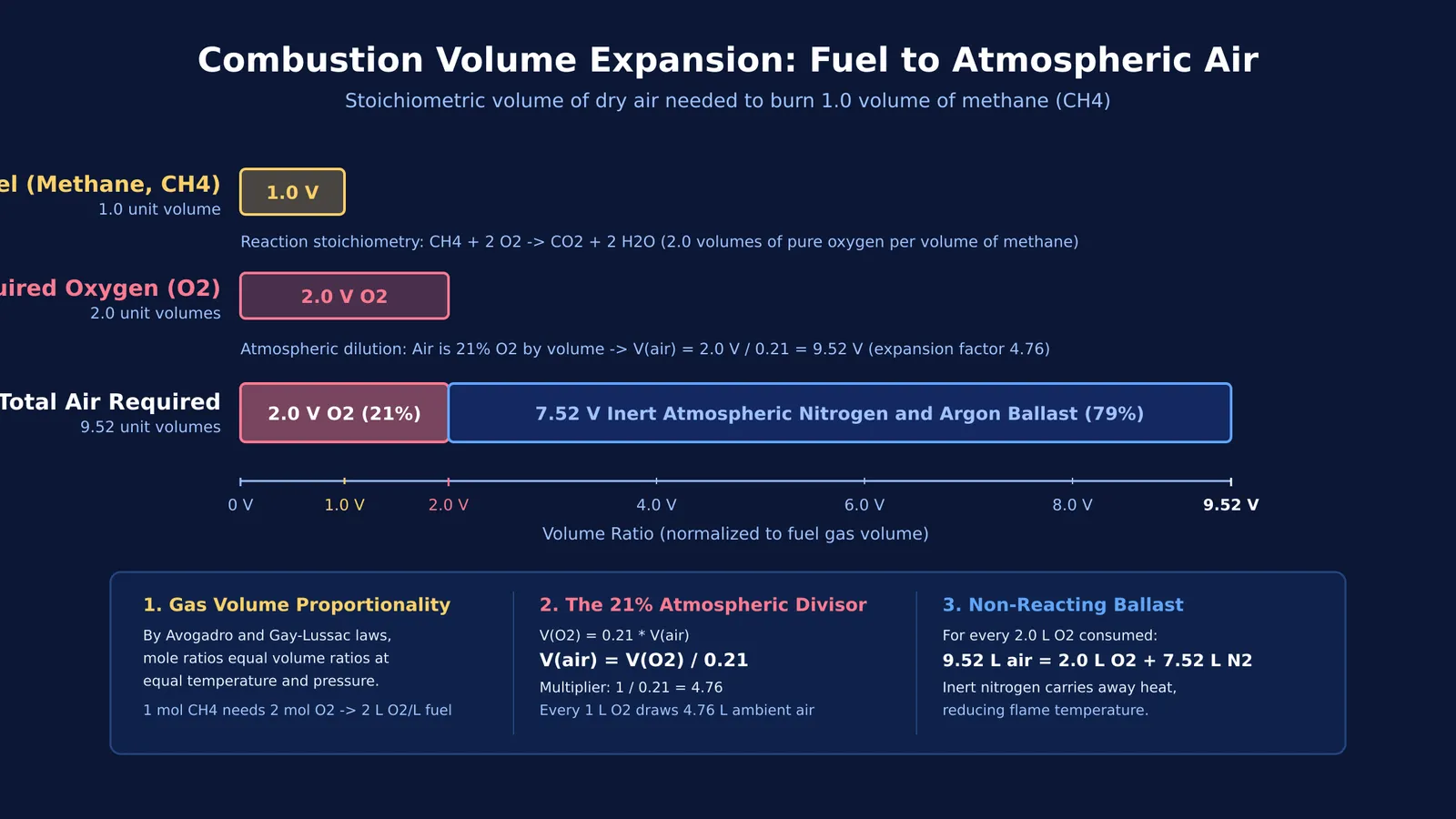
Dividing by 0.21 scales the oxygen requirement by 1 / 0.21 ≈ 4.76. For every litre of oxygen a flame consumes, 4.76 litres of air must enter the combustion chamber. The remaining 3.76 litres are non-reacting nitrogen and trace gases that carry away sensible heat. Understanding the average molar mass of a gas mixture helps connect these volume fractions to overall density.
How much air is needed to burn one litre of methane?
Methane (CH₄) is the primary component of natural gas. Its complete combustion in oxygen is documented in the NIST Chemistry WebBook:
CH₄(g) + 2 O₂(g) → CO₂(g) + 2 H₂O(l)
Here, 1 mole of methane requires 2 moles of oxygen. By Avogadro's law, burning 1.0 litre of methane gas consumes exactly 2.0 litres of pure oxygen gas at the same temperature and pressure.
Applying the 21% atmospheric oxygen factor gives the air required:
V(air) = 2.0 L / 0.21 ≈ 9.52 litres of air
Using the unrounded figure of 20.95% oxygen from NASA gives 2.0 / 0.2095 ≈ 9.55 litres. In either case, burning one litre of methane requires more than 9.5 litres of air. Supplying less leads to incomplete combustion, producing soot and poisonous carbon monoxide.
How do you calculate the air required for LPG mixtures?
Liquefied petroleum gas (LPG) in Indian kitchens is a commercial blend of propane (C₃H₈) and butane (C₄H₁₀), governed by Indian Standard IS 4576 and supplied by Indian Oil Corporation. Data from the Petroleum Planning & Analysis Cell show over 3,200 lakh active domestic connections nationwide.
To find the air needed for mixed LPG, evaluate each hydrocarbon component:
Propane from the NIST Chemistry WebBook: C₃H₈(g) + 5 O₂(g) → 3 CO₂(g) + 4 H₂O(l). One litre of propane vapor needs 5.0 litres of oxygen, or 5.0 / 0.21 ≈ 23.81 litres of air.
Butane from the NIST Chemistry WebBook: C₄H₁₀(g) + 6.5 O₂(g) → 4 CO₂(g) + 5 H₂O(l). One litre of butane vapor needs 6.5 litres of oxygen, or 6.5 / 0.21 ≈ 30.95 litres of air.
For a domestic blend of 40% propane and 60% butane by volume, the oxygen demand for 1.0 litre of fuel vapor is:
V(O₂) = (0.40 × 5.0 L) + (0.60 × 6.5 L) = 2.00 L + 3.90 L = 5.90 litres of O₂
Dividing by 0.21 gives the total air:
V(air) = 5.90 L / 0.21 ≈ 28.10 litres of air
Each litre of vaporized LPG demands more than 28 litres of air. When converting cylinder liquid mass to gas volume, working through ideal gas problems provides the volume at ambient conditions.
Where do students make mistakes in combustion stoichiometry?
Combustion stoichiometry questions often highlight common pitfalls:
Multiplying instead of dividing: Multiplying oxygen volume by 0.21 yields a smaller number, which is impossible because air is mostly non-oxygen ballast.
Confusing volume and mass percentages: Dry air is 20.95% oxygen by volume according to NASA, but 23.2% oxygen by mass because oxygen molecules are heavier than nitrogen molecules. Avogadro's volume ratio applies only to volumetric percentages.
Counting condensed water as gas: Water produced in combustion condenses at ambient temperature, so liquid water volume is omitted from gaseous flue totals.
Checking for mole concept errors avoids these traps. The Fermi Problem Library has worked problems with a step-by-step solver that explains the reasoning rather than printing an answer, making it easy to practice gas stoichiometry. To revise the laws governing gases, the Fermi Concept Library maps every concept across chemistry and physics.


