

On this page
Have you ever wondered why burning 1 kg of a fuel produces more than 1 kg of exhaust gas? The answer is oxygen. When methane or petrol burns, carbon atoms in the fuel bond with heavy oxygen atoms drawn from the air.
How much CO2 is produced by burning 1 kg of methane?
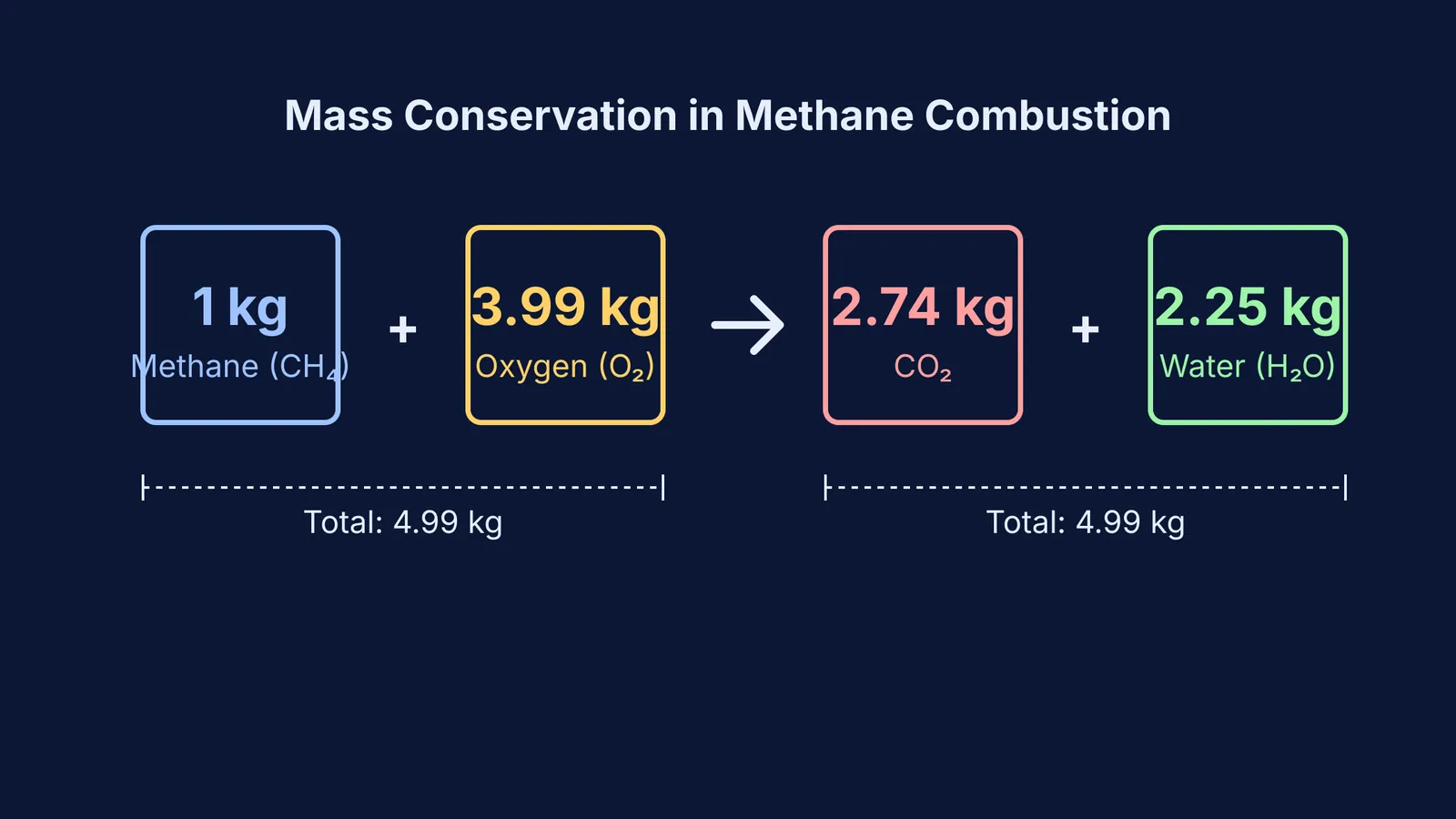
Methane (CH₄) is the primary component of natural gas. When it reacts with oxygen (O₂) in a complete combustion reaction, it forms carbon dioxide (CO₂) and water (H₂O).
The balanced chemical equation is: CH₄ + 2O₂ → CO₂ + 2H₂O
This tells us that exactly one mole of methane produces one mole of carbon dioxide. (If you want to know what else a formula tells you, read our guide on what a balanced chemical equation gives and its limitations).
To find the exact mass, we look at the standard atomic weights published by the Commission on Isotopic Abundances and Atomic Weights (CIAAW). The conventional atomic weight of carbon is 12.011, hydrogen is 1.008, and oxygen is 15.999 [[1]](https://www.ciaaw.org/atomic-weights.htm).
We can use these values to find the molar masses:
Molar mass of methane (CH₄): 12.011 + (4 × 1.008) = 16.043 g/mol.
Molar mass of carbon dioxide (CO₂): 12.011 + (2 × 15.999) = 44.009 g/mol.
Because one mole of methane yields one mole of carbon dioxide, the mass ratio of CO₂ to CH₄ is simply their molar masses divided: 44.009 / 16.043 = 2.743.
Therefore, burning 1 kg of methane produces 2.74 kg of carbon dioxide.
How much CO2 does 1 kg of octane produce?
Petrol is a complex mixture of hydrocarbons, but chemists often use octane (C₈H₁₈) as a mathematical model for combustion.
The balanced equation for burning octane is: 2C₈H₁₈ + 25O₂ → 16CO₂ + 18H₂O
This equation shows that two moles of octane produce 16 moles of carbon dioxide, which simplifies to a 1:8 ratio. One mole of octane yields eight moles of CO₂.
Using the same standard atomic weights [[1]](https://www.ciaaw.org/atomic-weights.htm), we find:
Molar mass of octane (C₈H₁₈): (8 × 12.011) + (18 × 1.008) = 114.232 g/mol.
Mass of 8 moles of CO₂: 8 × 44.009 = 352.072 g.
The ratio of the CO₂ mass to the octane mass is 352.072 divided by 114.232, which equals 3.082.
Burning 1 kg of octane produces 3.08 kg of carbon dioxide.
Why does the CO2 weigh more than the original fuel?
It might seem counter-intuitive that 1 kg of fuel produces 2.74 kg or 3.08 kg of a gas [[1]](https://www.ciaaw.org/atomic-weights.htm). This happens because combustion is a chemical reaction with oxygen from the air. You are not creating mass out of nothing; you are adding oxygen's mass to the fuel's carbon.
An oxygen atom (15.999) is heavier than a carbon atom (12.011). In a single molecule of CO₂, there is one carbon atom and two oxygen atoms. For every 12 grams of carbon in the fuel, the fire draws in 32 grams of oxygen from the air, creating 44 grams of CO₂. The oxygen added during combustion makes up more than two-thirds of the final mass.
Organisations like the US Environmental Protection Agency (EPA) rely on these exact stoichiometric calculations to set their standard emission factors for greenhouse gas inventories [[2]](https://www.epa.gov/climateleadership/ghg-emission-factors-hub).
How can you practise these mass calculations?
Working out mass ratios from a chemical formula is a core skill in stoichiometry. If you make a mistake in calculating a molar mass or writing chemical formulas, your final answer will be wrong.
If you get stuck on mole concept problems, the Fermi Concept Library has a complete guide to stoichiometry. It breaks down the rules of molar masses, balancing equations, and finding limiting reagents. If you want to test your understanding before a chemistry exam, try the Fermi Problem Library to work through step-by-step examples. You can also check your mole concept numericals with an AI tutor to find exactly where you missed a step.


