

On this page
You can ask an AI chatbot to solve a mole-concept numerical and get a neat answer in seconds. The trouble is that a wrong answer looks just as neat. In stoichiometry, many slips are not deep chemistry errors. They are a dropped unit, a different molar mass, too many digits or the wrong limiting reagent.
Can you trust AI with mole concept numericals?
Partly. In 2025, a team led by Adrian Mirza published ChemBench in Nature Chemistry: more than 2,700 chemistry question-answer pairs used to test large language models against human chemists (Mirza et al., Nature Chemistry). The best models, on average, outperformed the best human chemists in the study. The same paper reports that the models "struggle with some basic tasks and provide overconfident predictions".
A chatbot may not tell you when it is unsure about a molar mass. So treat its solution as a draft you check, not an answer key. Our post on why AI chatbots get maths wrong explains the arithmetic side of this.
Which mistakes should you check in an AI's stoichiometry answer?
Check four things, in this order.
Units. Every quantity should carry its unit on every line: g, g mol⁻¹, mol, L. If the units do not cancel, the line is wrong.
Molar masses. The Commission on Isotopic Abundances and Atomic Weights (CIAAW) publishes abridged standard atomic weights such as H 1.0080, C 12.011, N 14.007, O 15.999 and Cl 35.45 (CIAAW abridged atomic weights). If your question paper gives molar masses, use those instead, because an AI may quietly use its own.
Significant figures. The Avogadro constant is exactly 6.022 140 76 × 10²³ mol⁻¹, with no uncertainty (NIST CODATA value). So it never limits your significant figures; your measured data does. If masses are given to three significant figures, an answer quoted to six is false precision. Keep extra digits in the middle steps and round once, at the end. Our guide to significant figures and units has the full rules.
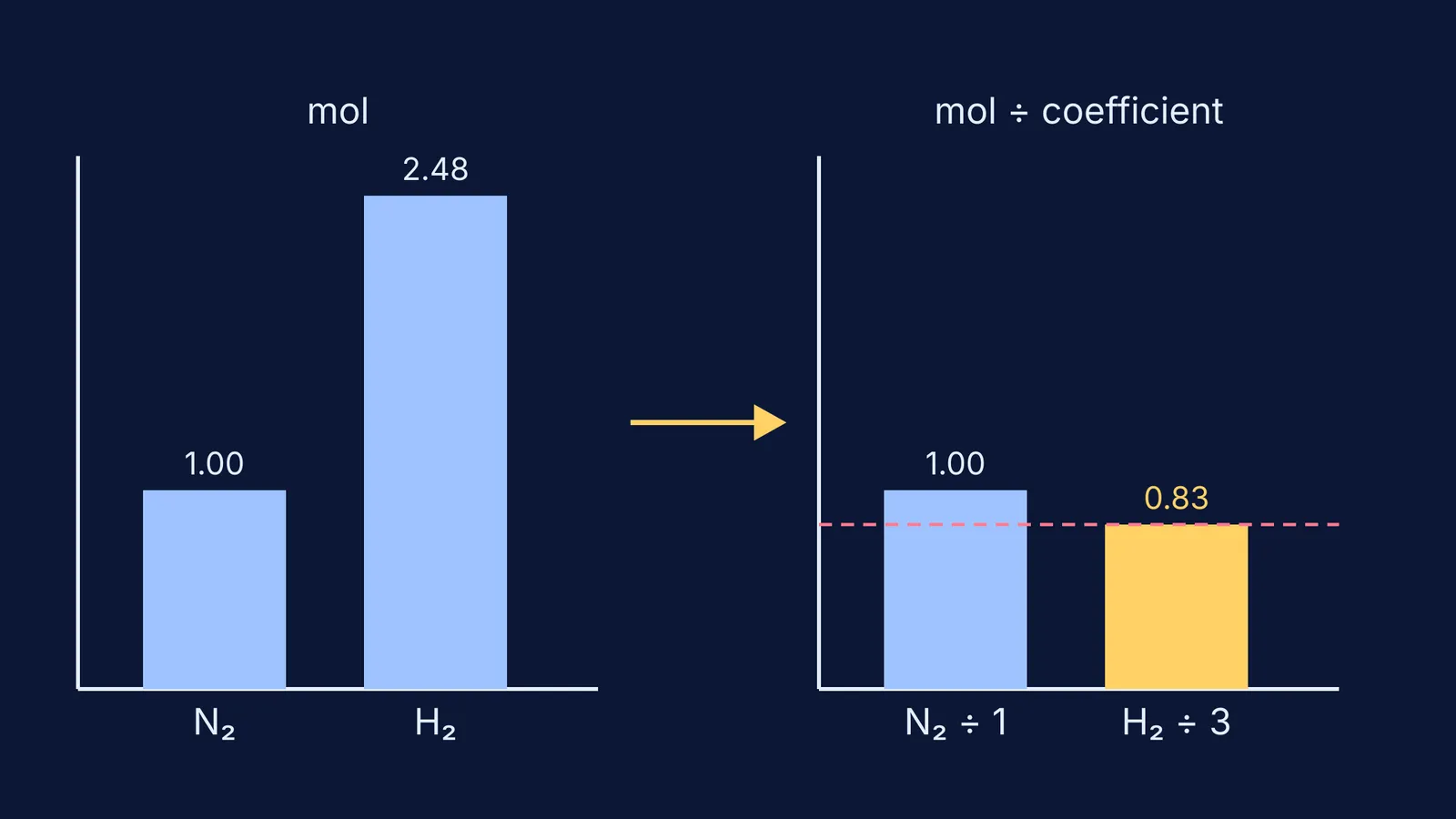
Limiting-reagent logic. The limiting reagent is not simply the reactant with fewer moles. Divide each reactant's moles by its coefficient in the balanced equation; the smallest result is limiting.
Where does a chatbot go wrong? A worked example
Question: 28.0 g of N₂ reacts with 5.00 g of H₂ to form ammonia. What mass of NH₃ forms?
The balanced equation is N₂ + 3H₂ → 2NH₃. With the CIAAW abridged atomic weights, M(N₂) = 28.014 g mol⁻¹, M(H₂) = 2.016 g mol⁻¹ and M(NH₃) = 17.031 g mol⁻¹.
Moles: n(N₂) = 28.0 g ÷ 28.014 g mol⁻¹ = 0.9995 mol, and n(H₂) = 5.00 g ÷ 2.016 g mol⁻¹ = 2.480 mol.
The tempting shortcut: N₂ has fewer moles, so call it limiting. That gives 2 × 0.9995 = 1.999 mol of NH₃, or 34.0 g.
The correct test: divide by coefficients. N₂ gives 0.9995 ÷ 1 = 0.9995; H₂ gives 2.480 ÷ 3 = 0.827. H₂ is smaller, so H₂ is limiting.
n(NH₃) = 2.480 × 2/3 = 1.653 mol, so the mass is 1.653 mol × 17.031 g mol⁻¹ = 28.2 g, to three significant figures like the data.
Practise this step with limiting reagent and percentage yield problems, step by step.
How do you use AI for numericals without losing the learning?
Solve on paper first, then ask the AI to check your work, not the other way round.
Ask it to write units on every line and to list the molar masses it used.
Ask directly: which reagent is limiting? Show moles divided by coefficients.
If its answer and yours differ, find the first line where they part ways. That line is your lesson.
Ask for a similar problem with new numbers, and solve that one without help.
If the same wrong-method mistake keeps coming back, the Fermi Problem Library has worked problems with a step-by-step solver that explains the reasoning rather than printing an answer, and Fermi's AI tutor notices where you are stuck and decides whether to explain, ask or show.
Your checklist for every AI-solved mole problem
Is the equation balanced, atom for atom?
Do the units cancel on every line?
Are the molar masses the ones the question gives, or standard values if it gives none?
Was the limiting reagent found by moles ÷ coefficient, not by smallest moles?
Is the product mass no more than the total mass of reactants?
Does the final answer have the same significant figures as the least precise data?
Could you redo it tomorrow without the AI?
Run the checklist on the next mole problem you give a chatbot.


