On this page
On a hot afternoon, it is tempting to open the fridge and stand in front of it. It feels wonderful for a few seconds, but an hour later the kitchen is warmer than with the door shut. Here is why.
Why does an open fridge make the room warmer?
A fridge does not make cold. It is a heat pump that moves heat from inside the box to the coils at the back, which sit in your room. The University of Illinois Physics Van answered this exact question with a clear no: the heat taken out has to go somewhere, and some electrical energy also ends up as heat (Physics Van, University of Illinois).
The bookkeeping is energy conservation, the first law of thermodynamics. For any refrigerator, the heat given out on the hot side equals the heat taken from the cold side plus the work put in: Qh = Qc + W (OpenStax College Physics 2e, section 15.5).
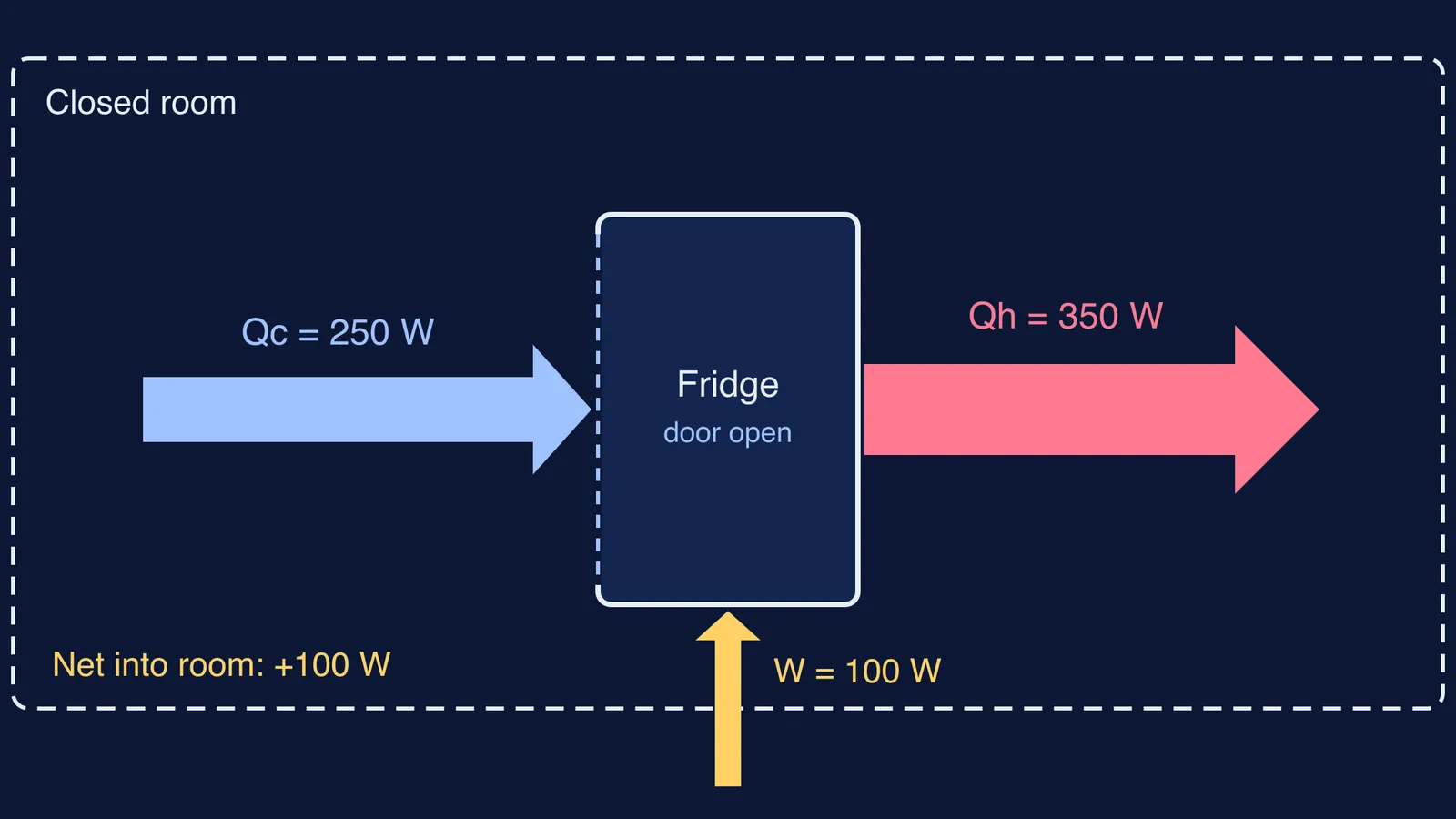
With the door open, the cold side and the hot side are the same room. The room loses Qc through the door, gets Qh back from the coils, and so gains Qh − Qc = W while the compressor runs. For the machine itself, see how a refrigerator makes things cold.
How much heat does an open fridge add? A worked heat balance
Compressor power, W. In a 2010 Bureau of Energy Efficiency (BEE) star-rating table for a 250-litre frost-free fridge, a 1-star model uses 977 units (kWh) a year and a 5-star model 400 units (BEE table in the 2010 Energy Efficiency Guide for home refrigerators). Divided by 8,760 hours, that averages about 112 W and 46 W, including the time the compressor is off. With the door open, the thermostat keeps the motor running far more of the time (Physics Van), so take W = 100 W as a round working value.
Heat pulled from the room air, Qc. Real refrigerators have a coefficient of performance, COP = Qc/W, between 2 and 6 (OpenStax). Take COP = 2.5, so Qc = 2.5 × 100 = 250 W.
Heat dumped from the back coils, Qh. Qh = Qc + W = 250 + 100 = 350 W.
Net heat into the room. 350 − 250 = 100 W. Over one hour that is 100 × 3,600 = 360,000 J, or 0.1 kWh.
Notice that the COP cancels: a better fridge moves more heat around the loop, but the room still gains exactly W. How COP depends on the temperature gap is explained in why a refrigerator works harder in summer.
Doesn't the cold air that spills out cool the room a bit?
A little, once. Take a 4 m × 3 m × 3 m room: 36 m³ of air at 30 °C. Air at 30 °C has a density of 1.164 kg/m³ and at 5 °C 1.268 kg/m³ (Engineering ToolBox, air density). The specific heat of air is about 1.006 kJ per kg per kelvin (Engineering ToolBox, specific heat of air).
Room air: 36 × 1.164 ≈ 42 kg, so warming it by 1 °C takes about 42 × 1,006 ≈ 42,000 J.
Fridge air: 250 litres at 5 °C is 0.25 × 1.268 ≈ 0.32 kg. Warming it to 30 °C absorbs 0.32 × 1,006 × 25 ≈ 8,000 J.
Spread over the room, that one-time puff of cold lowers the air temperature by about 8,000 ÷ 42,000 ≈ 0.2 °C.
At 100 W, the compressor puts those 8,000 J back in 80 seconds.
If the full 360,000 J from an hour stayed in the air alone, the air would warm by about 8.5 °C. Real rooms rise much less, because walls and furniture soak up most of the heat and some leaks out. The direction never changes: warmer, not cooler.
What should you do on a hot day instead?
Keep the door shut. The BEE guide advises deciding what you need before opening it, because an open door uses more electricity (BEE Energy Efficiency Guide).
Give the coils room. The same guide recommends keeping the fridge at least 100 mm from the wall.
Move heat outdoors. Cooling a room means sending energy out across its boundary, for example by opening windows when the air outside is cooler.
How can you use this in a thermodynamics exam?
A classic question asks what happens to a closed, insulated room when a fridge runs inside it with the door open. Use three lines:
Draw the system boundary around the whole room.
List what crosses it: only electrical work W, coming in.
Apply the first law: the room's internal energy rises by W, so its temperature rises.
Why a fridge needs that work at all is the Clausius statement of the second law of thermodynamics. Heat flows that loop back on themselves are easier to see than to read; the Fermi Simulation Lab has interactive simulations for ideas like this.
Next time someone opens the fridge to beat the heat, ask them where the back of the fridge is.