

On this page
Most of us know our fridge runs more often in the summer. But the jump in your electricity bill is larger than you might expect. When the air around a refrigerator gets warmer, it does not just leak heat faster—the cooling cycle itself becomes fundamentally less efficient.
Researchers measuring real-world appliances found that raising a room's temperature from 12 °C to 25 °C increased a domestic refrigerator's daily energy use from 1.3 kWh to 2.3 kWh, a 72% jump (Energies, 2019). This means your fridge might consume nearly twice as much electricity on a hot summer day compared to a cold winter night.
Why does a 13 °C change make the compressor work 72% harder? We can predict this by looking at the thermodynamics of heat pumps and the ideal coefficient of performance.
Why does a refrigerator work harder in summer?
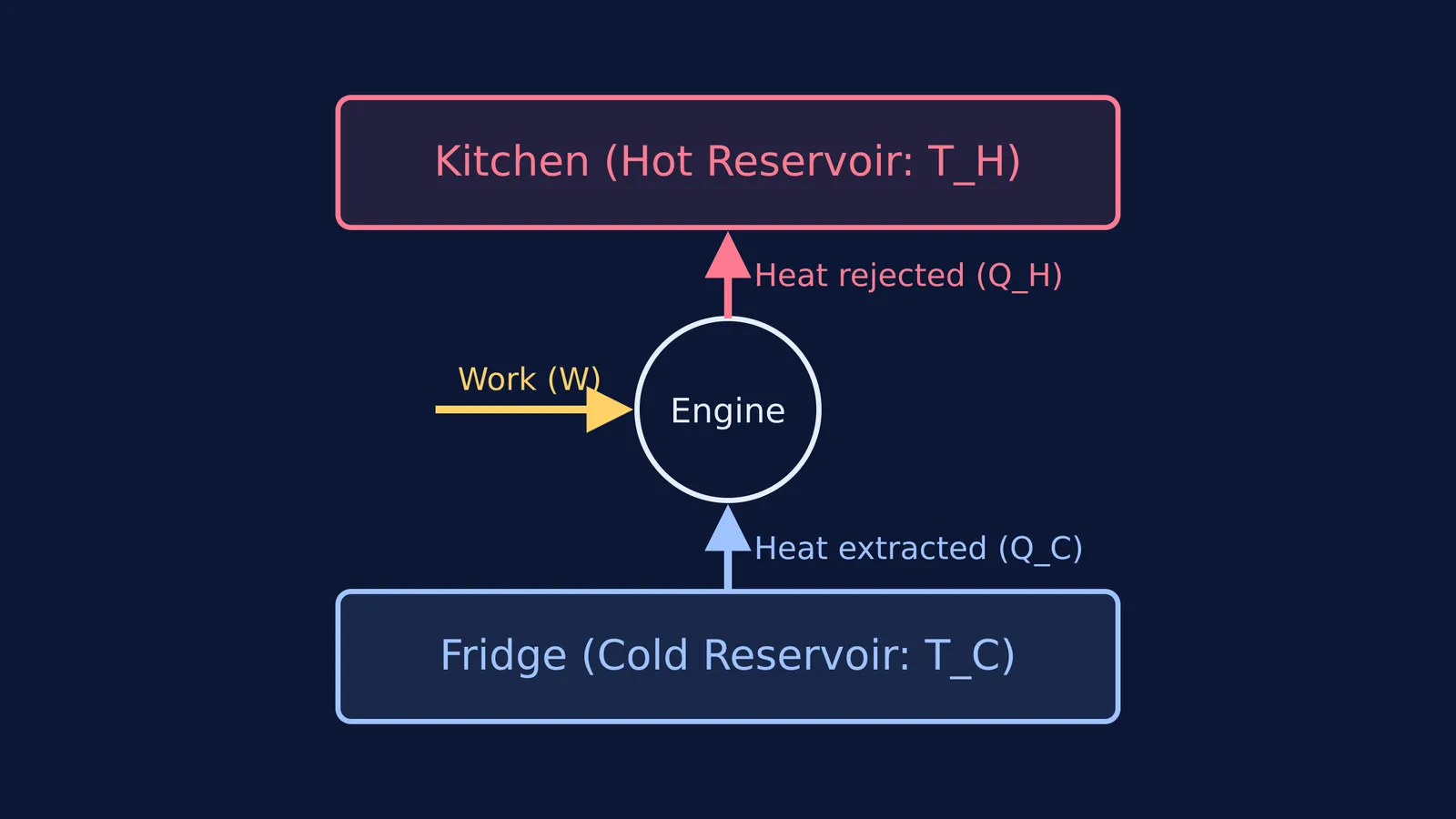
To understand the energy spike, we need to look at what a refrigerator actually does. A refrigerator is a heat pump. It cannot magically destroy heat; it can only move it. It does electrical work (W) to extract heat (Q_C) from the cold interior and dump both that heat and the compressor's work into the kitchen (Q_H).
The efficiency of this cycle is called the coefficient of performance (COP). Rather than a percentage, COP is a ratio of the useful cooling provided to the work required: COP = Heat extracted / Work done = Q_C / W.
As summer pushes the kitchen temperature up, the thermal gap between the kitchen and the fridge grows. Because the compressor is pushing heat against a steeper temperature gradient, its COP drops. The machine has to do more work just to extract the same amount of heat, which is why you hear the compressor running for much longer periods.
How do you calculate the COP of a refrigerator?
For a perfect machine (a Carnot refrigerator), the maximum possible COP depends only on the absolute temperatures of the cold interior (T_C) and the hot kitchen (T_H) measured in Kelvin. Let's run the numbers for a fridge kept at a steady 4 °C (277 K), using ambient temperatures from the study (Energies, 2019).
Ideal COP = T_C / (T_H − T_C)
In a cool 12 °C kitchen:
The kitchen is at 285 K.
The temperature gap (T_H − T_C) is 8 K.
Ideal COP = 277 / 8 = 34.6.
For every joule of electrical work, a perfect fridge could theoretically move 34.6 joules of heat out of the cold compartment.
In a warm 25 °C kitchen:
The kitchen is at 298 K.
The gap (T_H − T_C) is 21 K.
Ideal COP = 277 / 21 = 13.2.
The ideal efficiency has more than halved. To extract the same amount of heat, the compressor must run longer and draw more power from the grid.
Why do real fridges differ from the ideal equation?
The Carnot formula predicts that moving from a 12 °C room to a 25 °C room should make the compressor work nearly three times as hard (because the COP drops from 34.6 to 13.2, while the heat leak also increases). Yet the published study recorded only a 72% increase in energy consumption (Energies, 2019). Why the discrepancy?
Real refrigerators operate far below the ideal Carnot limit to begin with. They have fixed energy costs—such as ventilation fans, automatic defrost heaters, and electronic control boards—that run regardless of the temperature gap. Furthermore, a real compressor's efficiency curve does not perfectly track the Carnot equation. Still, the fundamental physics remains true: a wider temperature gap forces the system to do more work.
If you want to visualise how this temperature gap reshapes the cooling cycle, you can open the Fermi Simulation Lab. There, you can adjust the ambient temperature on a virtual heat pump and watch how the work required—represented by the net work in a cycle on an indicator diagram—stretches out as the room gets hotter.
How to use this physics to save energy
By understanding the denominator in the COP equation (T_H − T_C), you can see why putting a fridge in a cool spot is the most effective way to lower its energy draw, a principle supported by researchers (Energies, 2019).
Keep it away from heat sources: Do not install your refrigerator next to an oven or in direct sunlight. Raising the local T_H by just a few degrees dramatically lowers the COP.
Ensure good ventilation: The heat rejected (Q_H) must dissipate. If the coils at the back are trapped in a tight, unventilated space, the local air temperature rises, artificially inflating T_H.
Set the right temperature: Dropping T_C unnecessarily (for example, setting the fridge to 1 °C instead of 4 °C) also shrinks the COP and increases the heat leak.
This relationship between temperature and work is a core concept in thermodynamics. You can explore how these heat transfers depend on different environmental conditions in our guide to heat in isobaric and isochoric processes.


