

On this page
When you open a refrigerator door, cold air hits your face. It feels as though the machine is creating "cold" and pumping it inside. However, in thermodynamics, cold is not a substance; it is simply the absence of heat.
If you place your hand near the back or bottom of a running refrigerator, you will feel warm air blowing out. This reveals what the machine is actually doing. Rather than adding coldness, a refrigerator is constantly absorbing heat from your food and dumping it into your kitchen.
What is a heat engine in reverse?
In physics, a standard heat engine—like a car engine or a steam turbine—takes heat from a hot source, converts some of it into useful mechanical work, and exhausts the rest to a cold sink. You can study the efficiency of these forward processes by looking at Heat engines and the Carnot cycle: efficiency problems for JEE.
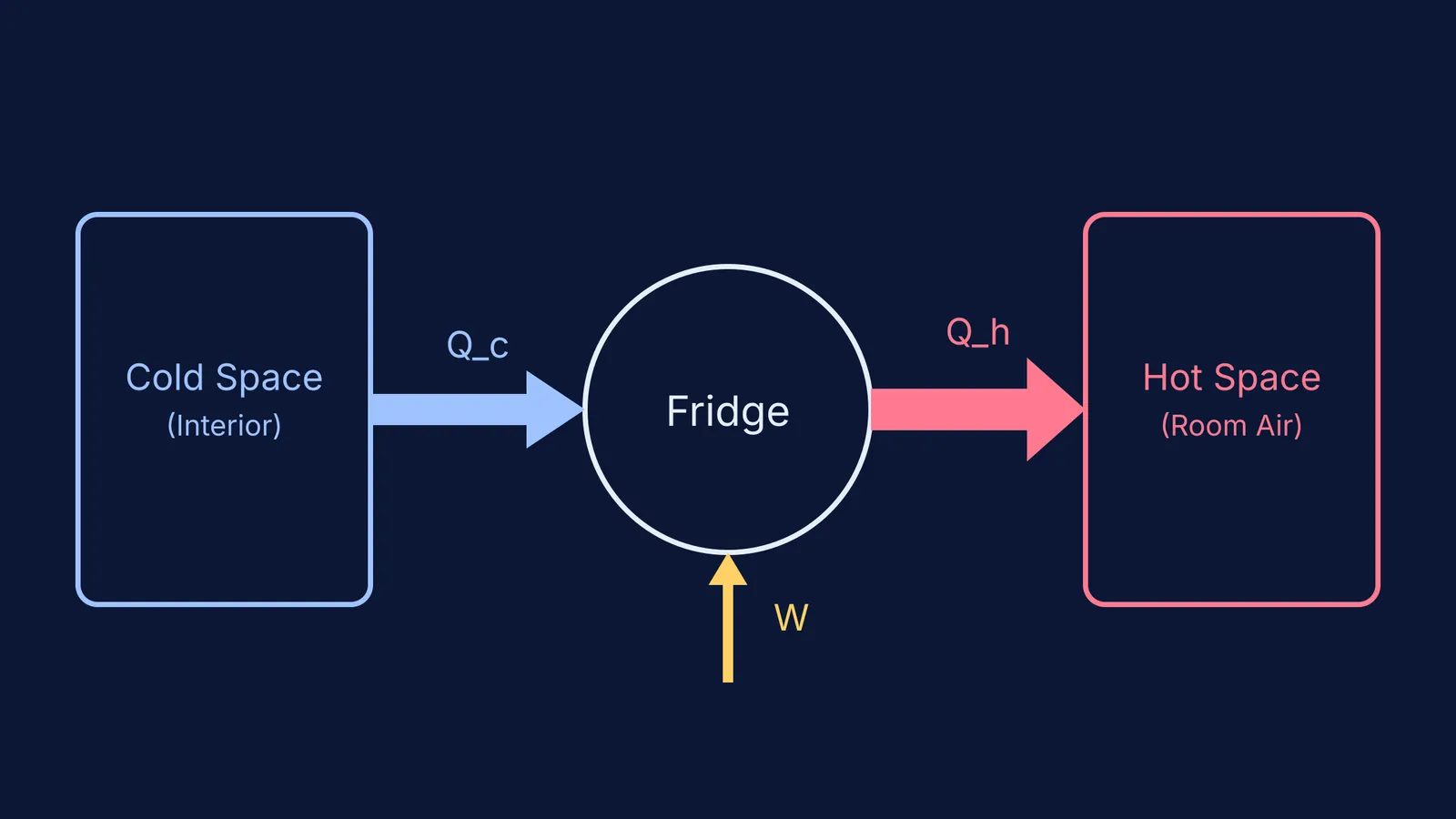
According to OpenStax *University Physics Volume 2*, a refrigerator operates as a heat engine in reverse. The Second Law of Thermodynamics states that heat naturally flows from a hot object to a cold one. To force heat to flow backwards—from the cold fridge to the warm room—you must put in external energy. This is why you plug a refrigerator into the wall. Electrical work (W) powers a motor that forces heat (Q_c) out of the cold space. The total heat exhausted into your room (Q_h) is the sum of the heat removed and the work done: Q_h = Q_c + W.
How does the refrigeration cycle work?
The secret to moving this heat lies in the refrigerant, a special fluid that easily transitions between a liquid and a gas. The cycle relies on changes in pressure and latent heat, much like the phase changes discussed in Matter in our surroundings: states, evaporation and latent heat.
The cycle happens in four continuous steps:
Evaporation: Inside the fridge walls are coils called the evaporator. The liquid refrigerant entering these coils has a very low boiling point. As it absorbs thermal energy from the food, it boils and evaporates into a gas. This phase change absorbs a massive amount of heat, leaving the interior cold.
Compression: The now-warm gas travels to the compressor. Powered by electricity, the compressor squeezes the gas, significantly increasing its pressure and temperature. The gas is now much hotter than the room temperature.
Condensation: This hot, high-pressure gas flows into the condenser coils on the outside of the fridge. Because the gas is hotter than the kitchen air, heat naturally flows out into the room. As it cools, the refrigerant condenses back into a high-pressure liquid.
Expansion: Finally, the liquid passes through a narrow expansion valve. This sudden drop in pressure causes the liquid to cool rapidly. The chilled liquid flows back into the evaporator, ready to absorb more heat.
What is the coefficient of performance?
Unlike a car engine, which is measured by its thermal efficiency, a refrigerator's effectiveness is measured by its Coefficient of Performance (COP). This is the ratio of what you want (heat removed, Q_c) to what you pay for (electrical work, W):
COP = Q_c / W
Because a refrigerator often removes more heat than the work required, the COP can be greater than 1. According to OpenStax *College Physics 2e*, real household refrigerators typically have a coefficient of performance between 2 and 6. This means that for every 1 Joule of electrical work consumed by the compressor, the fridge can remove 2 to 6 Joules of heat from the inside.
If you are preparing for exams and need to see how these thermodynamic cycles and parameters interact, the Fermi Simulation Lab has interactive simulations for the ideas that are easier to see than to read.
How do you solve a refrigerator COP problem?
When tackling thermodynamics problems in exams, remember that the work done is the difference between the heat exhausted and the heat removed. If you want more practice on this specific relationship, review Refrigerators and heat pumps: coefficient of performance problems.
Worked Example:
A household refrigerator has a COP of 3.0. In one hour, it removes 1200 J of heat from the cold interior. How much work is done by the compressor, and how much heat is released into the kitchen?
Find the work (W): Using the formula COP = Q_c / W, rearrange to find W = Q_c / COP. This gives W = 1200 / 3.0 = 400 J.
Find the heat exhausted (Q_h): Use the conservation of energy: Q_h = Q_c + W. This gives Q_h = 1200 + 400 = 1600 J.
In this scenario, the motor consumes 400 J of electrical energy to extract 1200 J of heat from the food, and dumps a total of 1600 J of heat into your kitchen. This is exactly why leaving the refrigerator door open will eventually heat up your room, not cool it down!


