On this page
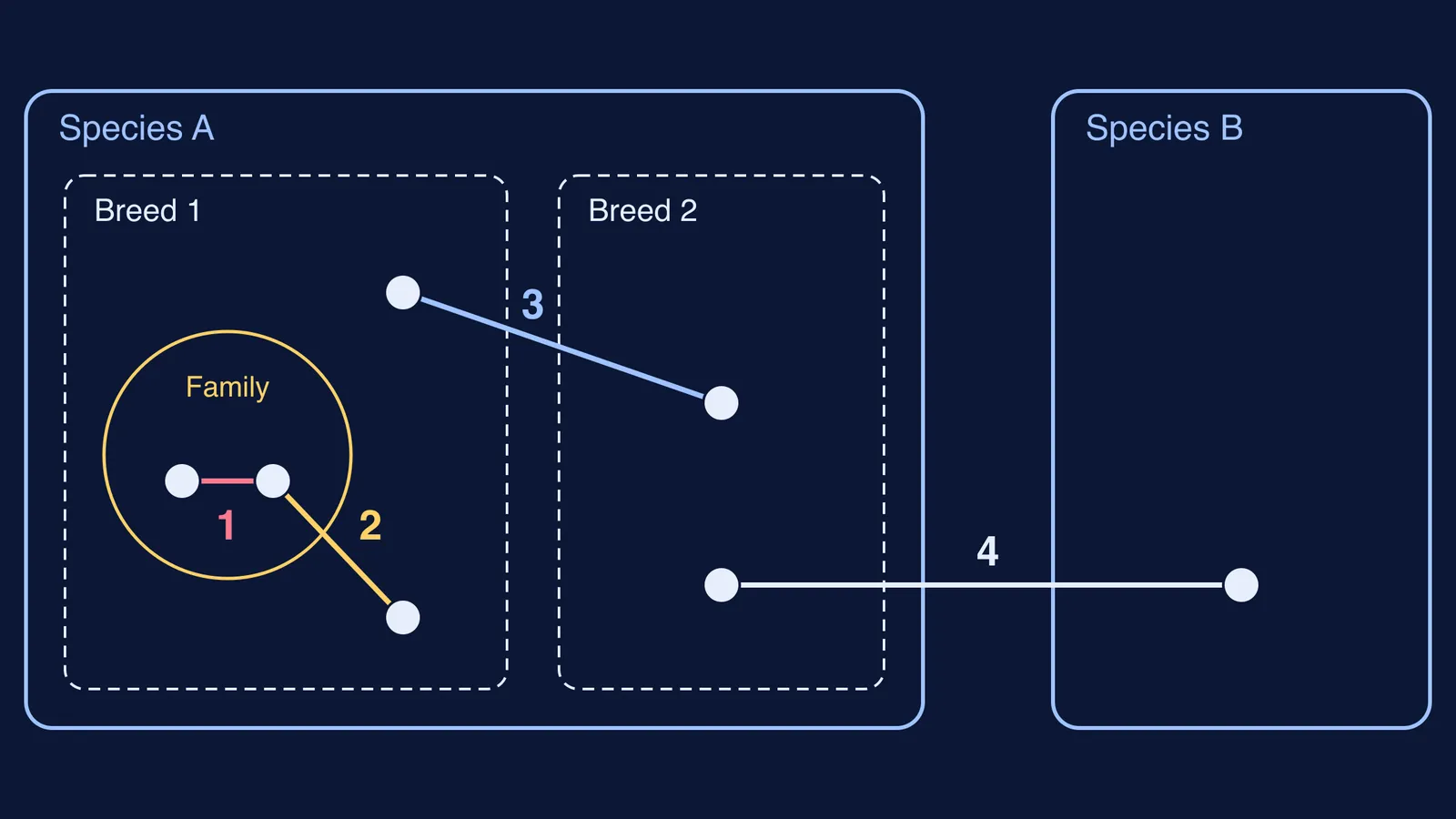
An animal breeder picks a mate from one of four groups: relatives, unrelated members of the same breed, a different breed, or a different species. Those are the four methods your textbook names, and many exam questions come down to which group the mate came from. Here is each one in plain words, followed by two real cases: India's Hisardale sheep and the mule.
What is the difference between inbreeding, out-crossing and cross-breeding?
One study guide that follows the NCERT wording defines the methods like this (Unacademy's summary of breeding systems):
Inbreeding is the mating of closely related animals of the same breed, repeated over successive generations.
Out-crossing is the mating of animals of the same breed that share no common ancestor for 4-6 generations.
Cross-breeding is the mating of superior males of one breed with superior females of another breed.
Interspecific hybridisation is the mating of animals from two different species, such as a male donkey and a female horse, whose offspring is the mule.
Out-crossing, cross-breeding and interspecific hybridisation all count as out-breeding, because in each one the parents share no common ancestry. The real difference between them is how far apart the parents are: same breed, different breed, or different species.
What is inbreeding depression, and why does it happen?
Inbreeding depression is the decrease in an average trait value as inbreeding increases, according to a 2021 meta-analysis in Genes by Doekes, Bijma and Windig.
That review pooled 154 livestock studies and found that each 1% rise in pedigree inbreeding went with a median fall of 0.13% in a trait's mean (Doekes et al., 2021). It found harmful effects on all sorts of traits, from reproduction and survival to production.
A widely cited review by Charlesworth and Willis in Nature Reviews Genetics explains why. Inbreeding depression and its opposite, heterosis (the better yield you get by crossing inbred strains), are mainly caused by recessive harmful mutations already present in populations. Related parents are more likely to carry the same hidden recessive allele, so their offspring are more often homozygous for it and the defect shows (refresher: homozygous vs heterozygous and the test cross). The same arithmetic in humans is worked through in cousin marriage and recessive disorders.
How was the Hisardale sheep developed?
Hisardale is the textbook example of cross-breeding, and its real history involves three of the four methods. A 2006 review in Agricultural Reviews by scientists at the National Bureau of Animal Genetic Resources, Karnal, describes how it happened:
Cross-breeding: Bikaneri ewes were mated with Australian Merino rams; the strain was developed at the Government Livestock Farm, Hisar (Haryana).
Selection and interbreeding: the crossbred animals were bred among themselves, giving a strain with 75% Merino inheritance.
Inbreeding depression: only a small flock is kept, and the review says its performance deteriorated over the years, "probably due to inbreeding and no selection" because the population was small.
Out-crossing as the fix: the National Commission on Agriculture (1976) recommended out-crossing the flock with another fine-wool breed, such as Rambouillet or Merino.
You may see Hisardale described as developed in Punjab. The review places the farm at Hisar in Haryana. Either way, the answer about the method stays the same: cross-breeding.
Why is a mule an interspecific hybrid, and why is it sterile?
A mule is the offspring of a male donkey and a female horse (Unacademy's summary of breeding systems). The parents belong to two different species, so this is interspecific hybridisation, not cross-breeding.
Horses have 64 chromosomes and donkeys have 62, and the hinny (the reverse cross) examined in a study of hinny testes in the Asian-Australasian Journal of Animal Sciences had 63. The same study says the main cause of sterility in mules and hinnies is probably that homologous chromosomes fail to pair at meiosis during sperm formation. Exceptions do turn up: a 1985 paper in the Journal of the Royal Society of Medicine described a fertile mule in China and her unusual foal.
How do you tell the four methods apart in an exam question?
Ask three questions in order, using the same definitions:
Same species? If not, it is interspecific hybridisation (mule).
Same breed? If not, it is cross-breeding (Hisardale).
Unrelated for 4-6 generations? If yes, it is out-crossing. If the animals are related, it is inbreeding.
Try these:
A Sahiwal bull is mated with a Sahiwal cow from another herd, with no shared ancestors. Same breed, unrelated: out-crossing.
A dairy line is mated brother to sister for several generations and milk yield falls. That is inbreeding, and the fall is inbreeding depression.
If the definitions keep blurring, the Fermi Concept Library gives each biology concept its own lesson, and the Fermi Problem Library has a step-by-step solver that explains the reasoning rather than printing an answer. Plants follow the same logic: see the steps of plant breeding.