On this page
You touch the blade to a live socket, put your thumb on the metal cap, and the bulb glows orange. Nothing seems to connect back to the neutral wire. But the circuit is closed, just not by a wire you can see. It runs through you.
What is inside a line tester screwdriver?
Inside the plastic handle sit a metal rod ending in the blade, a neon bulb, a resistor, a spring and a metal cap you touch, as this EngineersGarage explainer on line testers shows. The plastic insulates your fingers from the live metal.
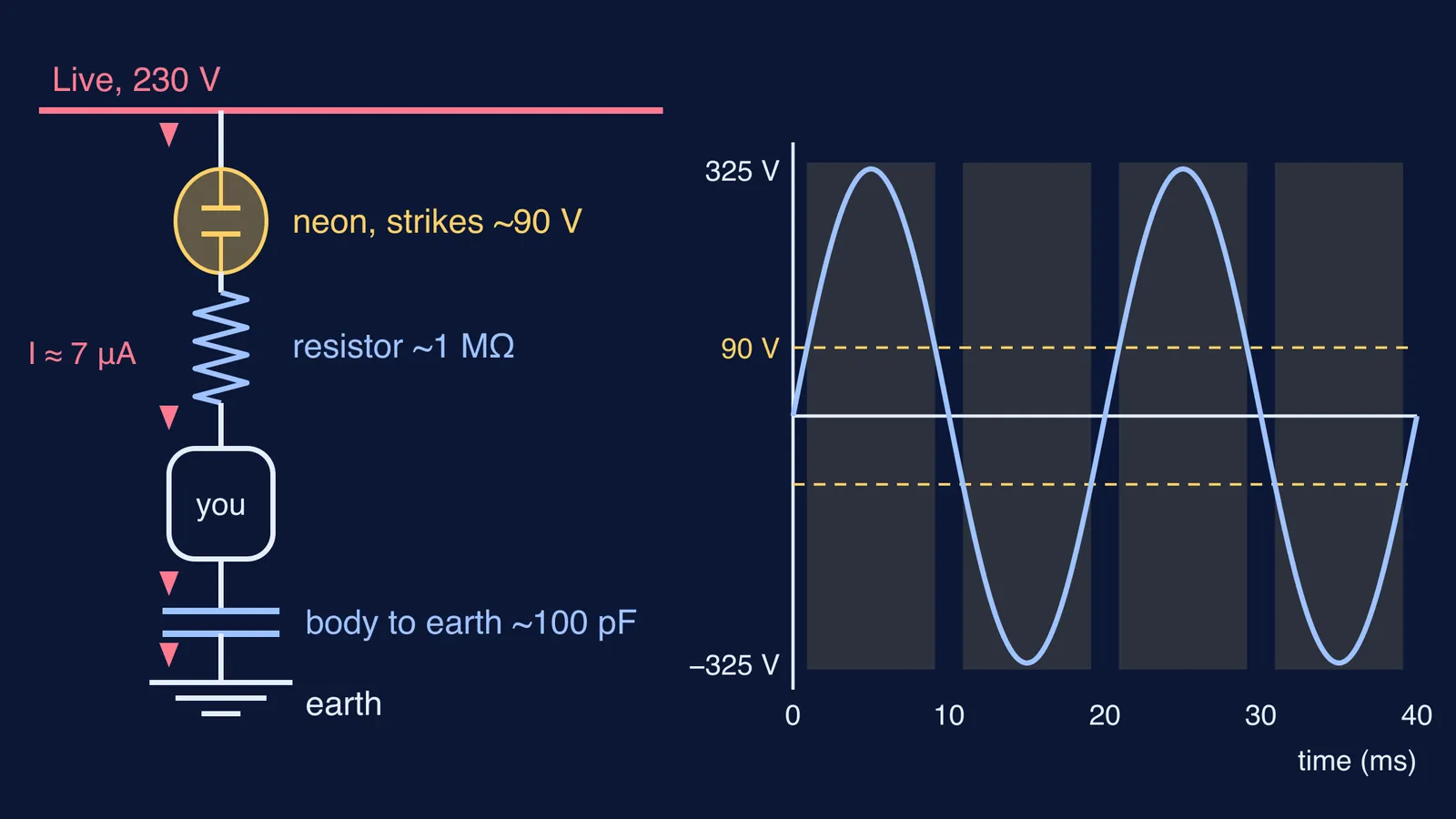
Small neon indicator lamps such as the common NE-2 have a striking voltage of around 90 V, according to the Wikipedia overview of neon lamps. Below that, the gas does not conduct and the bulb stays dark.
The resistor does the protecting. It is about a megohm (a million ohms), as this electricians' forum discussion of neon testers notes. The Wikipedia article on test lights traces the current through "a high ohm resistor and the lamp" and then the user's body.
How does a line tester glow without completing the circuit?
It does complete a circuit. Class 10 electricity says current flows when there is a potential difference across a closed path. India's mains supply is 230 V at 50 Hz, according to this table of mains electricity by country, and the earth is at about 0 V. The path runs: live wire, blade, neon, resistor, your body, the floor, earth.
Even in rubber slippers, current flows, because you and the ground act like the two plates of a capacitor. A human body in normal surroundings has a capacitance in the tens to low hundreds of picofarads, according to Wikipedia's page on body capacitance. With AC, this capacitor charges and discharges every half cycle, so a tiny current keeps flowing in and out, and the neon stays lit.
Worked example: how much current goes through you?
Use Ohm's law, the 230 V mains figure and the effects table in OSHA's guide to electrical safety.
Barefoot on a damp floor, suppose the 1 MΩ resistor is the only real resistance. Then I = V/R = 230 ÷ 1,000,000 = 0.00023 A, or 0.23 mA.
In slippers, your body's capacitance limits the current. As a rough figure, take C = 100 pF, the human-body model value on the body capacitance page. A capacitor opposes AC by X = 1/(2πfC), a Class 12 formula, so X = 1/(2 × 3.14 × 50 × 100 × 10⁻¹²) ≈ 32 MΩ, so I ≈ 230 ÷ 33,000,000 ≈ 7 microamps.
OSHA's table calls anything below 1 milliampere "generally not perceptible". Both cases sit below it.
Why does it still light? Until the neon strikes, almost no current flows, so the full voltage sits across it. The peak of 230 V AC is 230 × √2 ≈ 325 V, far above the 90 V striking voltage, so the lamp lights every half cycle. Fewer microamps in slippers means a fainter glow.
Is a line tester safe to use at home?
Only if it is intact and used as designed. Wikipedia's test light article lists the problems: water trapped inside can shock you, a failed resistor can put your hand in direct contact with the circuit, and bright light, or standing insulated from ground near other live wires, can make a live wire look dead. OSHA's guide adds that dry skin has fairly high resistance, but moist or wet skin conducts.
A home checklist:
Read the voltage range printed on the handle and use the tester only on household AC within it; this guide to phase testers gives 100 V to 500 V AC as the usual range.
Look first: no cracks, no moisture inside.
Check it on a socket you know is live. If it does not glow there, do not trust it.
Hold the plastic. Touch only the cap, never the blade. Keep hands and floor dry.
Glow means live; no glow does not prove dead. Switch off at the main switch or MCB before opening anything, and call a licensed electrician for repairs.
Younger children should use it only with an adult watching.
How does this connect to your Class 10 syllabus?
The tester is a series circuit: the same current flows through the neon, the resistor and you. The same idea explains why birds on a power line don't get a shock, why an earth wire keeps metal appliances safe and why Indian plugs have three pins.
If current flowing in and out of a capacitor is hard to picture, the Fermi Simulation Lab has interactive simulations for ideas that are easier to see than to read. For more Ohm's law numericals, the Fermi Problem Library has a step-by-step solver that explains the reasoning rather than printing an answer.
Next time the bulb glows, remember: the last part of the circuit is you.