

On this page
If you have ever examined the inside of a standard three-pin plug, you will have noticed three coloured wires: the brown live wire, the blue neutral wire, and the green-and-yellow earth wire. While the live and neutral wires carry the electricity needed to run your appliances, the earth wire sits quietly in the background. It carries no current under normal conditions.
However, when something goes wrong inside an appliance with a metal body, that wire becomes your primary defence against a fatal electric shock.
Why is the earth wire used in appliances?
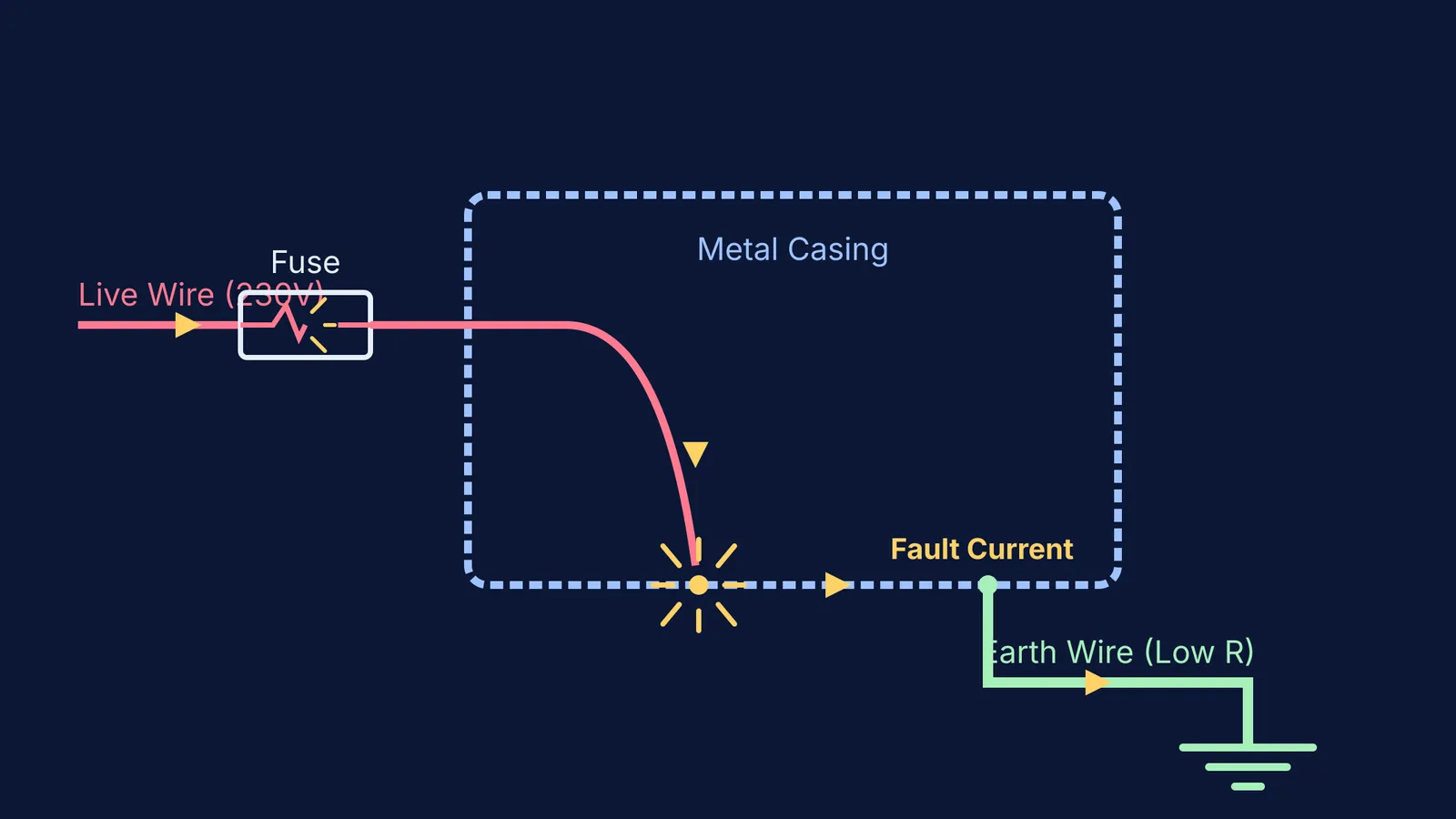
Many everyday appliances, such as microwaves, toasters and washing machines, are housed in metal casings. If a fault occurs—for example, if the insulation on the live wire wears away and the bare wire touches the inside of the casing—the entire metal exterior becomes "live".
Without an earth wire, the casing would sit at 230 volts, waiting for a path to the ground. If you touched the appliance, your body would complete the circuit. According to a document on worker deaths by electrocution published by the National Institute for Occupational Safety and Health (NIOSH), human skin resistance can be as high as 100,000 ohms when dry, but it drops to just 1,000 ohms when wet. This low resistance allows a massive current to flow through your body to the ground, resulting in a severe and potentially lethal shock.
The earth wire prevents this by connecting the metal casing directly to the ground. Because the thick copper of an earth wire has an extremely low electrical resistance, it offers an easier path for the electricity to follow. When the live wire touches the casing, the fault current instantly rushes down the earth wire instead of waiting for someone to touch the appliance.
How does a fault current blow the fuse?
The earth wire does not just redirect the electricity; it actively works to shut the power off by blowing the fuse. This safety mechanism relies directly on Ohm's Law (I = V/R).
When the live wire touches the earthed metal casing, it creates a short circuit. Because the earth wire's resistance (R) is incredibly low, the current (I) drawn from the mains supply surges to a huge value almost instantly.
This massive fault current travels through the live wire, which is connected in series with the fuse. A fuse contains a thin wire designed to melt if the current exceeds its safety rating (such as 3 A or 13 A). The huge surge of current generates intense heat, melting the fuse wire in a fraction of a second. This breaks the circuit, completely disconnecting the appliance from the mains power before anyone even realises a fault has occurred.
If you are studying electrical safety for your exams and get stuck on calculating fault currents, resistance or fuse ratings, the Fermi Problem Library has worked problems with a step-by-step solver that explains the reasoning rather than printing an answer.
What happens to your body without an earth wire?
Understanding the physical effects of an electric shock highlights why this system is so critical. The severity of a shock depends on the current flowing through the body, which is driven by the voltage and your skin's resistance.
According to the same NIOSH safety data on 60-Hz AC currents:
1 mA: Barely perceptible; a slight tingling is felt.
16 mA: The maximum "let-go" threshold for an average man; beyond this, muscle contraction prevents releasing the appliance.
100 mA: The threshold for ventricular fibrillation, meaning the heart stops pumping rhythmically, which is usually fatal.
Because an un-earthed metal casing can easily drive well over 100 mA through a wet hand, the earth wire is an absolutely essential feature.
How can you check your appliances for safety?
You can easily verify the safety of your own appliances by keeping a few physical details in mind:
Check the plug for a metal earth pin (the longer, top pin on a standard UK or Indian plug). This pin is longer so that the appliance is earthed before the live pins even connect.
Look for the "square inside a square" symbol on the appliance's label. This means the device is double-insulated and safely operates without an earth wire.
Never use an appliance with a frayed power cord, as this exposes the live wire and risks a short circuit before the current even reaches the fuse.


