On this page
The clear lumps of mishri served with prasad or saunf are ordinary sugar that has been given time to arrange itself. NCERT's Class 9 book, Exploration, Chapter 5, uses it as an example, describing sugar crystals "that grow while making candy sugar (called mishri in Hindi)". With two ideas from school chemistry, you can grow your own over several days.
What is a saturated solution?
In Class 6 Curiosity, Chapter 9, you get salt back from salt water by boiling the water away.
NCERT's Class 9 chapter defines solubility as the maximum amount of solute that dissolves in a fixed quantity of solvent (100 mL or 100 g) at a given temperature (NCERT Class 9, Chapter 5).
A saturated solution is one that cannot dissolve any more solute at that temperature, and the same chapter notes that the solubility of a solid in a liquid generally increases with temperature.
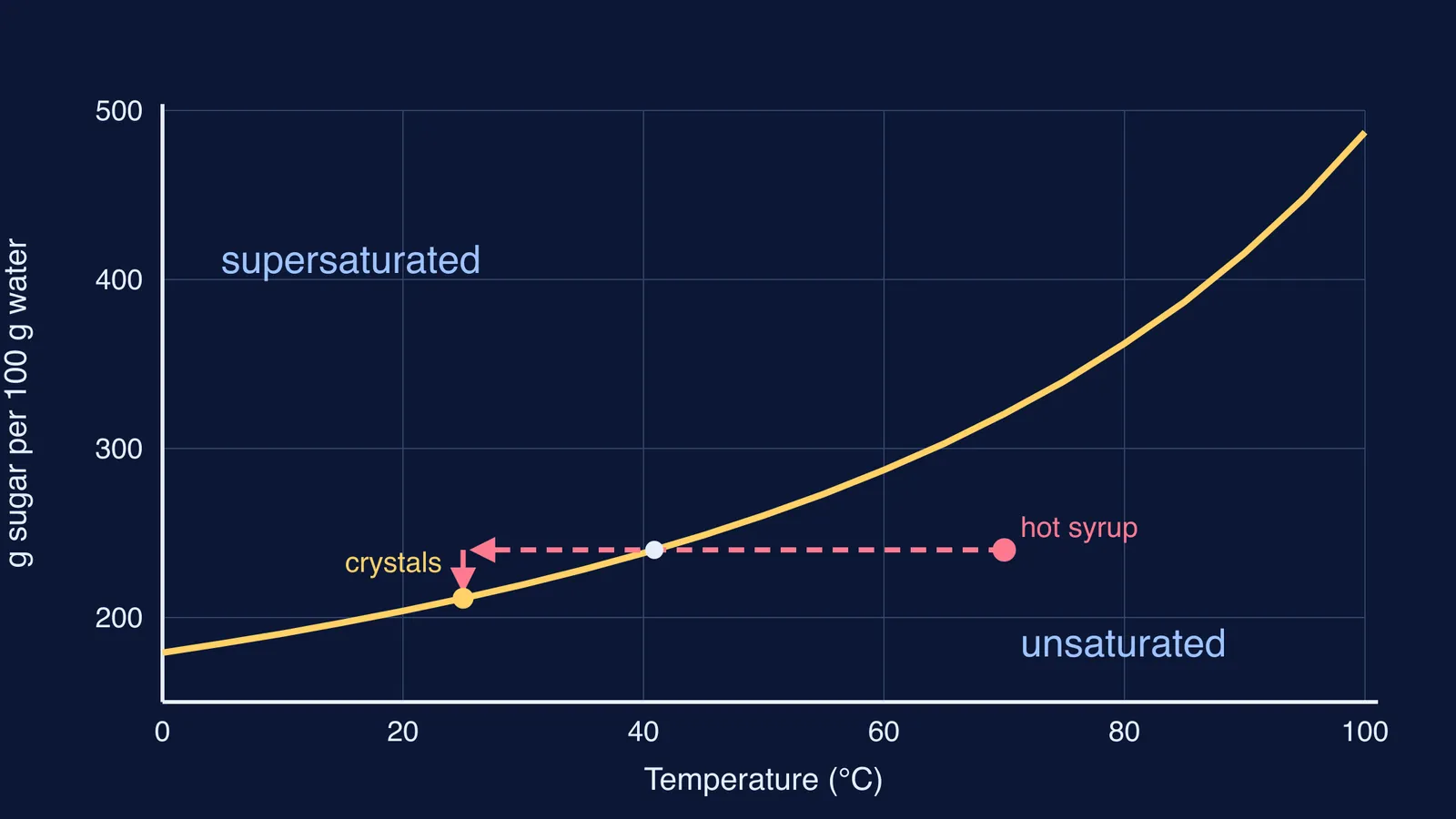
A sucrose table from Browne's *Handbook of Sugar Analysis*, reproduced in Belle Lowe's Experimental Cookery, gives these amounts per 100 g of water:
0 °C: 179.2 g
20 °C: 203.9 g
40 °C: 238.1 g
60 °C: 287.3 g
80 °C: 362.1 g
100 °C: 487.2 g
So boiling water holds more than twice as much sugar as water at room temperature.
How is mishri made from sugar crystals?
The Australian National University's rock candy guide explains that as a hot sugar solution cools, it "becomes supersaturated, meaning it contains more dissolved sugar than it can normally hold", and the extra sugar leaves the solution as solid crystals.
NCERT calls this crystallisation: forming crystals from a saturated solution. It defines a crystal as a solid whose particles are arranged in a regular geometric pattern (NCERT Class 9, Chapter 5).
Two things decide whether you get mishri or sugary sludge:
A surface to grow on. The ANU method coats the string or skewer in sugar first, so those grains act as seed crystals for dissolved sugar to build on. That is the job of the thread in dhaga mishri.
Slow cooling. In NCERT's crystallisation activity, cooling slowly without disturbing the solution gives the particles time to form larger, well-shaped crystals. The chapter also asks you to test the idea that cooling fast in ice-cold water gives smaller, less well-formed ones. More in our guide to why slow cooling makes bigger crystals.
How do you grow sugar crystals on a thread at home?
This adapts the ANU method, which uses 2.5 parts sugar to 1 part water. ANU warns that boiling water and hot sugar syrup can cause serious burns, so an adult should supervise the heating.
Wet a cotton thread, roll it in sugar and let it dry completely.
Heat 1 cup of water. Add 2.5 cups of sugar a little at a time, stirring until no more dissolves.
Pour the warm syrup into a clean glass jar.
Tie the thread to a pencil laid across the jar's mouth so it hangs without touching the bottom or sides.
Cover loosely with paper and leave it somewhere it will not be disturbed.
Wait several days without lifting the thread.
If a crust forms on the surface, gently loosen it with a fork, lift the thread out and let it dry in a clean jar.
How much sugar crystallises as the syrup cools?
Say you use 250 g of water (250 mL) and 600 g of sugar. That is 240 g per 100 g of water.
From the Browne table, 100 g of water holds 238.1 g at 40 °C and 248.7 g at 45 °C, so all 600 g dissolves once the water is warmer than about 41 °C.
At 25 °C, 100 g of water holds 211.4 g, so 250 g of water holds 2.5 × 211.4 = 528.5 g.
600 − 528.5 = 71.5 g of sugar has to leave the solution as the jar cools to 25 °C.
As water slowly evaporates over the following days, more sugar comes out. Our guide to reading a solubility curve to find crystal mass uses the same method for exam-style questions.
Why did my sugar crystals not grow?
Nothing after a few days: the syrup was probably too weak. Reheat, dissolve more sugar, start again.
A crust of tiny crystals: it cooled too fast or got bumped. Keep it still, away from a fan.
Crystals on the jar, not the thread: too few seeds, or the thread touched the glass.
For ideas that are easier to see than to read, the Fermi Simulation Lab has interactive simulations. For the vocabulary in one place, read our explainer on saturated, unsaturated and supersaturated solutions.