

On this page
Take one hot, saturated solution and cool it two ways: in a few seconds, or over half an hour. The same mass of solid comes out both times. What changes is how that solid is shared out: a crowd of tiny crystals, or a few large ones. Here is why, a prediction exercise to run in a simulation, and two real places where the rule matters: the chemistry lab and volcanoes.
Why does slow cooling make bigger crystals?
Crystallising happens in two steps. First a nucleus forms: a tiny cluster of particles that is just large enough to survive. Then that nucleus grows as more dissolved particles join it. Cooling rate decides which step wins.
As a saturated solution cools, it can hold less solute, so it becomes supersaturated. Nucleation is very sensitive to this: the overview of nucleation theory on Wikipedia notes that the time you have to wait for nucleation "decreases extremely rapidly when supersaturated".
Fast cooling makes supersaturation shoot up before crystals have time to form. Lots of nuclei appear almost at once, and they share out the dissolved material, so each stays small.
Slow cooling keeps supersaturation low. Only a few nuclei form, and the solute keeps adding to them instead of starting new ones, so they grow large.
Geologists see the same thing in rocks: an introductory geology text on LibreTexts/04:_Igneous_Processes_and_Volcanoes/4.01:_Classification_of_Igneous_Rocks) says slow cooling deep in the crust "allows crystals to grow large".
How do you test this in a simulation?
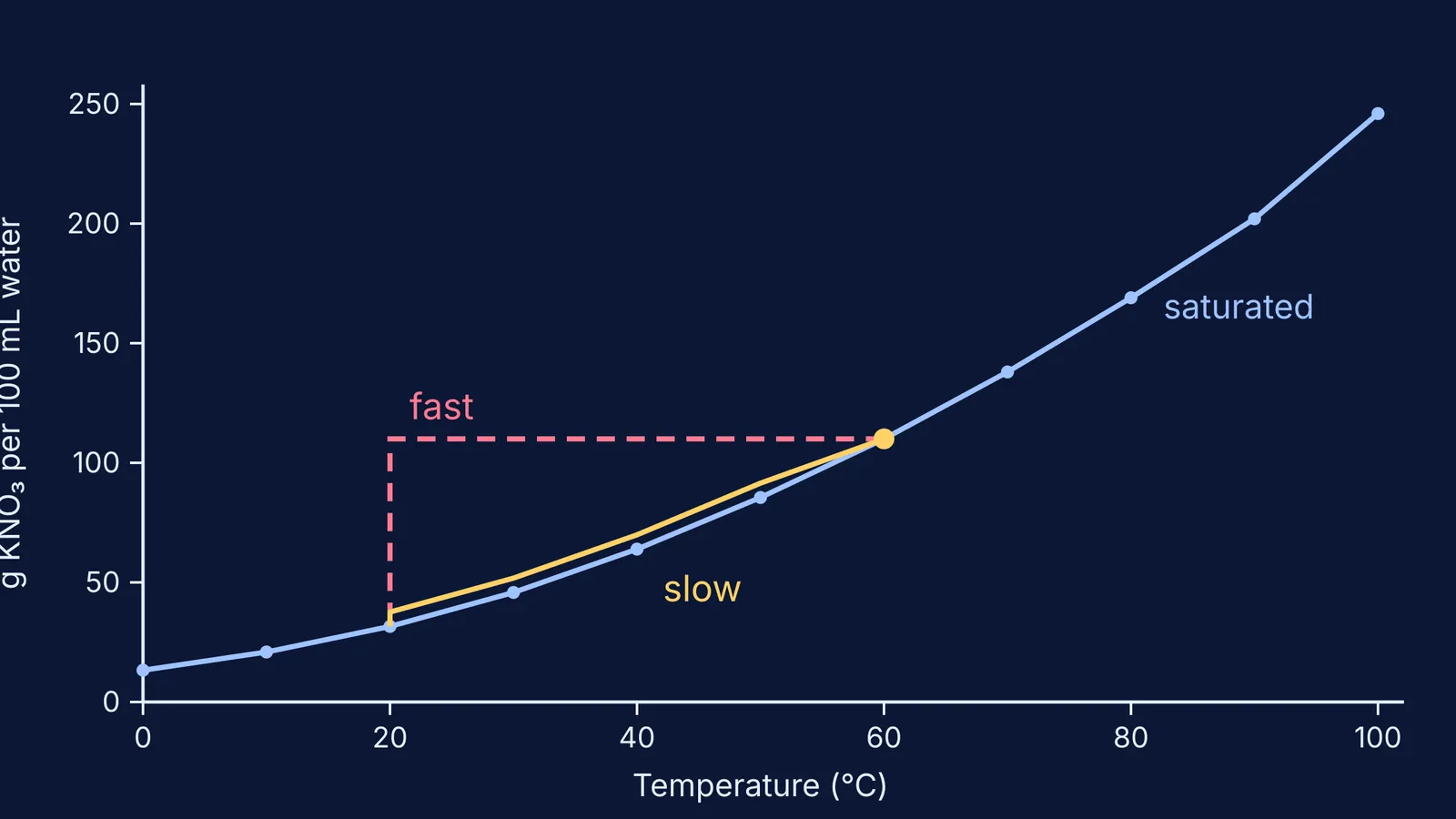
Use potassium nitrate, because its solubility changes a lot with temperature. The solubility table on Wikipedia lists 110 g of KNO₃ per 100 mL of water at 60 °C, and 31.6 g at 20 °C.
Worked example. Saturate 100 mL of water with KNO₃ at 60 °C, then cool it to 20 °C.
Mass that must crystallise: 110 − 31.6 = 78.4 g. Solubility fixes this, not the cooling rate.
Fast run: suppose 1,000 crystals form. The average crystal is 78.4 ÷ 1,000 ≈ 0.08 g.
Slow run: suppose only 10 crystals form. The average crystal is 78.4 ÷ 10 ≈ 7.8 g.
Now the size. Mass grows with the cube of length, so 100 times as many crystals means each is about 4.6 times shorter (the cube root of 100), not 100 times shorter.
The counts 1,000 and 10 are made up to show the arithmetic; your simulation will give its own. Before you press play, write down predictions for a fast, a medium and a slow run:
How many crystals will form?
How big will the largest one be?
Will the total mass of crystals change? (It should not, if every run ends at the same temperature.)
Then run each one and compare. If a result surprises you, change one setting at a time. Our Fermi Simulation Lab has interactive simulations for ideas that are easier to see than to read, and the same predict-then-check habit applies there. For why predicting first matters, see what studies found about simulations versus static diagrams.
How does slow cooling purify a solid?
Recrystallisation, a common way to purify a solid in a chemistry lab, works best with slow cooling. The Organic Chemistry Lab Techniques troubleshooting guide on LibreTexts/03%3A_Crystallization/3.06%3A_Step-by-Step_Procedures/3.6F%3A_Troubleshooting) warns that in rapid crystallisation "impurities tend to become incorporated into the crystal". Its rule of thumb: some crystals should appear in about 5 minutes, with growth continuing over about 20 minutes.
If crystals crash out at once, the same guide suggests adding a little extra hot solvent, covering the flask with a watch glass and standing it on paper towels or a cork ring so it cools more gently. You will meet this in practicals such as preparing Mohr's salt and potash alum, and alongside other methods in purifying organic compounds, from distillation to chromatography.
What do igneous rocks tell you about cooling rate?
Rocks that crystallise from molten rock record how fast they cooled. The LibreTexts geology chapter/04:_Igneous_Processes_and_Volcanoes/4.01:_Classification_of_Igneous_Rocks) links each texture to a cooling history:
Granite cools slowly underground and is coarse-grained: you can see the separate crystals.
Basalt cools fast at the surface and is fine-grained, with grains too small to see with the unaided eye.
Porphyritic rock has large crystals set in a fine matrix, a sign of cooling in two stages.
Obsidian is volcanic glass: lava that cools extremely quickly may not form crystals at all.
Obsidian is the far end of your fast run: so little time that no ordered crystals form. A porphyritic rock is a simulation you can set up yourself: cool slowly, then switch to fast, and predict the mix of sizes before you look.
Next step: pick one cooling rate, write your prediction, then run the simulation and check it.


