

On this page
In short
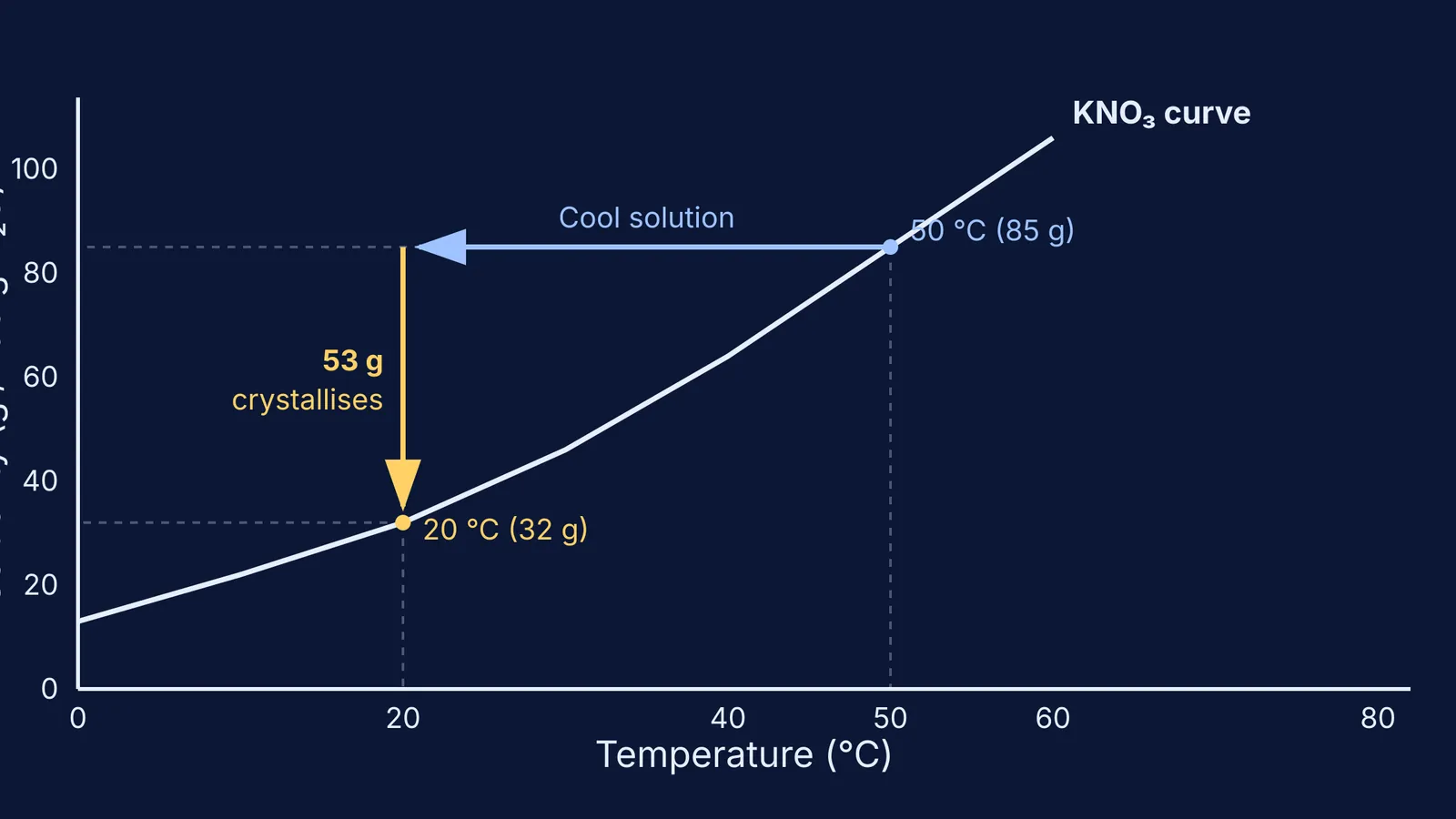
To find the mass of crystals on cooling, read the solubility curve at the hot and cold temperatures, then subtract the two values. For example, cooling 100 g of water saturated with potassium nitrate from 50 °C (85 g dissolved) to 20 °C (32 g dissolved) yields 53 g of crystals.
A solubility curve is a graph that shows how much of a solid can dissolve in water at different temperatures. While most students know that heating a liquid lets it dissolve more solid, chemistry exams test your ability to read the graph backwards: what happens when a hot, saturated solution cools down?
Because colder water cannot hold as much dissolved salt, the excess solid falls out of the solution as crystals.
What is a solubility curve?
A solubility curve plots temperature on the x-axis and solubility on the y-axis. By standard convention, solubility is measured in grams of solute per 100 g of water (OpenStax).
Different salts have different curves. For example, sodium chloride (table salt) has a nearly flat curve; heating the water from 0 °C to 100 °C barely changes how much salt it can hold. Potassium nitrate (KNO₃), on the other hand, has a very steep curve. According to the OpenStax Chemistry textbook, a saturated solution of potassium nitrate at 50 °C holds about 85 g of salt per 100 g of water, but at 20 °C, it can only hold about 32 g (OpenStax).
When reading the graph, the line itself represents a saturated solution. A point below the curve is an unsaturated solution (it could dissolve more salt). A point above is a supersaturated solution, an unstable state holding more salt than it normally should.
How do you find the mass of crystals on cooling?
When a saturated solution cools, you can find the exact mass of the crystals that form by reading the solubility at the two temperatures and subtracting them.
Here is the step-by-step method for a solution containing exactly 100 g of water:
Find the hot solubility. Locate your starting temperature on the x-axis, move straight up to the curve, and read the value on the y-axis. This is the mass of salt currently dissolved in the water.
Find the cold solubility. Locate your final temperature on the x-axis, move straight up to the curve, and read the new y-axis value. This is the maximum mass the water can hold at the new, lower temperature.
Subtract the two. The difference between the hot solubility and the cold solubility is the mass of salt that crystallises out.
Worked Example: You have a saturated solution of potassium nitrate in 100 g of water at 50 °C. You let it cool to 20 °C. How much potassium nitrate crystallises?
From the curve, the solubility at 50 °C = 85 g.
The solubility at 20 °C = 32 g.
Mass of crystals = 85 g − 32 g = 53 g.
If you keep getting stuck on setting up ratios for these problems, the Fermi Problem Library has worked problems with a step-by-step solver that explains the reasoning rather than printing an answer.
What if you have more or less than 100 g of water?
Examiners often change the mass of the water. Because the curve is given per 100 g of water, you must scale your answer using a ratio.
For instance, what if the example above used 50 g of water instead of 100 g?
First, calculate the mass of crystals for 100 g of water, exactly as you did before. Our calculation showed that cooling 100 g of water from 50 °C to 20 °C yields 53 g of crystals. Since you only have half as much water (50 g is half of 100 g), the solution will drop half as many crystals.
Mass of crystals = 53 g × (50 / 100) = 26.5 g.
This ratio trick works for any amount of water. Just find the difference from the curve first, then multiply by your actual mass of water divided by 100.
What happens if water evaporates during cooling?
Sometimes a problem will state that water evaporated while the solution was cooling. In this case, you cannot simply subtract the two solubility values directly because you no longer have 100 g of water at the end.
To solve this, you need to track the salt and the water separately:
Find the total mass of salt dissolved at the hot temperature.
Subtract the mass of water that evaporated from your starting mass of water to find your final mass of water.
Calculate how much salt this new, smaller amount of cold water can hold.
Subtract the salt it can hold from the salt you started with.
The same proportional thinking applies to other solution problems, such as mixing and diluting solutions to find final molarity or working with heterogeneous equilibria where solids drop out.


