

On this page
Water can dissolve sugar, but only up to a point. Stir in a teaspoon, and it vanishes. Keep pouring, and eventually, the grains just sink to the bottom. What governs this limit?
The difference between an unsaturated, saturated and supersaturated solution comes down to how much solute the solvent holds compared to its maximum capacity at a given temperature, and the thermodynamics of how crystals form.
What is an unsaturated solution?
A solution is unsaturated when it contains less solute than the solvent can dissolve at that temperature.
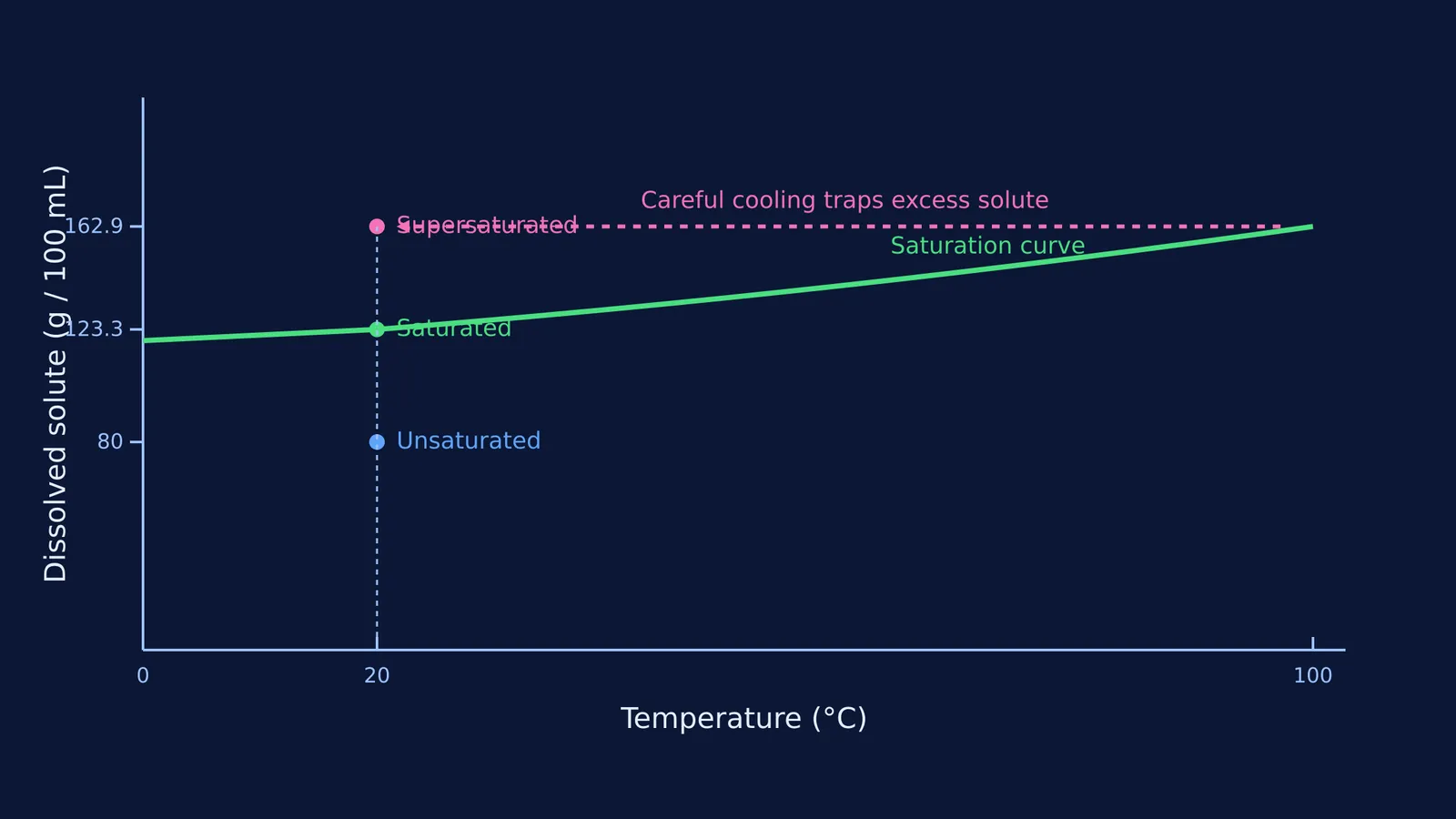
For example, at 20 °C, 100 mL of water can dissolve up to 123.3 grams of anhydrous sodium acetate. If you dissolve 80 grams of it in 100 mL of water, the solution is unsaturated.
Because the system has not reached its solubility limit, adding more solute to an unsaturated solution simply results in it dissolving. You will often calculate the concentration of such solutions when dealing with mixing and diluting solutions in chemistry problems.
What makes a solution saturated?
A saturated solution contains the exact maximum amount of solute that can remain dissolved at equilibrium.
Using the same example, if you dissolve exactly 123.3 grams of anhydrous sodium acetate in 100 mL of water at 20 °C, it is saturated.
What happens if you add more? The excess will not dissolve; it sinks to the bottom as a solid precipitate, because the solvent has no more capacity to hydrate the extra ions. In chemical calculations, this is an example of heterogeneous equilibria, where the solid itself drops out of the equilibrium constant expression.
How does temperature affect solubility?
For most solid solutes like sodium acetate or sugar, solubility increases as the temperature rises. When you heat the solvent, the water molecules move faster and have more kinetic energy. This increased movement allows them to break apart the solid crystal lattice more effectively and keep more solute particles separated in the liquid phase.
However, this is not a universal rule. Gases, for example, become less soluble in water as temperature increases, which is why a warm carbonated drink goes flat faster than a cold one.
How is a supersaturated solution made?
A supersaturated solution holds more solute than is theoretically possible at that equilibrium temperature. It is a metastable state.
You cannot make a supersaturated solution just by stirring in more powder at room temperature. You must use heat. Because solubility generally increases with temperature, water at 100 °C can hold 162.9 grams of anhydrous sodium acetate.
If you dissolve 162.9 grams in boiling water, you have a saturated solution at 100 °C. If you then cool this solution very carefully and slowly back to 20 °C without disturbing it, the excess solute remains trapped in the liquid, creating a supersaturated state.
Why does a seed crystal cause crystallisation?
Supersaturated solutions are metastable. The dissolved molecules "want" to become a solid, but they face a thermodynamic energy barrier.
For a crystal to form spontaneously (a process called homogeneous nucleation), molecules must bump into each other and form a stable cluster. But creating a new solid-liquid boundary requires energy, and tiny clusters often redissolve before they can grow. According to the LaMer model of nucleation, the solution will remain liquid until it is disturbed or cooled further to reach a critical saturation point.
Adding a seed crystal provides a pre-existing solid surface (heterogeneous nucleation). The dissolved molecules no longer need to form a new nucleus from scratch; they simply dock onto the existing crystal lattice.
This bypasses the energy barrier. A rapid chain reaction begins, and the excess solute crashes out of the solution until it returns to its normal, saturated limit.
What is the "hot ice" experiment?
The rapid crystallisation of a supersaturated solution is often demonstrated using sodium acetate, sometimes called "hot ice". When a seed crystal is introduced, the sudden formation of the solid lattice releases a significant amount of latent heat. This exothermic reaction can quickly raise the temperature of the container so that it feels very warm to the touch.
Commercial reusable hand warmers use this exact principle. They contain a supersaturated solution of sodium acetate and a small flexible metal disc. Snapping the disc creates a microscopic shockwave or exposes a tiny nucleation site, triggering the crystallisation and releasing heat into your hands. Once cooled, you can reset the hand warmer by boiling it, which redissolves the solid and sets up the supersaturated state again.
Visualising the energy barriers of nucleation or molecules docking onto a seed crystal can be difficult from a textbook. The Fermi Concept Library maps out every concept in physics, chemistry, biology, mathematics and computing, each with its own lesson and its place in the map.


