On this page
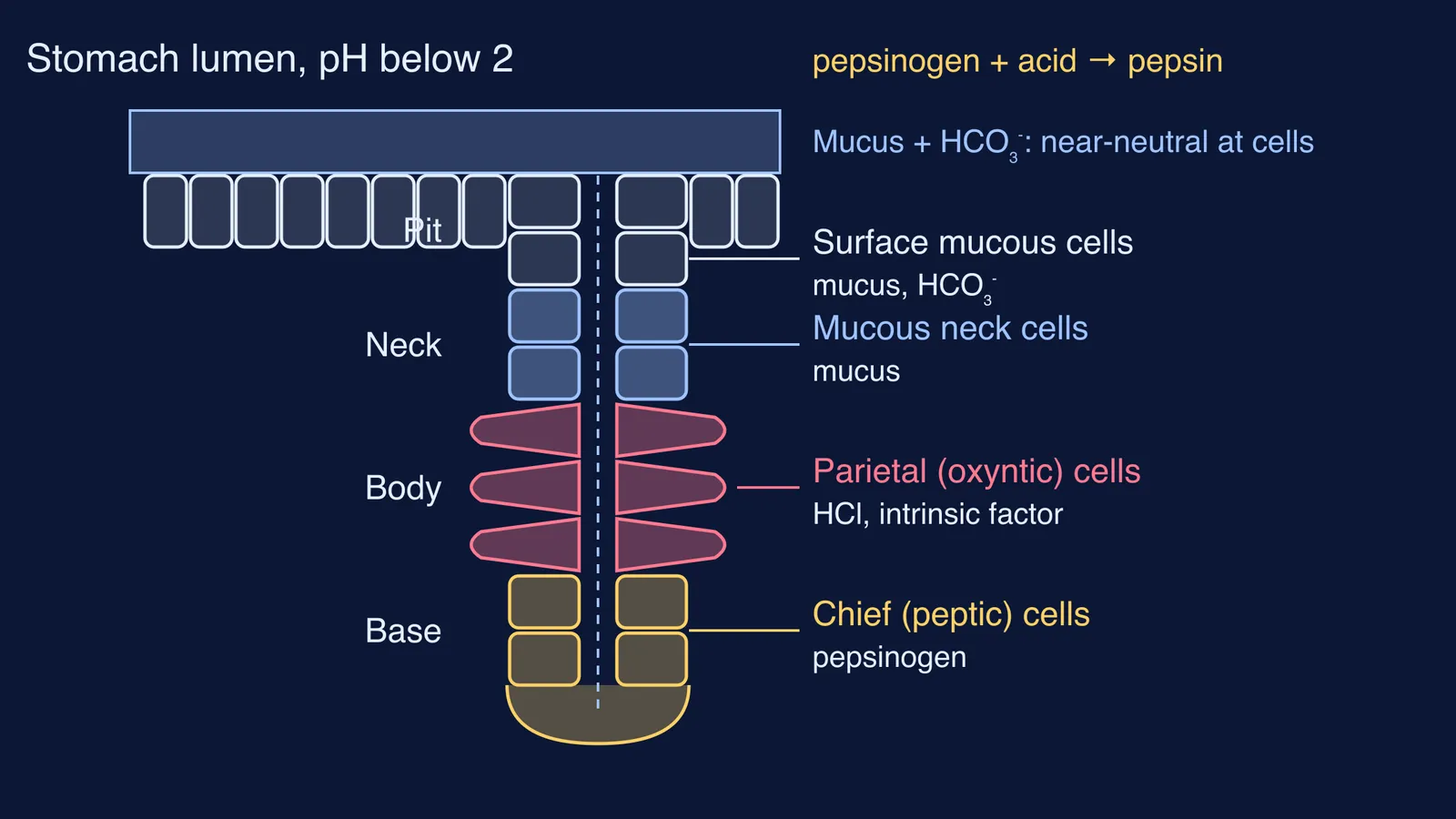
A gastric gland is a narrow tube that opens into the stomach through a small pit. Several kinds of cells line it, and four of them make the secretions this topic is about: mucus, acid, intrinsic factor and pepsinogen. Place each cell in the tube, name what it releases, and you can see why the stomach survives its own acid. The sketch above is your map: pit, neck, body, base.
Which gastric gland cell secretes what?
A 2020 review in Physiological Reviews by Engevik, Kaji and Goldenring describes the cell types of these acid-secreting glands. Combined with the NCBI StatPearls chapter on gastric intrinsic factor, the matching looks like this:
Surface mucous cells (lining the pit and the stomach surface): mucus.
Mucous neck cells (just below the pit): a second type of mucus.
Parietal cells, also called oxyntic cells: hydrochloric acid (HCl) and intrinsic factor.
Chief cells, also called peptic cells (at the base of the gland): pepsinogen.
The two-name pairs trip people up. Oxyntic and parietal mean the same cell; peptic and chief mean the same cell. Learn them as pairs, not as four separate cells.
How do oxyntic cells make hydrochloric acid?
Parietal cells pump hydrogen ions into the gland using an enzyme called the H+-K+-ATPase, which swaps hydrogen ions out of the cell for potassium ions coming in. According to Engevik and colleagues, the secreted H+ combines with chloride in the lumen to form HCl, and this acid makes the stomach lumen strongly acidic, at pH below 2.
The same cell has a second product. The StatPearls chapter on intrinsic factor defines it as a glycoprotein made by the parietal (oxyntic) cells of the gastric body and fundus. Intrinsic factor binds vitamin B12 so that it can be absorbed in the terminal ileum, not in the stomach. A separate StatPearls chapter on parietal cell histology links these cells to pernicious anaemia, which is why a question about B12 often turns out to be a question about parietal cells.
For the other jobs stomach acid does, see our explainer on the functions of hydrochloric acid in the stomach.
How does pepsinogen turn into pepsin?
Chief cells release pepsinogen into the gland, an inactive precursor called a zymogen. A 2022 narrative review in Annals of Esophagus by Stanforth and colleagues explains that pepsinogen activates itself once the pH falls below 5, which happens in the gastric glands. So HCl from the parietal cells is the trigger that switches the chief cells' product on.
The same review gives the other half of the story. Pepsin works up to about pH 6.5, and it is irreversibly destroyed at pH 7 to 8, while pepsinogen stays stable up to pH 10.
Why does the stomach not digest itself?
Three protections explain most of it.
The enzyme starts switched off. Chief cells release pepsinogen, not pepsin, and it only activates once acid drops the pH below 5 (Stanforth et al.).
Mucus forms a physical barrier. A 2005 review by Allen and Flemström describes a continuous layer of mucus gel stuck to the stomach lining that keeps pepsin in the lumen away from the cells beneath it.
Bicarbonate neutralises acid inside the mucus. The same review explains that bicarbonate secreted into that gel creates a pH gradient, so the surface of the cells sits near neutral while the lumen is strongly acidic.
Put the numbers side by side. Pepsin loses its activity by about pH 6.5, and the cell surface under the mucus is near neutral. Any pepsin that does reach the lining meets a pH at which it has little or no activity.
We go further into the mucus layer in why your stomach does not digest itself, and into the hormone that tells parietal cells to secrete in gastrin, secretin, CCK and GIP.
How to remember gastric gland cells: a 3-minute drill
Use this once today and once more in a few days.
On a blank page, draw a tall test tube with the open end at the top. Mark four zones: pit, neck, body, base.
Fill in the cells from top to bottom: surface mucous, mucous neck, parietal, chief.
Next to each, write its product: mucus, mucus, HCl plus intrinsic factor, pepsinogen.
Draw one arrow from parietal to chief labelled "acid activates", and one from the mucus to the lining labelled "bicarbonate, near neutral".
Cover your sketch and answer aloud: Which cell is needed for B12 absorption? Which cell's product is inactive when released? Why is pepsin harmless at the cell surface?
If a word in this chain (zymogen, glycoprotein, pH gradient) still feels shaky, the Fermi Concept Library gives each biology and chemistry concept its own lesson and shows where it sits in the map. And if you want to test yourself on worked questions, the Fermi Problem Library has a step-by-step solver that explains the reasoning rather than printing an answer.