On this page
Your stomach makes a strong acid every day, and it is there on purpose. Hydrochloric acid (HCl) does three jobs that school biology keeps coming back to: it kills germs in food, it makes the stomach acidic enough for the enzyme pepsin to work, and it helps the body absorb minerals. Then there is the puzzle: why doesn't it eat the stomach?
What makes the acid in your stomach?
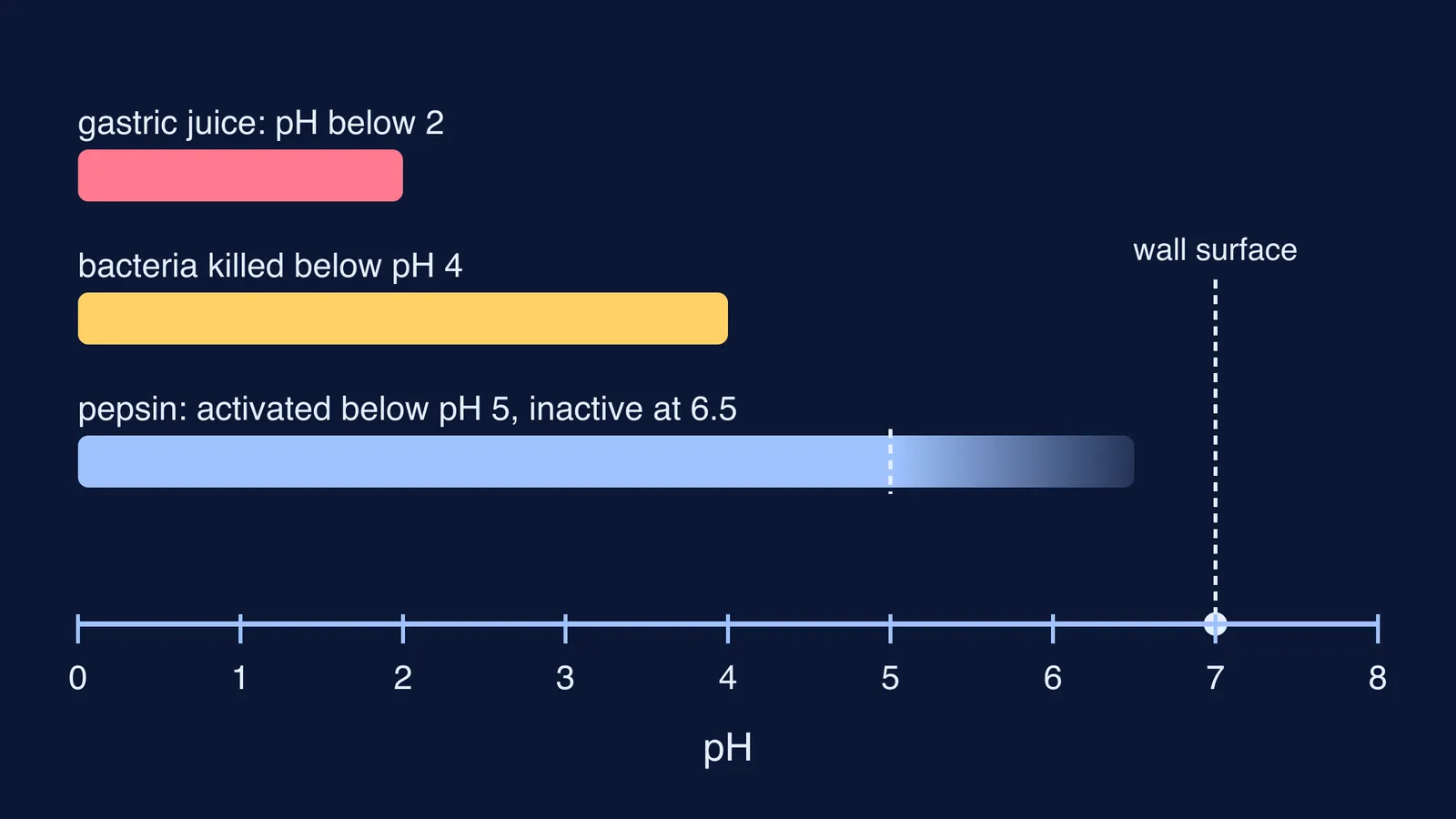
Hydrochloric acid is secreted by parietal cells in the gastric glands, and it keeps the inside of the stomach strongly acidic, below pH 2, according to a review in Physiological Reviews by Amy Engevik, Izumi Kaji and James Goldenring. The same review lists what the acid does: it kills bacteria that come in with food, helps digest food, and promotes the absorption of minerals including phosphate, calcium and iron.
pH counts in powers of ten, so a liquid at pH 2 has 100,000 times more hydrogen ions than pure water at pH 7. To see where stomach acid sits next to things you know, look at our pH chart from stomach acid to bleach.
How does stomach acid kill germs?
The main function of gastric acid is to inactivate swallowed microorganisms so that infectious agents do not reach the intestine, write Tom Martinsen, Reidar Fossmark and Helge Waldum in a 2019 review in the International Journal of Molecular Sciences. Below pH 4, they report, gastric juice kills bacteria rapidly, usually within 15 minutes, and the effect weakens above pH 4.
So the stomach is a filter as well as a mixer. Food from a street stall or water from a doubtful tap meets an acid bath before it reaches the intestine. The filter is not perfect, which is why clean water and washed hands still matter.
Why does pepsin need an acidic medium?
The chief cells of the stomach release pepsin in an inactive form called pepsinogen. Pepsinogen switches itself on (autocatalytic activation) when it meets a pH below 5, according to a 2022 review by Kyle Stanforth and colleagues in Annals of Esophagus. The same review reports that pepsin has no protein-cutting activity at pH 6.5 and is irreversibly denatured between pH 7 and 8.
The inactive form makes sense for two reasons:
The cells that make it are not digested on the way out.
Pepsin works only where it is meant to, inside the acidic stomach.
Pepsin cuts proteins into smaller peptides; enzymes such as trypsin finish the job in the small intestine. Our guide to digestive enzymes for Class 10 maps where each one acts.
Why doesn't the stomach digest its own wall?
The stomach wall is coated with a sticky layer of mucus, and the cells beneath it secrete bicarbonate, a base. In a review in the American Journal of Physiology-Cell Physiology, Adrian Allen and Gunnar Flemström describe how the mucus gel forms an unstirred layer: bicarbonate neutralises acid that diffuses into the gel, keeping the pH near neutral right at the cell surface, while the gel itself shields the tissue from pepsin. They conclude that under normal conditions this mucus-bicarbonate barrier is enough to protect the stomach lining against acid and pepsin.
Put that next to the pepsin facts above and the design is neat. A juice below pH 2 sits a short distance from a near-neutral surface, where pepsin cannot work. Our explainer on why your stomach does not digest itself looks at the barrier in more detail.
How do you write this as a board-exam answer?
Here is a worked answer to a common question: "State the functions of hydrochloric acid in the stomach. Why does the acid not harm the stomach lining?"
Kills germs: HCl kills bacteria and other microbes that enter with food.
Acidic medium: it makes the stomach acidic, which converts inactive pepsinogen into active pepsin, so proteins can be digested.
Absorption: the acid helps the body absorb minerals such as iron and calcium.
Protection: mucus coats the inner lining and holds bicarbonate, which keeps the surface near neutral, so acid and pepsin do not digest the wall.
Three mistakes that cost marks:
Writing "HCl digests proteins". Pepsin does; the acid sets the conditions.
Skipping pepsinogen. The enzyme is released inactive, and the acid switches it on.
Saying mucus neutralises acid. Bicarbonate neutralises it; the mucus holds the bicarbonate in place.
If the chain from acid to pepsinogen to pepsin still feels like loose facts, the Fermi Concept Library gives each concept in biology and chemistry its own lesson and its place in the map. To practise the reasoning, the Fermi Problem Library has worked problems with a step-by-step solver that explains the reasoning rather than printing an answer.