

On this page
The NCERT account of human digestion rests on four named enzymes and one helper. Learn which juice carries each enzyme, where it acts and what it breaks down. Everything below follows the NCERT Class 10 science chapter Life Processes (Chapter 5). Extra details come from the free OpenStax textbook *Anatomy and Physiology*. For the whole chapter, see our Class 10 life processes guide to nutrition, respiration, transport and excretion.
Which digestive enzymes act where in Class 10?
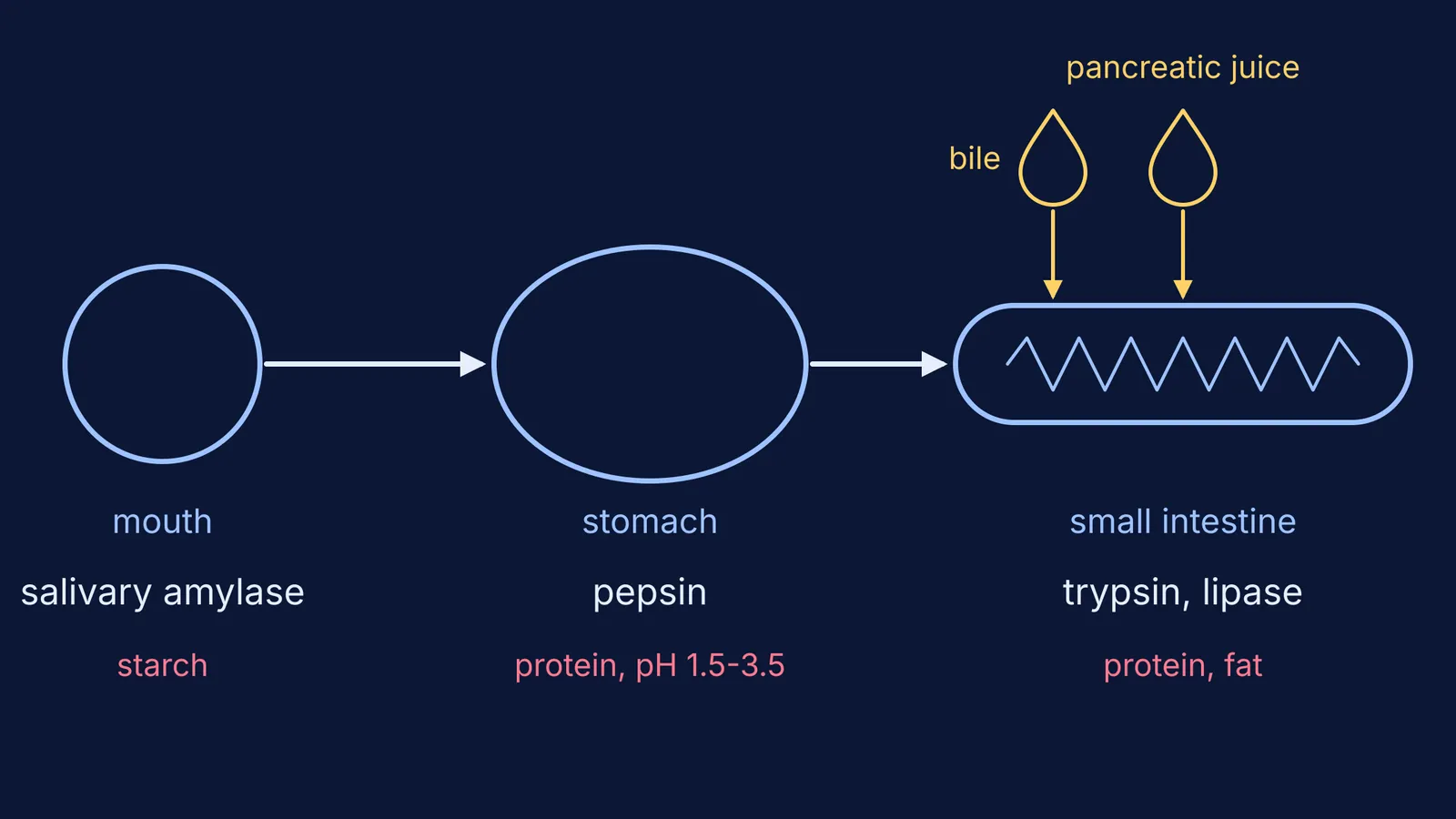
The NCERT chapter follows food down one long tube, the alimentary canal, from the mouth to the anus (NCERT, Life Processes). Learn it as four stops, each with a juice, an enzyme and a food.
Mouth: saliva, salivary amylase. Saliva comes from the salivary glands and contains salivary amylase, which breaks starch down into simple sugar.
Stomach: gastric juice, pepsin. Gastric glands in the stomach wall release hydrochloric acid, pepsin (a protein-digesting enzyme) and mucus.
Small intestine: pancreatic juice, trypsin and lipase. Juice from the pancreas carries trypsin to digest proteins and lipase to break down emulsified fats.
Small intestine: intestinal juice. Glands in the intestine wall finish the job, turning proteins into amino acids, complex carbohydrates into glucose and fats into fatty acids and glycerol.
NCERT calls the small intestine the site of complete digestion of carbohydrates, proteins and fats. Finger-like villi on its lining then absorb the products into the blood.
The chapter's Activity 5.3 tests the first stop: saliva goes into one of two tubes of starch solution, and after 20 to 30 minutes both get dilute iodine. Predict which tube changes colour, and which enzyme explains it.
What does bile do if it has no enzymes?
Bile is where the trick questions are. NCERT says bile comes from the liver, its diagram shows the gall bladder storing it, and the text gives it two jobs (NCERT, Life Processes):
It makes the acidic food coming from the stomach alkaline, so the pancreatic enzymes can act.
Its bile salts break large fat globules into smaller ones, which makes lipase work more efficiently. NCERT compares this to the emulsifying action of soap on dirt.
OpenStax lists what bile contains: water, bile salts, bile pigments, phospholipids, electrolytes, cholesterol and triglycerides (OpenStax, Accessory organs in digestion). None of these is an enzyme. The same page says liver cells secrete about one litre of bile each day.
Why does pepsin need acid while trypsin needs alkali?
NCERT says the hydrochloric acid in the stomach creates an acidic medium that helps pepsin act, and the mucus protects the stomach lining from that acid (NCERT, Life Processes).
The stomach contents have a pH of 1.5 to 3.5, according to OpenStax's chapter on the stomach. The same chapter says this acidity inactivates salivary amylase. For the history, read how William Beaumont watched digestion inside a living stomach.
Pancreatic juice is slightly alkaline, with a pH of 7.1 to 8.2, says OpenStax's chapter on the liver, pancreas and gallbladder. That buffers the acid arriving from the stomach and inactivates pepsin, so trypsin and lipase take over.
One step beyond the Class 10 book: OpenStax explains that pepsin is made as inactive pepsinogen and needs stomach acid to become active. Trypsin is made as inactive trypsinogen and is activated in the small intestine with the help of an enzyme called enteropeptidase. Lipase, by contrast, is released already active. Our post on enzymes for NEET biology, from kinetics to inhibition picks up from there.
How do you write a full-marks answer on digestive enzymes?
Here is a worked example of a typical short-answer question: *Name the enzymes present in pancreatic juice and state the role of bile in digestion.*
Pancreatic juice contains trypsin, which digests proteins, and lipase, which breaks down emulsified fats.
Bile, made in the liver, makes the acidic food from the stomach alkaline so pancreatic enzymes can act.
Bile salts break large fat globules into smaller ones (emulsification), increasing the efficiency of lipase.
Each line pairs one substance with one job. Before you hand in any answer on this topic, check it for these four mistakes:
Bile described as an enzyme, or as digesting fat.
Trypsin placed in the stomach, or pepsin in the small intestine.
Amylase written without "salivary" when the question asks about the mouth.
The small intestine left out as the place where digestion is completed.
To revise, write the chain juice, enzyme, food, product for each stop, then check it against the first section. If one link in the chain stays shaky, the Fermi Concept Library gives every concept in biology its own lesson and shows its place in the map, so you can see how digestion connects to the rest of life processes. For practice questions, the Fermi Problem Library has worked problems with a step-by-step solver that explains the reasoning rather than printing an answer.
Start tonight: close the book, draw the four stops and fill in each juice and enzyme from memory.


