

On this page
Enzymes sit at the end of the Biomolecules chapter, and they connect to almost everything that follows: respiration, photosynthesis, digestion, DNA replication. NEET questions on them test a small set of ideas, but they test them precisely, often through a graph. This post covers how enzymes work, the kinetics with worked numbers, inhibition, classification and cofactors, then the common mistakes and a practice routine.
What does the NEET syllabus include?
Under cell structure and function, the NEET (UG) 2026 syllabus lists "Enzymes-types, properties, enzyme action, classification and nomenclature of enzymes". In NCERT this is section 9.8 of Class 11 Chapter 9, Biomolecules.
What makes an enzyme a catalyst?
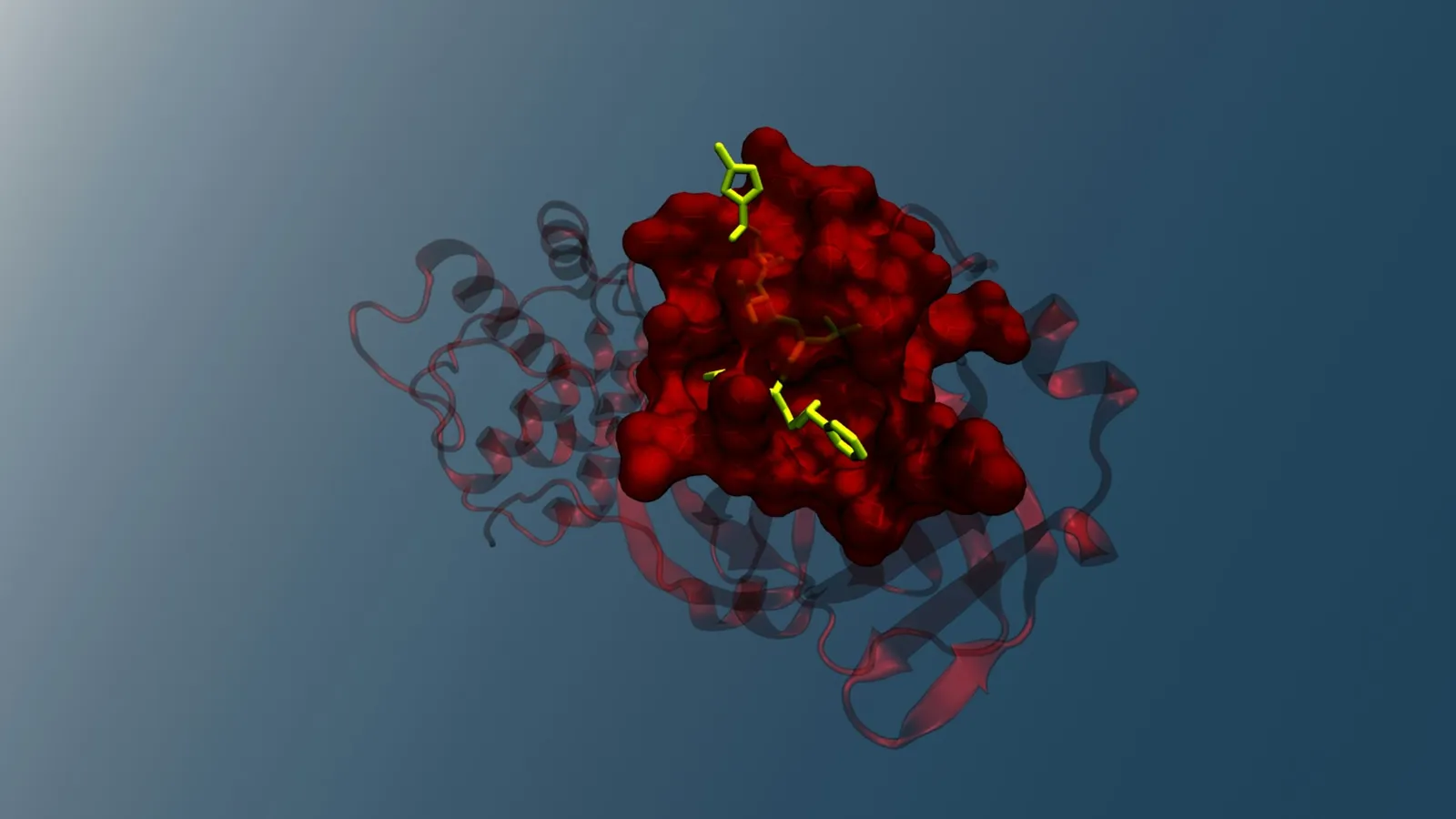
Almost all enzymes are proteins; a few nucleic acids, called ribozymes, also act as enzymes. Folding of the protein chain creates pockets, one of which is the active site where the substrate fits. NCERT gives a striking example: without an enzyme, about 200 molecules of carbonic acid form from CO₂ and water in an hour; with carbonic anhydrase, about 600,000 form every second. Check the factor yourself: 600,000 per second is 600,000 × 3600 = 2.16 billion per hour, and 2.16 billion ÷ 200 is about 10.8 million. NCERT rounds this to "about 10 million times".
Unlike inorganic catalysts, most enzymes are damaged at high temperatures (NCERT says above about 40°C), though enzymes from thermophilic organisms can stay active up to 80 to 90°C.
How do enzymes speed up reactions?
Every reaction passes through a high-energy transition state. The energy needed to reach it is the activation energy. Enzymes lower that barrier. The steps NCERT gives:
The substrate binds the active site.
Binding makes the enzyme change shape and fit more tightly around the substrate.
The active site breaks bonds in the substrate, forming an enzyme-product complex.
The product is released and the free enzyme is ready for another substrate.
In short: E + S ⇌ ES → EP → E + P. Formation of the ES complex is essential for catalysis.
What do Vmax and Km mean?
Temperature and pH each have an optimum, with activity falling on either side. Low temperature keeps an enzyme temporarily inactive; high temperature denatures it.
Substrate concentration behaves differently. As [S] rises, the reaction velocity rises, then levels off at a maximum velocity, Vmax, because all enzyme molecules are busy. NCERT's Figure 9.5(c) marks Km on the x-axis at the point where velocity is Vmax/2. The curve comes from the equation Leonor Michaelis and Maud Menten published in 1913; a 2011 translation and reanalysis of their paper describes how they showed the rate depends on the concentration of the enzyme-substrate complex. The equation is:
v = Vmax × [S] / (Km + [S])
Worked example. An enzyme has Vmax = 100 µmol/min and Km = 2 mM. Find the velocity at [S] = 2, 6 and 18 mM.
[S] = 2 mM: v = 100 × 2 / (2 + 2) = 50 µmol/min. Exactly Vmax/2, which is the definition of Km.
[S] = 6 mM: v = 100 × 6 / (2 + 6) = 75 µmol/min.
[S] = 18 mM: v = 100 × 18 / (2 + 18) = 90 µmol/min.
Tripling [S] from 2 to 6 mM adds 25 units; tripling again to 18 mM adds only 15. That is saturation in numbers. A low Km means the enzyme reaches half its top speed at a low substrate concentration.
How does competitive inhibition work?
An inhibitor is a chemical that binds an enzyme and shuts off its activity. A competitive inhibitor closely resembles the substrate and competes for the active site. NCERT's example is malonate, which resembles succinate and inhibits succinic dehydrogenase. Competitive inhibitors are used in controlling bacterial pathogens.
Beyond NCERT's text, it helps to know what this does to the graph: because enough substrate can outcompete the inhibitor, Vmax stays the same, but more substrate is needed to reach half of it, so the apparent Km rises.
How are enzymes classified, and what are cofactors?
NCERT lists six classes, each with 4 to 13 subclasses and a four-digit number:
Oxidoreductases (dehydrogenases): oxidation-reduction between two substrates.
Transferases: transfer of a group other than hydrogen.
Hydrolases: hydrolysis of ester, ether, peptide, glycosidic and other bonds.
Lyases: removal of groups by means other than hydrolysis, leaving double bonds.
Isomerases: interconversion of optical, geometric or positional isomers.
Ligases: joining two compounds, for example C–O, C–S, C–N and P–O bonds.
Some enzymes need a non-protein cofactor. The protein part is then the apoenzyme. There are three kinds:
Prosthetic groups: organic and tightly bound, such as haem in peroxidase and catalase.
Coenzymes: organic but only transiently bound; many contain vitamins, such as NAD and NADP, which contain niacin.
Metal ions: for example zinc in carboxypeptidase.
Remove the cofactor and catalytic activity is lost.
Common mistakes and how to avoid them
Saying enzymes change the energy of reactants or products. They lower the activation energy only.
Thinking more substrate always means a faster reaction. Past saturation, velocity stays at Vmax.
Mixing up prosthetic groups and coenzymes. Both are organic; the difference is how tightly they bind.
Confusing lyases and hydrolases. Hydrolases use water; lyases remove groups without hydrolysis and leave double bonds.
A practice routine
Sketch the three graphs in NCERT's Figure 9.5 from memory and mark the optimum, Vmax and Km.
Do five Michaelis-Menten calculations with different Km values, and predict the answer roughly before you calculate.
Write the six classes with one-line definitions, then recall them two days later. Recalling beat rereading for retention at two days and a week in Roediger and Karpicke's study.
Read enzymes alongside our guide to the cell as the unit of life, since organelles such as lysosomes are defined by their enzymes.
If the kinetics graph does not make sense yet, the Fermi Concept Library has every concept in biology and chemistry with its own lesson, so you can work through activation energy or enzyme kinetics on its own before returning to the chapter.
This week, solve the worked example again with Km = 5 mM and check that velocity at [S] = 5 mM is 50 µmol/min.


