

On this page
When you plug in a heavy appliance like an iron, geyser or refrigerator, you use a plug with three pins. The top pin is visibly bulkier and longer than the other two. This is not just a design quirk to make the plug grip the socket better. The three-pin layout is a deliberate, highly engineered safety system built on the laws of electricity and standardized across the country.
What do the three pins do?
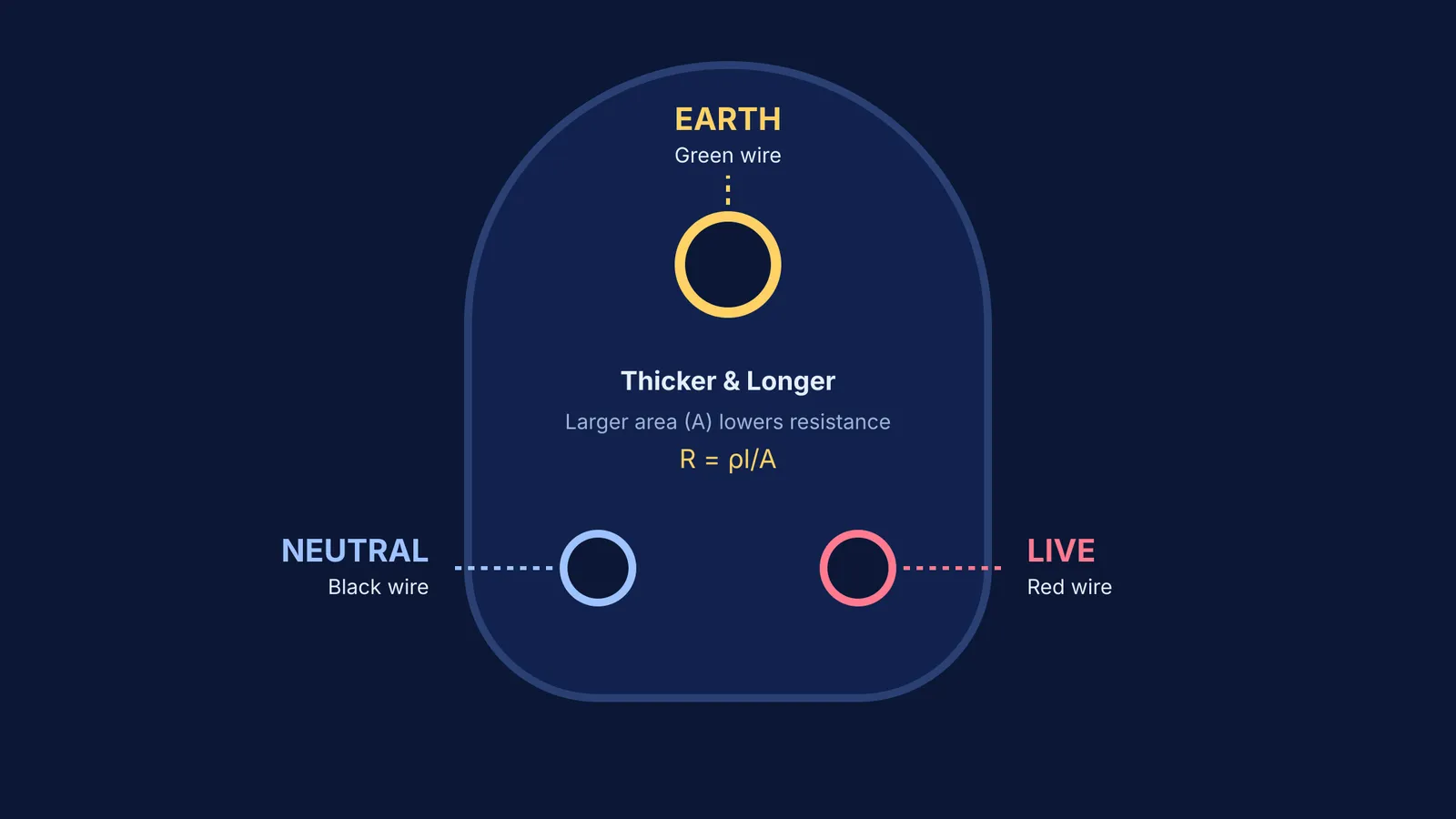
A typical Indian domestic circuit supplies power through three distinct wires. As detailed in the Class 10 science curriculum on the magnetic effects of current, each wire has a specific role and colour code (Source):
Live wire (Red): This brings the current into the house from the local substation at a high potential of 220 V. It is the active carrier of electrical energy.
Neutral wire (Black): This provides the return path for the current, completing the circuit, and is maintained at zero potential.
Earth wire (Green): This is a dedicated safety wire. It runs from the socket directly to a metal plate buried deep in the ground outside your house.
The two lower pins on your plug connect to the live and neutral wires to power the appliance. The top pin connects the appliance's outer metallic body to the earth wire. If the insulation inside the appliance frays over time and the live wire touches the metal casing, the entire body of the appliance becomes "live."
Without an earth connection, if you touch the appliance, your body completes the circuit to the ground, resulting in a severe electric shock. With an earth connection, the green wire ensures the casing stays at zero potential, safely carrying the rogue current away.
Why is the earth pin thicker?
According to the Indian Standard (IS 1293) set by the Bureau of Indian Standards, the earth pin must be significantly thicker than the power pins. For a standard 6 A plug, the earth pin has a diameter of roughly 7.06 mm, while the live and neutral pins are about 5.08 mm (Source).
This added thickness serves two critical purposes. First, it is a foolproof physical safeguard: a thick earth pin simply will not fit into the smaller live or neutral slots. This prevents anyone from accidentally forcing the earth pin into a live terminal, which would instantly electrify the metal body of the appliance.
Second, the design relies on the physics of resistance. The resistance of any conductor is inversely proportional to its cross-sectional area (R = ρl/A). By making the pin thicker, its cross-sectional area increases, which drastically lowers its electrical resistance.
When a fault occurs, electric current naturally seeks the path of least resistance. The human body has a relatively high electrical resistance, especially when dry. A thick copper or brass earth pin, paired with the green earth wire, offers a resistance of just a tiny fraction of an ohm. The thick pin ensures the fault current effortlessly bypasses your body and flows straight into the ground.
How does earthing protect your circuit?
The protection offered by the third pin goes beyond just diverting current away from your body; it also actively alerts your home's circuit breakers that something is wrong.
When a live wire faults to an earthed metal casing, the thick earth pin provides a near-zero resistance path. According to Ohm's law (V = IR), if the voltage remains at 220 V (Source) and the circuit's resistance drops to almost zero, the current will suddenly spike to a massive value.
This is exactly what your home's safety devices are waiting for. The sudden surge in current instantly blows the safety fuse or trips the Miniature Circuit Breaker (MCB). This immediately cuts off the power supply to the faulty appliance, preventing wires from overheating and starting a fire. You can see exactly how current divides and spikes when resistance drops by setting up a parallel fault circuit in the Fermi Simulation Lab.
Understanding domestic circuits, earthing, and the right Class 10 science diagrams (like the layout of a household wiring system) is a recurring part of the board exams. When you know the physical reasons why the pins are shaped the way they are, the textbook physics becomes much easier to remember.
Is your home earthing safe?
Many electrical accidents happen because the earthing system is bypassed or poorly maintained. Here is how to ensure your home is safe:
Check the pin: Ensure the earth pin on heavy appliances (like irons, geysers, and heaters) is completely intact. Never break it off or file it down to make it fit into an older two-pin socket.
Check the socket shutters: Many modern sockets have internal safety shutters blocking the live and neutral holes to protect children. The longer earth pin acts as a key to push these shutters open. Never jam a pen or a stick into the earth hole to bypass this.
Check the wiring: In some older homes, sockets may have three holes, but the crucial green earth wire is missing or disconnected behind the wall plate. An electrician can easily verify your earth connection with a plug-in tester.


