On this page
Two plant breeding lists come up again and again: the five steps for breeding a new variety, and the table of varieties bred to resist disease. Both come from Chapter 9, Strategies for Enhancement in Food Production, in the 2020-21 edition of NCERT's Class 12 Biology textbook. Here they are, with the common trap and a ten-minute learning plan.
What are the five steps of plant breeding?
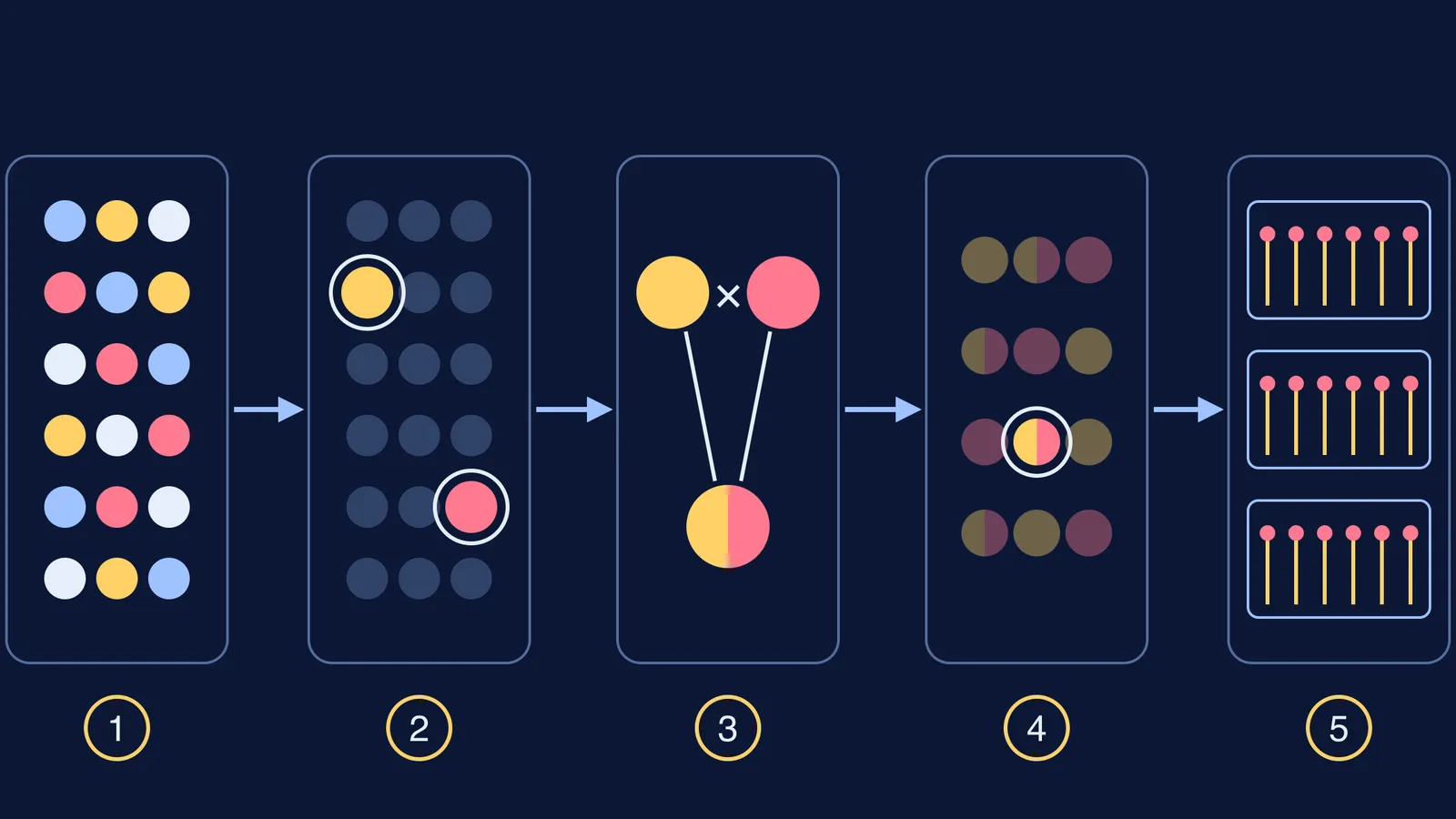
NCERT defines plant breeding as "the purposeful manipulation of plant species in order to create desired plant types that are better suited for cultivation, give better yields and are disease resistant" (NCERT Class 12 Biology, Chapter 9). The chapter lists the main steps in breeding a new genetic variety in this order:
Collection of variability. Gather wild varieties, species and relatives of the crop. The entire collection of all the diverse alleles for all genes in a crop is the germplasm collection.
Evaluation and selection of parents. Screen the germplasm for plants with the right combination of characters, multiply them, and create pure lines where possible.
Cross hybridisation among the selected parents. Pollen from the male parent goes on the stigma of the female parent, so that, say, high protein quality from one meets disease resistance from the other. Usually only one in a few hundred to a thousand crosses shows the desired combination.
Selection and testing of superior recombinants. Pick progeny with the wanted combination and self-pollinate them for several generations until they are uniform (homozygous).
Testing, release and commercialisation of new cultivars. Test the lines in research fields, then in farmers' fields for at least three growing seasons at several locations, against the best local cultivar as a check.
For the hands-on part of step 3, see our explainer on emasculation and bagging in artificial hybridisation.
How does breeding for disease resistance work?
It is the same pipeline, aimed at one trait. NCERT says fungal, bacterial and viral pathogens can cause crop losses of up to 20-30 per cent, or sometimes total loss (NCERT Class 12 Biology, section 9.2.2). Host resistance is the plant's ability to prevent the pathogen from causing disease, and it is set by the plant's genetic constitution.
NCERT names two routes:
Hybridisation and selection: screen germplasm for resistance sources, hybridise the selected parents, select and evaluate the hybrids, then test and release new varieties.
Mutation breeding: induce mutations with chemicals or radiation such as gamma rays, then screen for resistance. In mung bean, resistance to yellow mosaic virus and powdery mildew was induced this way.
Resistance can also come from a wild relative: yellow mosaic virus resistance in bhindi was transferred from a wild species, giving the variety Parbhani Kranti.
Which crop varieties are disease resistant in NCERT?
Table 9.1 lists five crops, all bred by hybridisation and selection (NCERT Class 12 Biology, Table 9.1):
Wheat: Himgiri (spelt Himagiri in the table) resists leaf and stripe rust, and hill bunt.
Brassica: Pusa Swarnim (Karan rai) resists white rust.
Cauliflower: Pusa Shubhra and Pusa Snowball K-1 resist black rot and curl blight black rot.
Cowpea: Pusa Komal resists bacterial blight.
Chilli: Pusa Sadabahar resists chilly mosaic virus, tobacco mosaic virus and leaf curl.
The classic trap is mixing this list with Table 9.2, the insect-pest table. There, Pusa Gaurav (Brassica) resists aphids, Pusa Sem 2 and 3 (flat bean) resist jassids, aphids and fruit borer, and Pusa Sawani and Pusa A-4 (okra) resist shoot and fruit borer. None of these is a disease-resistant variety.
How do you remember Himgiri, Pusa Komal and the rest?
Try this ten-minute plan:
Write the five crops from memory: wheat, Brassica, cauliflower, cowpea, chilli.
Add each variety. Two anchors: Himgiri is the only name without Pusa, and wheat is the only cereal.
Add the disease and, where the chapter says so, the pathogen type: rusts are fungal, black rot of crucifers is bacterial, tobacco mosaic is viral.
Cover the page and go in reverse: given a disease, name the crop and variety.
Box the pest-table varieties separately so they never drift into the disease list.
If the pathogen groups blur, the Fermi Concept Library gives every concept in biology its own lesson and its place in the map. For practice, the Fermi Problem Library has worked problems with a step-by-step solver that explains the reasoning rather than printing an answer.
Is this chapter still in the current NCERT book?
No. The contents page of the NCERT Class 12 Biology reprint (2026-27) lists 13 chapters: Unit VIII, Biology in Human Welfare, now holds only Human Health and Disease and Microbes in Human Welfare, and Chapter 9 is Biotechnology: Principles and Processes. You will still meet these lists in older editions, previous-year papers and question banks.
For the story behind India's high-yielding wheat and rice, read about M. S. Swaminathan and the science of the Green Revolution, and for breeding aimed at nutrition rather than disease, see biofortification examples such as Atlas 66 and golden rice.