

On this page
In genetics questions you meet the same three letter pairs again and again: TT, Tt and tt. Two of them are homozygous, one is heterozygous, and two of them look exactly alike. Here is the difference, with Mendel's own pea counts and a worked test cross.
What does homozygous mean?
According to the NHGRI genetics glossary, homozygous means having inherited the same version (allele) of a genomic marker from each biological parent.
In the pea example in NCERT's Class 12 chapter Principles of Inheritance and Variation, T is the allele for tall and t is the allele for dwarf. A true-breeding tall plant is TT and a true-breeding dwarf plant is tt, and the chapter calls both of them homozygous. TT is homozygous dominant; tt is homozygous recessive. If the words gene, allele and locus still blur together, start with our explainer on gene, allele and locus.
What does heterozygous mean?
The NHGRI glossary defines heterozygous as having inherited different versions (alleles) of a genomic marker from each biological parent.
When Mendel crossed TT with tt, every plant in the first generation was Tt, and every one of them was tall, just like the TT parent in appearance, as the NCERT chapter describes. That is what makes T dominant and t recessive. Dominant describes which allele shows up in a Tt individual; it says nothing about how common the allele is, a point we unpack in why dominant does not mean more common.
How do TT, Tt and tt compare?
The NCERT chapter states the key difference in its law of segregation: a homozygous parent produces gametes that are all alike, while a heterozygous parent produces two kinds of gametes in equal proportion.
TT: identical alleles, homozygous dominant, looks tall, every gamete carries T
Tt: different alleles, heterozygous, looks tall, half the gametes carry T and half carry t
tt: identical alleles, homozygous recessive, looks dwarf, every gamete carries t
TT and Tt look the same but make different gametes, and exam questions test exactly that.
Why can't you tell TT from Tt by looking?
The NCERT chapter says plainly that externally it is not possible to distinguish plants with genotypes TT and Tt. Mendel's own data show the problem. In his stem-length experiment, Mendel's 1865 paper reports that out of 1,064 second-generation plants, 787 had long stems and 277 short, a ratio of 2.84 to 1.
Those tall plants were a mix: on a 1:2:1 genotypic ratio, about one third should be TT and two thirds Tt. Mendel checked this by growing ten seeds from each of 100 tall second-generation plants. In the same paper, the offspring of 28 plants were all tall, while the offspring of 72 plants included both tall and short, close to the expected 1 to 2.
How does a test cross tell TT from Tt?
In a test cross, the NCERT chapter explains, an organism showing the dominant phenotype is crossed with the recessive parent instead of being self-crossed.
Write the unknown tall plant as T_ and cross it with tt.
The tt parent can only give t, so each offspring's height reveals the allele it received from the unknown parent.
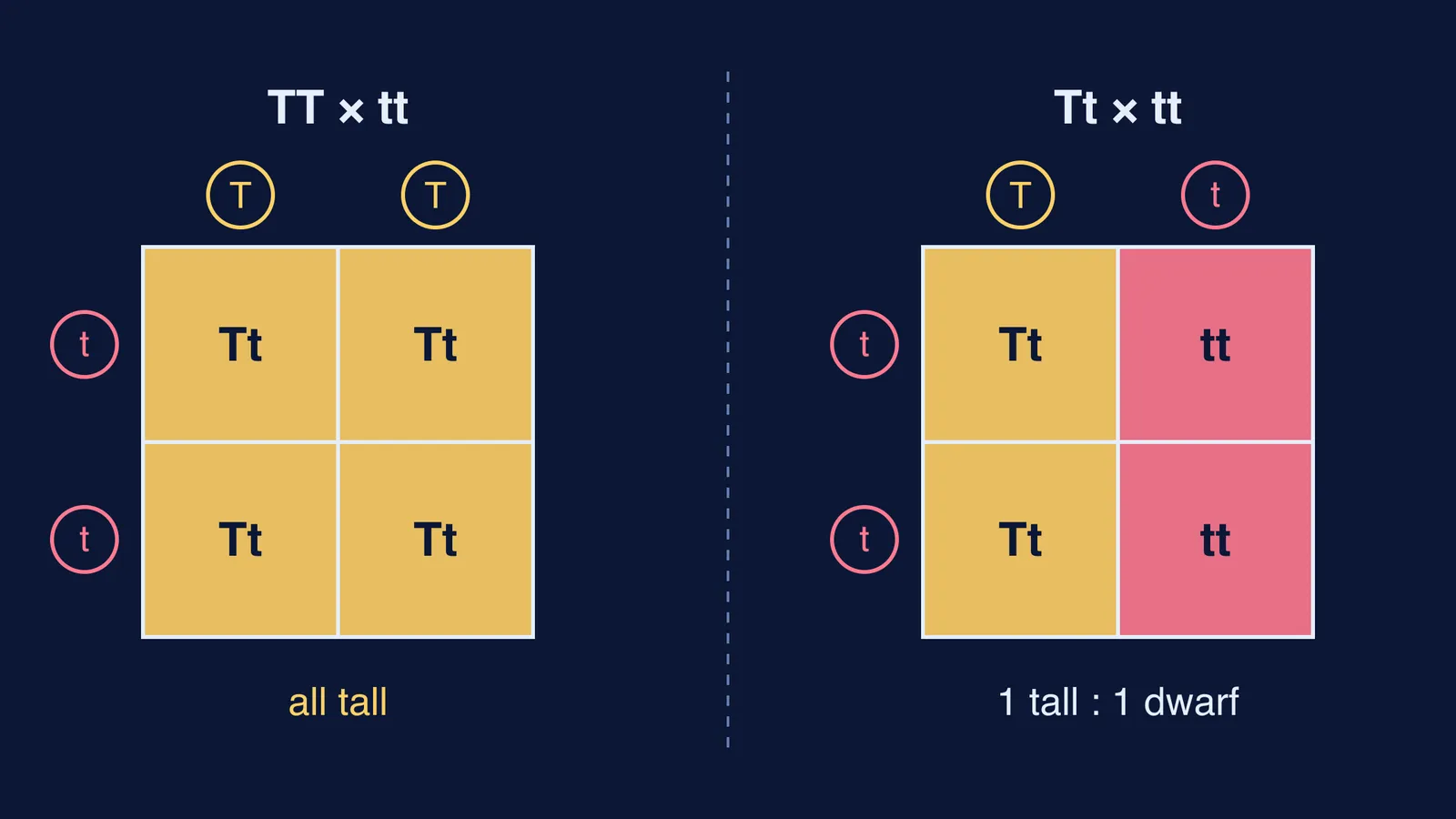
If the unknown is TT, every gamete carries T, so every offspring is Tt and tall.
If the unknown is Tt, half its gametes carry T and half carry t, so offspring are Tt and tt in a 1:1 ratio: half tall, half dwarf.
NCERT's Figure 4.5 runs the same logic with flower colour: violet (W) over white (w).
A numbers check of our own: suppose a test cross gives 20 offspring, 11 tall and 9 dwarf. A dwarf offspring needs a t from the unknown parent, so the plant is Tt; 11 to 9 is 1:1 with chance wobble. If instead all 20 are tall, the plant is almost certainly TT, because a Tt parent would produce 20 tall offspring in a row with probability (1/2) to the power 20, about 1 in a million.
Why cross with tt and not TT? A TT partner gives only T, which would hide every allele from the unknown parent. For how the test cross differs from a back cross, see our test cross vs back cross guide.
A 30-second checklist for exam questions
Write genotypes first, then phenotypes.
Read "true-breeding" or "pure line" as homozygous.
A recessive phenotype gives you the genotype at once: tt.
Test cross result all dominant: unknown is homozygous dominant. Result 1:1: unknown is heterozygous.
Keep the F2 ratios apart: 3:1 for phenotype, 1:2:1 for genotype.
If you set up crosses but keep picking the wrong method, the Fermi Problem Library has worked problems with a step-by-step solver that explains the reasoning rather than printing an answer. For the vocabulary itself, the Fermi Concept Library gives each concept in biology its own lesson and its place in the map, so you can see how allele, genotype and dominance connect.


