

On this page
Gene, allele, locus, genotype and phenotype are not synonyms, and in a multiple-choice question one swapped word can turn a true statement false. Here each gets a one-line definition, then one cross from NCERT Class 12 shows all five at work.
What is the difference between a gene, an allele and a locus?
Gene: the basic unit of inheritance, passed from parents to offspring and carrying the information that specifies a trait (NHGRI glossary).
Locus (plural loci): a physical site in the genome, which the US National Human Genome Research Institute compares to a street address (NHGRI glossary).
Allele: one of two or more versions of the DNA sequence at a given genomic location (NHGRI glossary).
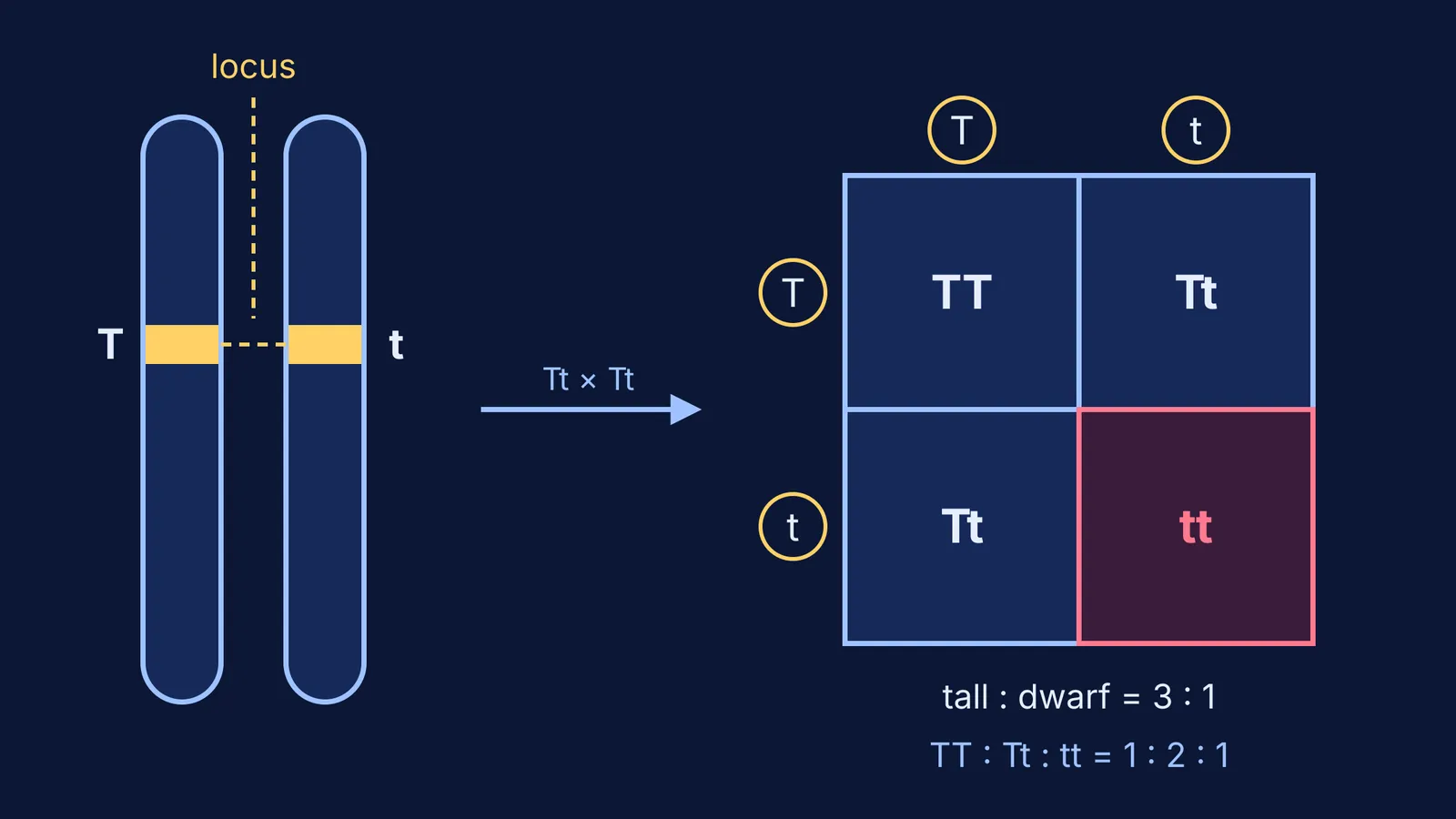
NCERT puts the gene-allele link in exam language: genes which code for a pair of contrasting traits are known as alleles, slightly different forms of the same gene (NCERT Class 12 Biology, Chapter 4). So T (tall) and t (dwarf) are not two genes. They are two alleles of one height gene, and both sit at the same locus on a pair of homologous chromosomes.
What do genotype and phenotype mean?
Genotype is the scoring of which variants an individual has at a locus, written as symbols such as BB, Bb or bb (NHGRI glossary). Phenotype is the observable trait, such as height or blood type, and it depends on both genotype and environment (NHGRI glossary).
In NCERT's wording, TT and tt are the genotype of the plant, while the descriptive terms tall and dwarf are the phenotype (NCERT Class 12 Biology, Chapter 4).
One cross that uses every term
NCERT records that Mendel ran hybridisation experiments on garden peas for seven years (1856-1863) and studied seven pairs of contrasting traits, including tall versus dwarf stems (NCERT Class 12 Biology, Chapter 4). Here is his height cross, with each term labelled.
Parents: true-breeding tall TT crossed with true-breeding dwarf tt. Both parents are homozygous: each carries two identical alleles at the height locus.
Gametes: the alleles segregate during meiosis, so TT makes only T gametes and tt makes only t gametes.
F1: every plant is Tt, which is heterozygous (two different alleles). Every F1 plant is tall, so T is the dominant allele and t is recessive.
F1 selfed: each Tt plant makes T and t gametes in equal proportion.
F2 genotypes: 1/4 TT, 1/2 Tt and 1/4 tt, a genotypic ratio of 1:2:1.
F2 phenotypes: 3/4 tall and 1/4 dwarf, a phenotypic ratio of 3:1, because TT and Tt look the same.
One phenotype, tall, hides two genotypes, TT and Tt. NCERT notes that you cannot tell them apart by looking, which is why Mendel crossed tall F2 plants with dwarf plants, a test cross. Our explainer on test cross versus back cross works through that next step.
Homozygous vs heterozygous and dominant vs recessive: how are they different?
The two pairs answer different questions.
Homozygous or heterozygous describes the genotype: are the two alleles the same or different? Homozygous means the same version from each parent (NHGRI glossary); heterozygous means different versions (NHGRI glossary).
Dominant or recessive describes the relationship between alleles: when the two alleles differ, the dominant one is expressed (NHGRI glossary), and a recessive trait shows only when both copies are the recessive allele (NHGRI glossary).
So tt is homozygous and recessive, TT is homozygous and dominant, and Tt is heterozygous with the dominant phenotype. Homozygous does not mean dominant, and dominant does not mean common or better. Dominance is also not always complete; the exceptions are covered in our post on incomplete dominance, codominance and multiple alleles.
Which swapped terms should you watch for in NEET options?
A wrong option can change a single word and keep the rest true. Check each option against this list.
Gene for allele: T and t are two genes. False; they are two alleles of one gene.
Allele for locus: an allele is a version, a locus is a position. Alleles of one gene share a locus.
Genotype for phenotype: 3:1 is the F2 phenotypic ratio and 1:2:1 the genotypic ratio (NCERT Class 12 Biology, Chapter 4). Swapped ratios are a classic trap.
Homozygous for dominant: a homozygous plant can be tt, and a tall plant can be Tt.
Monohybrid for any tall plant: NCERT calls Tt a monohybrid because it is heterozygous for one character; a true-breeding TT plant is not.
If a definition still feels shaky, the Fermi Concept Library gives each biology concept its own lesson and its place in the map. When the trouble is method rather than words, the Fermi Problem Library has worked problems with a step-by-step solver that explains the reasoning rather than printing an answer.
Next, practise the ratios in our guide to Punnett squares, ratios and traps in NEET genetics.


