On this page
Section A is where a CBSE paper begins, and where it is easy to spend minutes you need later. In the Class 10 Mathematics Standard sample paper for 2026-27, Section A has 18 multiple-choice questions and 2 assertion-reason questions: 20 marks out of 80, in a 3-hour paper. In the Class 12 Physics sample paper for 2026-27, Section A has 12 MCQs and 4 assertion-reason questions: 16 marks out of 70, also in 3 hours.
The Maths Standard marking scheme heads this section "MCQs of 1 Mark each, no part marks". A long answer can still earn method marks when the final number slips. A one-mark question earns 1 or 0, so the aim is accuracy at a steady pace.
How much time should you spend on the MCQ section?
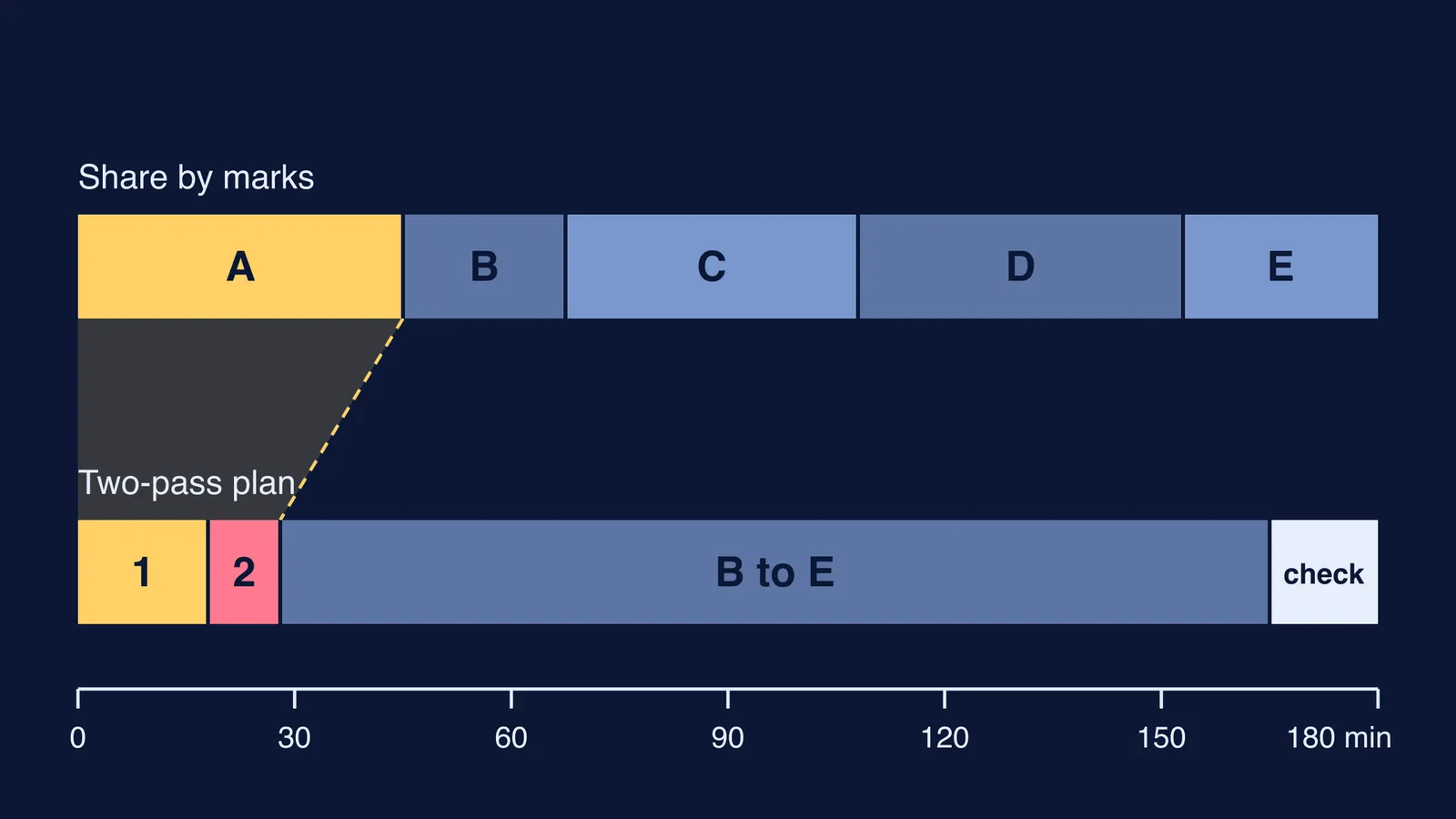
If you split 180 minutes in proportion to marks, Maths Section A (20 of 80 marks in the sample paper) would get 45 minutes and Physics Section A (16 of 70 in its paper) about 41. You should not need that much. Many one-mark questions take only one or two steps, and the minutes you save go to the long answers, where method marks live.
A workable budget:
Maths Standard (20 questions): about 28 minutes, 18 for the first pass and 10 for the second.
Physics Class 12 (16 questions): about 22 minutes, 15 for the first pass and 7 for the second.
Keep 10 to 15 minutes at the end of the whole paper for a final check.
Test these numbers on a sample paper first. Our guide on using the reading time before the paper starts covers what to do before you can write.
Science is laid out differently. In the Class 10 Science sample paper for 2026-27, Section A is Biology, B is Chemistry and C is Physics, and each opens with its own one-mark questions. There, run the two passes at the start of each section, not once at the top.
What is the two-pass method for MCQs?
Pass 1, from the first question to the last:
Read the stem and its last line ("respectively", "incorrect", "is:") before you look at the options.
If you can answer in about a minute, write the answer and move on.
If not, write a best guess, circle the question number, and move on.
Pass 2, straight after:
Return only to the circled questions.
Try a different route: substitute the options, eliminate, check units or a simple value.
When time is up, keep your best answer. Neither the instructions nor the marking scheme mention any deduction for wrong answers, so leave nothing blank.
Changing an answer in pass 2 is fine when you have found a reason. A 2005 paper by Justin Kruger, Derrick Wirtz and Dale Miller reviews earlier research: most answer changes go from incorrect to correct, and people who change answers usually improve their scores. We go further in should you change your answer in an MCQ exam?
Which traps appear in CBSE sample paper MCQs?
From the 2026-27 Maths and Science marking schemes:
Double counting. Maths Q9 asks for numbers from 4 to 99 that are a perfect square or cube. There are 8 squares and 3 cubes, but 64 is both, so the answer is 10/96 = 5/48. Option C, 11/96, counts 64 twice.
A changed sample space. Maths Q18 says 6 cards are missing from the pack. The answer is 13/46, and 13/52 sits right beside it.
Skipping a condition. Maths Q3 wants a line meeting x − y = 6 only at (5, −1). Line I is the same line, so "I and II" is wrong; the answer is II only.
A true reason under a false assertion. In Science Q8 and Q9 the assertions are false and the reasons are true, so both answers are D.5. Two true statements that are not linked. The answer to Science Q24 is B: both are true, but the reason does not explain the assertion.
A trap that catches you twice may point to a gap in the idea rather than carelessness. The Fermi Concept Library has a lesson for every concept in physics, chemistry, biology and mathematics, so you can repair the idea before the next paper.
How do you answer assertion-reason questions quickly?
Judge them in a fixed order. Is A true on its own? Is R true on its own? Only if both are true, read them as "A, because R" and ask whether that sentence holds. In the CBSE option set (A, B, C, D) there is no "both false" choice, so if you judge both statements false, re-read one of them. Our three-check method for assertion-reason questions has more worked examples.
For the questions you got wrong by method rather than by misreading, the Fermi Problem Library has worked problems with a step-by-step solver that explains the reasoning rather than printing an answer.