On this page
An assertion-reason question looks like one multiple-choice question but is really three true-or-false questions stacked together. Marks slip away when you take them out of order or stop after two. Here is a method, two official CBSE examples, the common traps and a short drill.
How are assertion-reason questions marked in boards and NEET?
In CBSE's Class 12 Physics sample question paper for 2025-26, Section A has four assertion-reason questions, Questions 13 to 16, worth 1 mark each. Its options, shortened:
(A) Both true, and R is the correct explanation of A.
(B) Both true, but R is not the correct explanation of A.
(C) A is true but R is false.
(D) Both A and R are false.
There is no option for "A false, R true". Some other question sets use (D) for exactly that, so read the option list first, every time.
In NEET-UG, the NTA Information Bulletin for NEET (UG) 2026 sets the marking for its 180 questions: four marks for a correct answer, minus one for a wrong one, zero if left blank. The same three checks apply to any assertion-reason item there.
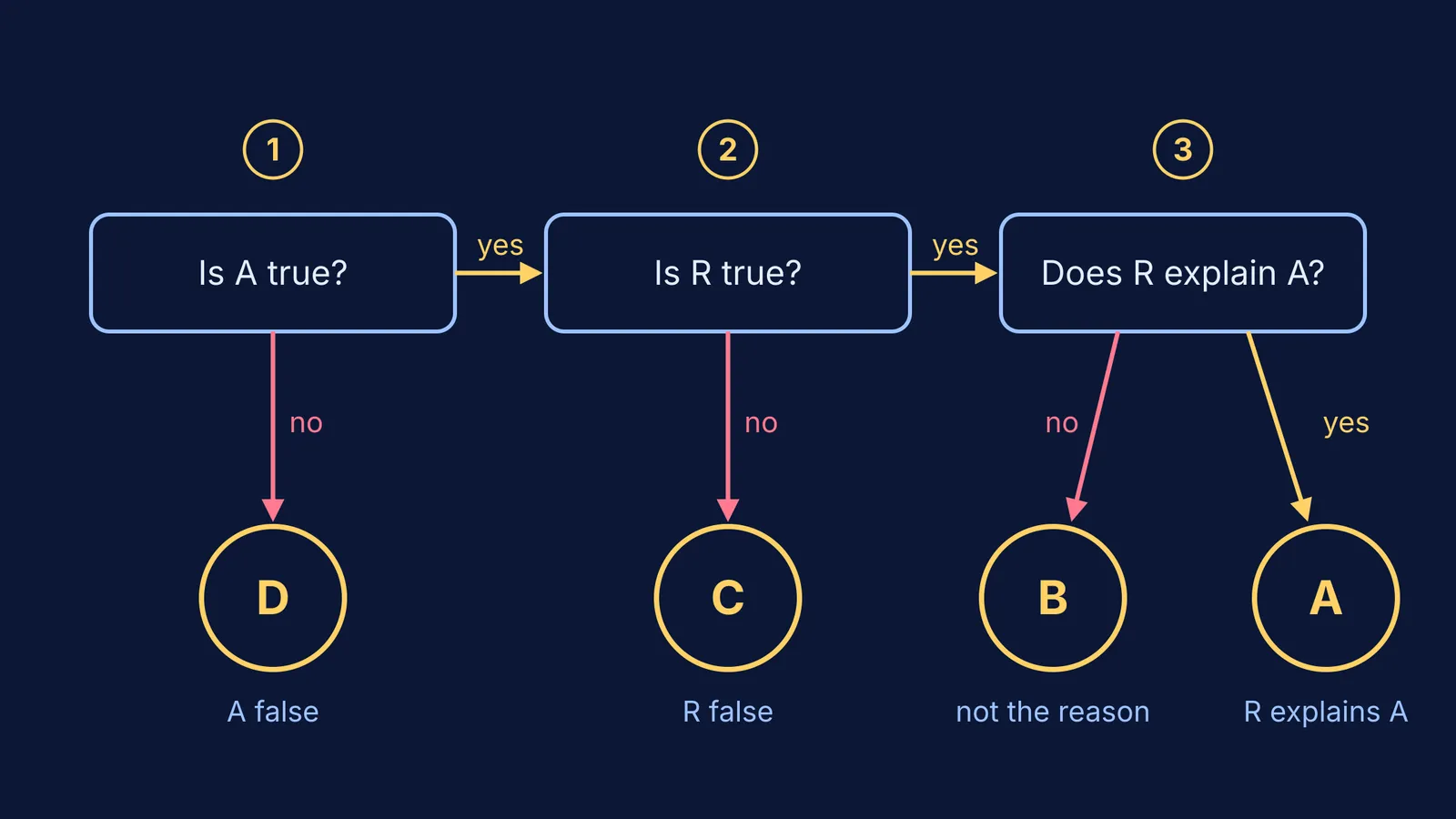
What is the three-check method?
Do the checks in this order, ticking or crossing A and R on the paper as you go.
Check 1: Is the assertion true on its own? Cover the reason and judge A as if R did not exist.
Check 2: Is the reason true on its own? Now cover A. A correct fact unrelated to A is still true.
Check 3: Does R explain A? Only when both are true. Read "A, because R" and ask whether R is the cause or rule behind A, not just a related fact.
If check 1 fails, skip check 3. If A is true and R is false, the answer is (C). Only both-true items need check 3, usually the hardest of the three. There is more on board papers in our guide to assertion-reason questions in CBSE papers.
How does the method work on real board questions?
Both examples come from the same CBSE sample paper, with answers from CBSE's official marking scheme.
Question 14. A: The critical angle of light passing from glass to air is minimum for violet colour. R: The wavelength of blue light is greater than the light of other colours.
Check 1: violet has the highest refractive index in glass, and sin C = 1/n, so its critical angle is smallest. True. Check 2: red, not blue, has the longest visible wavelength. False. Stop: the answer is (C), as in the marking scheme.
Question 16. A: For three point charges to be in equilibrium, they must be collinear. R: One of the three charges must have different polarity than rest of the two.
Checks 1 and 2 both pass. But the marking scheme gives (B), noting that the forces on each charge must be "linearly opposite": the charges lie on one line because the forces on each must act along one line to cancel. The opposite sign is true but does not explain that. This is the classic trap: a true reason beside a true assertion, without being its cause.
What traps should you watch for?
The true-but-unrelated reason. As in Question 16, both are correct lines from the same chapter.
The reversed reason. R is a result of A, not its cause, so "A, because R" sounds wrong.
One absolute word. "Always", "only" or "never" can make a sensible-sounding reason false.
The wrong option list. Check whether (D) means "both false" or "A false, R true" in this paper.
Language load. In a study of assertion-reason tests at an Australian graduate business school, Jeremy Williams reported student reactions suggesting that performance might have more to do with proficiency in English than with deep learning (Assessment and Evaluation in Higher Education, 2006). If you answer in your second language, read these items twice.
Can you try a five-minute practice drill?
Use the four CBSE options above.
A: A ball moving in a circle at constant speed is accelerating. R: The direction of its velocity keeps changing.
A: Mitochondria are called the powerhouse of the cell. R: Mitochondria have their own DNA.
A: Ice floats on water. R: Ice is denser than liquid water.
A: Sound travels faster in a vacuum than in air. R: Sound waves in air are transverse.
A: Noble gases are very unreactive. R: Their outermost electron shells are completely filled.
Answers: 1 (A), 2 (B), 3 (C), 4 (D), 5 (A).
For each miss, note which check failed. If it was check 1 or 2, the gap is a fact: reread the NCERT chapter, or open the Fermi Concept Library, which has a lesson for every concept in physics, chemistry, biology and mathematics. If it was check 3, practise the because test on ten more items, such as these assertion-reason traps in NEET genetics or this set on Class 11 laws of motion.
Keep your list of failed checks: it tells you exactly what to revise next.