

On this page
In CBSE Class 11 physics assessments published by the Central Board of Secondary Education, Assertion-Reason questions in Section A test whether students grasp physical mechanisms rather than rote formulas. Unlike standard numericals where formula substitution masks conceptual gaps, assertion-reason items test whether you can distinguish an isolated fact from a true cause-and-effect link.
Decades of physics education research show why this format challenges students. In a 6,542-student survey across 62 introductory courses in the American Journal of Physics, Richard Hake found that traditional lecture instruction achieved an average normalized conceptual gain of only 0.23 ± 0.04 on mechanics diagnostics like the Force Concept Inventory. As Lillian C. McDermott reported in Physics Today, students often calculate numerical accelerations correctly while retaining persistent misconceptions about force pairs, friction directions, and reference frames.
Why do assertion-reason questions in laws of motion trip students up?
The main obstacle is recognition bias. When students see two statements that sound scientifically true, they reflexively pick Option A without checking whether the Reason actually causes the Assertion.
In CBSE exams, four options govern each question:
Option A: Both statements are true, and Reason correctly explains Assertion.
Option B: Both statements are true, but Reason does not explain Assertion.
Option C: Assertion is true, but Reason is false.
Option D: Assertion is false, but Reason is true.
Selecting the right option requires isolating physical causality from mere factual familiarity.
How do you spot the four reasoning traps in Newton's laws?
Most errors in laws of motion trace to four common traps:
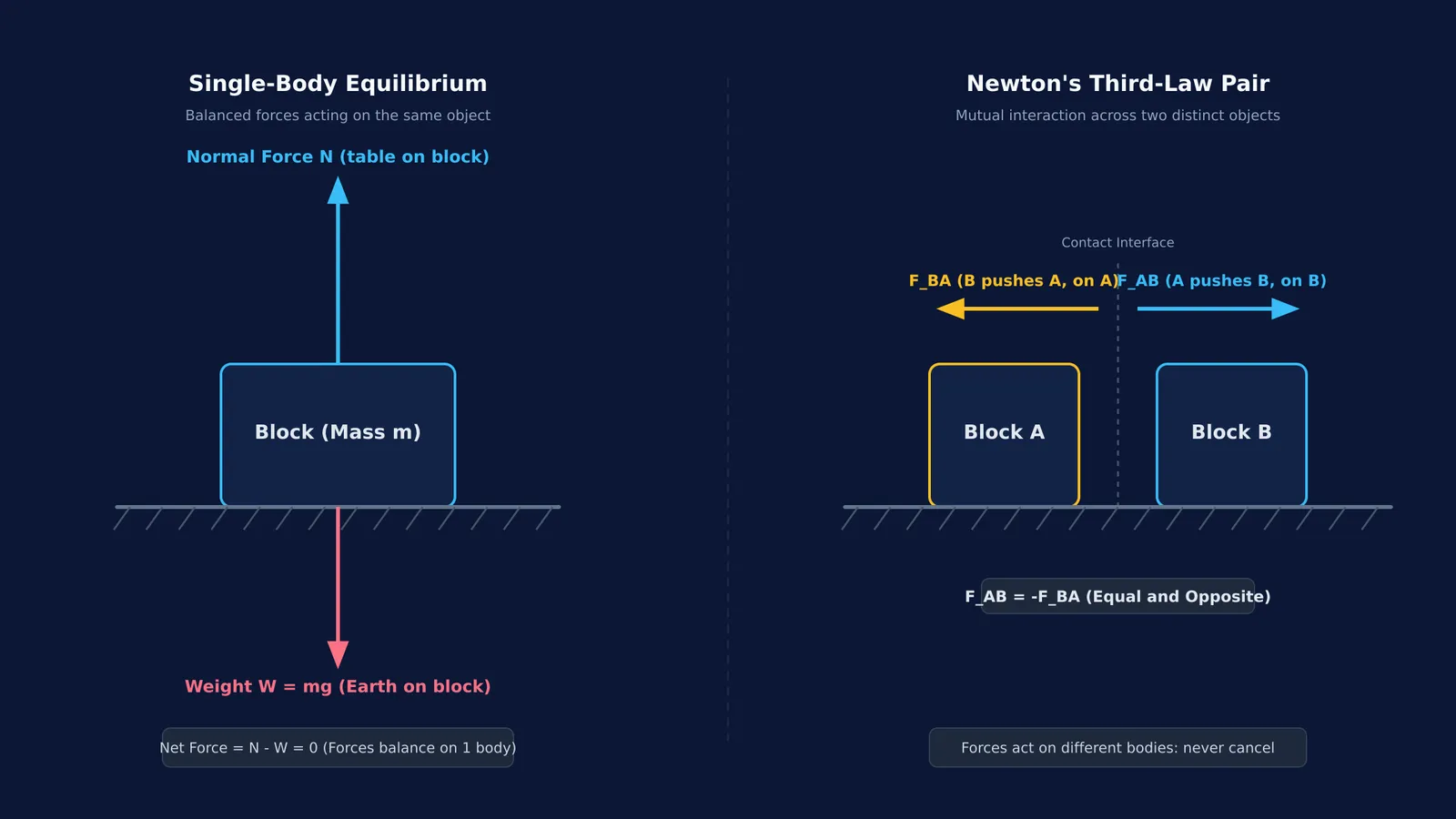
The "Both True, But Unrelated" trap (Action-Reaction cancellation):
Assertion: Action and reaction forces never cancel each other out.
Reason: Action and reaction forces are always equal in magnitude and opposite in direction.
Trap diagnosis: Both statements are true, but Reason does not explain Assertion. Equal and opposite forces on a single body do cancel; action-reaction pairs never cancel because they act on two distinct bodies. Testing with "because" shows Reason is not the explanation. The correct answer is Option B. Review contact forces between accelerated blocks.
The "Hidden Identity" trap (Normal force versus weight):
Assertion: A book resting on a table experiences an upward normal force equal to its downward weight.
Reason: Normal force and weight form an action-reaction pair under Newton's third law.
Trap diagnosis: Assertion is true from vertical equilibrium (ΣF = 0), but Reason is false. The normal force is an electromagnetic contact force from the table, while weight is Earth's gravitational pull. Because they act on the same body and stem from different interactions, they are not a third-law pair. The correct answer is Option C.
The "Direction of Friction" trap (Absolute motion versus relative motion):
Assertion: Friction acting on an object always opposes its motion.
Reason: Friction opposes relative motion between contacting surfaces.
Trap diagnosis: Reason is true, but Assertion is false. Friction opposes relative sliding between surfaces, not motion through space. When walking, static friction pushes forward on your shoe; on an accelerating truck, static friction propels the cargo forward. The correct answer is Option D. Review static and kinetic friction on blocks.
The "Non-Inertial Frame" trap (Real forces versus pseudo forces):
Assertion: In an accelerating carriage, an observer must introduce a pseudo force opposite to acceleration to apply Newton's second law.
Reason: Pseudo forces arise from physical contact between observer and object.
Trap diagnosis: Assertion is true, but Reason is false. Pseudo forces have no physical agent, contact origin, or third-law partner; they arise purely from the accelerating frame. The correct answer is Option C. Explore solving mechanics problems with pseudo forces.
What is a reliable step-by-step protocol for Class 11 exams?
To solve assertion-reason questions accurately under exam conditions, use this four-step protocol:
Evaluate Assertion independently: Determine if it is physically true or contains sweeping claims (such as friction always opposing motion). If false, choose Option D.
Evaluate Reason independently: Check Reason in isolation. If it contradicts core physical principles or invents contact mechanisms, choose Option C.
Apply the "Because Test": If both are true, join them with "because". Does the principle in Reason logically necessitate the specific Assertion? If not, choose Option B.
Verify agent-object pairs: Identify which body exerts each force and which receives it. Action-reaction pairs always act on opposite bodies (FAB and FBA). If both forces act on one mass, they are single-body equilibrium forces.
How should you evaluate inertia, friction, and force pairs?
Mastering assertion-reason questions requires active practice that tests conceptual reasoning rather than memorizing answer keys. When working through complex mechanics scenarios, the Fermi Problem Library provides worked problems with a step-by-step solver that explains the reasoning rather than printing an answer.
To see how static friction changes direction or how apparent weight shifts in an accelerated frame, the Fermi Simulation Lab offers interactive simulations for the ideas that are easier to see than to read. To verify definitions across mechanics, the Fermi Concept Library covers every concept in physics with its own lesson and its place in the map.


