

On this page
You ticked (B). Twenty minutes later, (C) looks better. A familiar voice says ‘your first instinct is usually right’. Research says that advice is mostly wrong, though not completely.
Is your first instinct usually right in an MCQ exam?
On average, no. In a study published in 2005, Justin Kruger, Derrick Wirtz and Dale Miller had trained judges check the Fall 2000 midterm exams of 1,561 University of Illinois introductory psychology students for eraser marks (Kruger, Wirtz and Miller, Journal of Personality and Social Psychology, 2005).
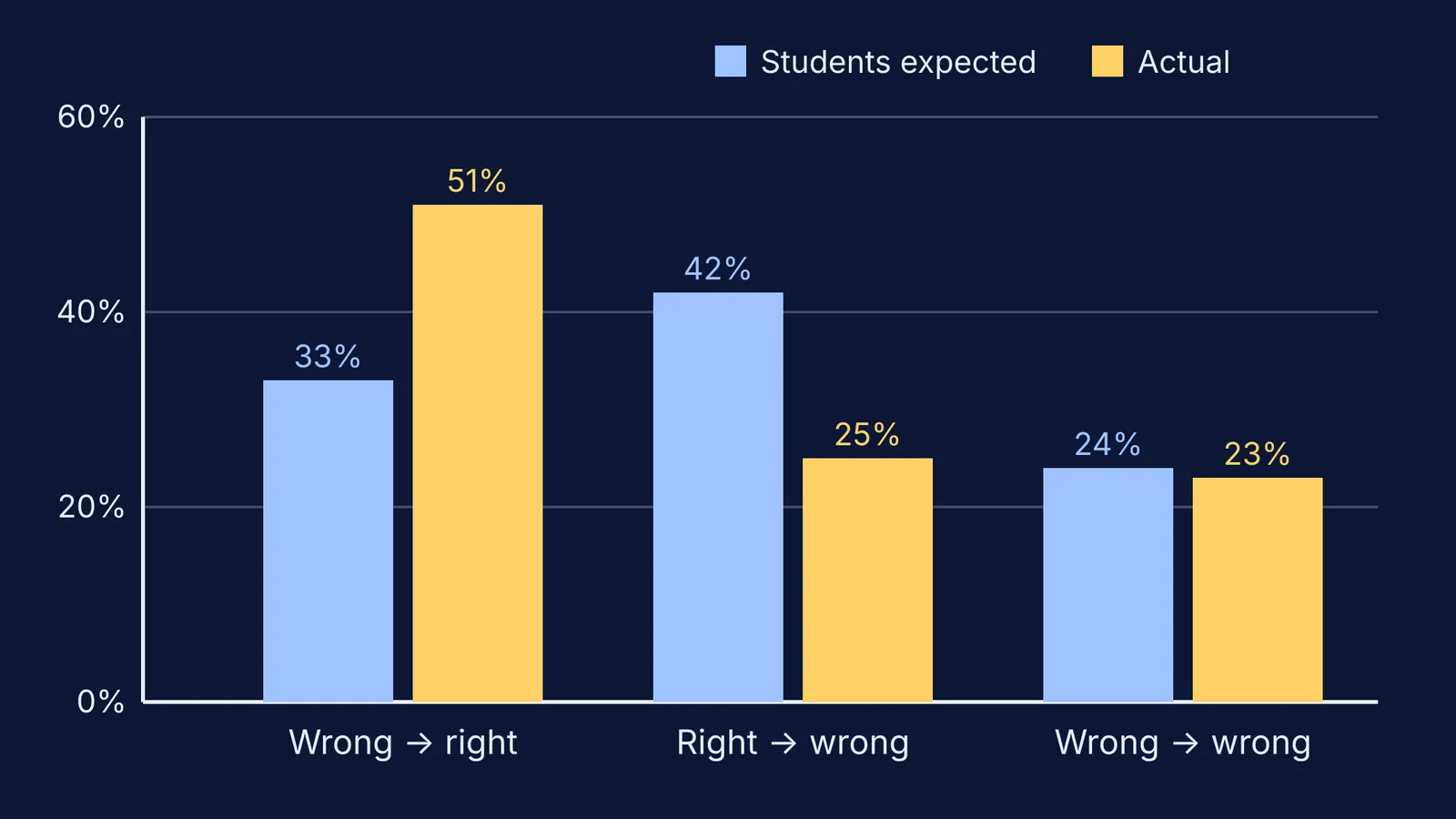
Of the 3,291 answers students changed, 51% went from wrong to right, 25% from right to wrong and 23% from one wrong answer to another (full paper, PDF).
Among students who changed at least one answer, 54% gained marks from their changes and 19% lost marks; the rest broke even. The same paper cites an earlier review of 33 studies (Benjamin and colleagues, 1984) that found not one in which test takers were hurt, on average, by changing answers.
A 2026 study points the same way. In the larger of its two experiments, 298 undergraduates answered multiple-choice questions on a geology text they had studied; 55.5% of revised responses went from wrong to right and 23.4% from right to wrong (Hardy and colleagues, Behavioral Sciences, 2026).
Why does changing an answer feel so risky?
Kruger’s team asked 51 of the students what they believed, and 75% said their original answer was more likely to be correct even when another option seemed better (Kruger, Wirtz and Miller, 2005).
Their explanation is regret. Changing a right answer to a wrong one brings a sharp ‘if only I had left it’ feeling, stronger than the regret of failing to fix a wrong answer. The painful switches are more memorable, so they seem more common than they are.
When should you change an answer, and when should you stick?
Your confidence at the moment of answering is a useful guide. Justin Couchman and colleagues had college students rate their confidence on each question during a real exam and note any revisions (Couchman and colleagues, Metacognition and Learning, 2016).
They found that both revising and sticking produced more correct than incorrect outcomes, and that these question-by-question confidence ratings predicted when each choice was most appropriate. Students’ general beliefs about the exam, formed afterwards, were poor guides.
The 2026 study adds a matching detail: the more confident students felt about an answer, the less likely they were to revise it (Hardy and colleagues, 2026).
A caution: these studies involve university students, mostly in the US, and describe averages, not any single question.
How to use this on exam day: flag, don’t flip
On the first pass, sort each answer: sure, unsure or guess. Use the mark-for-review button in a computer-based test, or a margin dot on paper.
Leave ‘sure’ answers alone on review unless you spot a concrete error, such as a missed ‘not’ in the question.
At the end of the paper, go back to the flagged questions with fresh eyes.
Change an answer only if you can name the reason in one line: ‘I read the question wrong’, ‘I recalculated and got 2.4, not 24’, ‘a later question reminded me of the fact’.
If the only reason is that another option ‘looks nicer now’, keep your first answer and move on.
Practise this in full-length mocks, using our guide to NTA’s official mock tests for JEE Main and NEET.
How does negative marking change the decision?
Say a paper gives +4 for a correct answer and −1 for a wrong one. Check your own exam’s current scheme in its official information bulletin on the National Testing Agency website.
Question 37: you ticked (A) and flagged it ‘unsure’. On review you notice the question asks for kinetic energy, but you worked out momentum. Redoing it gives (C). You have a named reason, so you switch.
Question 52: you ticked (B) and flagged it ‘guess’. Now (D) feels better, but nothing new has come to mind. With no named reason, leave it.
With this scoring, a switch that turns a wrong answer right gains 5 marks (from −1 to +4), and one that turns a right answer wrong loses 5. The reason behind a change matters more than the change.
What if your review keeps finding the same mistakes?
Many review-time catches are fast-thinking slips, explained in our piece on Kahneman’s fast and slow thinking and careless exam errors. If your confidence ratings often turn out wrong, read why students misjudge their own learning.
If the same wrong method keeps showing up, practise similar questions in the Fermi Problem Library, where a step-by-step solver explains the reasoning rather than printing an answer, so you can see where your method went off track.
In your next mock, flag as you go, and change only what you can explain.


