On this page
CBSE gives you 15 minutes to read the question paper before you may write a word: its Circular 29/2005 set papers to be handed out at 10:15 a.m., with writing from 10:30 a.m. The Class 10 Mathematics Standard sample paper for 2026-27 then allows 3 hours for 80 marks. The same circular noted that students often start writing at once, "without adequate planning", out of fear of running short of time. The fix is a plan for splitting the minutes. Here is one you can carry into the hall.
How many minutes should you spend per mark in a board exam?
Start with one sum. Take the writing time, keep a slice for checking, and divide the rest by the total marks.
For the 80-mark, 3-hour paper in CBSE's 2026-27 sample paper, 180 minutes minus 20 for checking leaves 160 minutes, which is 2 minutes per mark.
Then adjust. One-mark MCQs usually take less than two minutes, so they give time back. Case studies make you read a passage first, and five-mark answers need full working or a figure, so they get a little more. The total stays at 160.
What does a minute budget look like for an 80-mark paper?
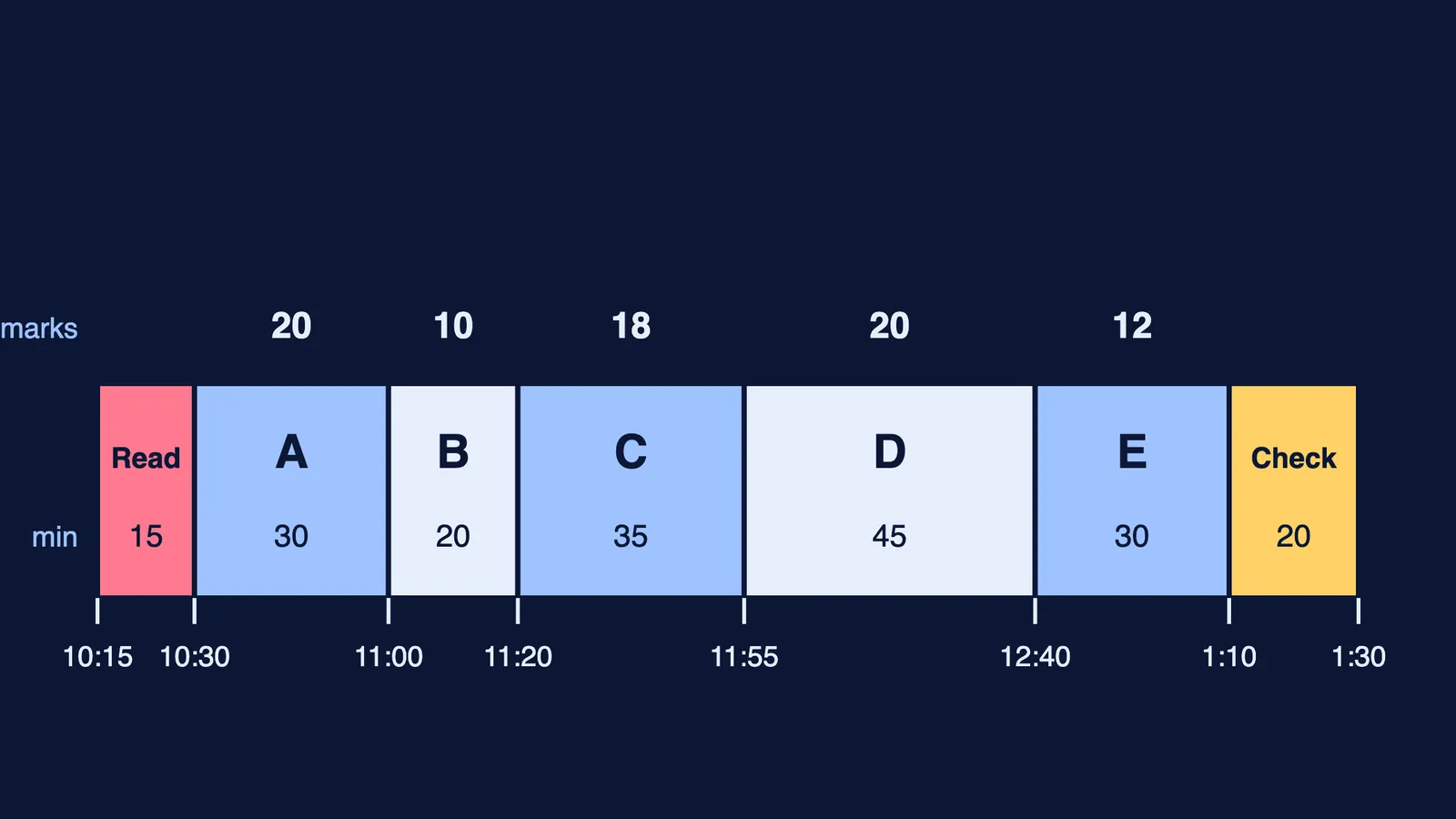
The 2026-27 Maths Standard sample paper has 38 questions in five sections. Here the budget starts from 2 minutes a mark and moves time from the MCQs to the long answers and case studies, with clock times to check against the hall clock:
Section A, 20 one-mark questions (18 MCQs and 2 assertion-reason), 20 marks: 30 minutes, 10:30 to 11:00, about 1.5 minutes each.
Section B, 5 two-mark questions, 10 marks: 20 minutes, 11:00 to 11:20, 4 minutes each.
Section C, 6 three-mark questions, 18 marks: 35 minutes, 11:20 to 11:55, about 6 minutes each.
Section D, 4 five-mark questions, 20 marks: 45 minutes, 11:55 to 12:40, about 11 minutes each.
Section E, 3 four-mark case studies, 12 marks: 30 minutes, 12:40 to 1:10, 10 minutes each.
Checking: 20 minutes, 1:10 to 1:30.
You do not need to remember all of it. Remember three times.
How should you use the 15-minute reading time?
The CBSE circular says this time is exclusively for reading and understanding the paper, not for writing answers. Follow your invigilator, and if your admit card or date sheet gives different timings, those win.
Minutes 1 to 4: read Section A quickly and notice which questions you can answer at sight.
Minutes 5 to 10: read Sections D and E carefully, and make your internal-choice decisions now so you never read both options twice.
Minutes 11 to 15: decide which question you will start with and the first line you will write.
Starting with a question you know well settles nerves. Whatever order you choose, keep the section budgets the same and number every answer exactly as it appears on the paper.
What should you do when one question eats your time?
Give every question a cap: its budget plus one minute. When you hit the cap, write down the steps you have, leave space below, and move on. Come back in the checking slot.
Unfinished working is not wasted. In CBSE's 2026-27 Maths Standard marking scheme, two-mark answers are split into half-mark and one-mark steps, so the first correct lines earn marks before the final answer does.
If your long answers keep running over in practice, the method is usually slower than it needs to be. When you go back over a slow question, the Fermi Problem Library has a step-by-step solver that explains the reasoning, so you can see which step cost you the minutes. For setting out answers an examiner can follow, try our 4-step plan for writing better answers in school exams and the 20-minute board answer-writing drill.
How do you adapt the budget to other papers?
CBSE publishes sample papers and marking schemes subject by subject on its academic website. Read the marks and sections on yours, then use the same sum. A paper with 70 theory marks gives 160 divided by 70, about 2.3 minutes per mark. Give MCQs a little less and case studies a little more, as above. Case studies reward a careful first read, and our guide to answering case-based questions in CBSE board exams covers that part.
Then test the budget once at home. Sit a full sample paper from 10:30 to 1:30 and note where you are at each checkpoint. A parent can help by keeping time and saying only the checkpoint times aloud, nothing else. If a checkpoint keeps slipping because of one or two chapters, Fermi's AI tutor can work out what you already know and build a plan for the session, so revision goes where the minutes are leaking.
Tonight, write your three checkpoints on a card and practise with them until they feel automatic.