On this page
In the CBSE Class 10 Mathematics Standard sample paper for 2026-27, Section E has three case-study-based questions of 4 marks each, so 12 of the 80 marks depend on them. The Class 12 Physics, Chemistry and Biology sample papers each have two 4-mark case-based questions in Section D. Each says the design is unchanged for 2026-27.
What is a case-based question in CBSE?
A case-based question is a short passage, table, graph or diagram set in a real situation, followed by sub-questions on one or two chapters. The Class 10 Science question paper design for 2026-27 lists "Source-based/ Case-based/ Passage-based/ Integrated assessment questions" as a question type. The same page weights the paper 50% knowledge and understanding, 30% application, and 20% formulating, analysing, evaluating and creating.
The sample papers show how a case is built:
A story with a few useful facts. A sanitiser company, a garden, a door lock: most of the text is setting, and one or two numbers or a figure carry the marks.
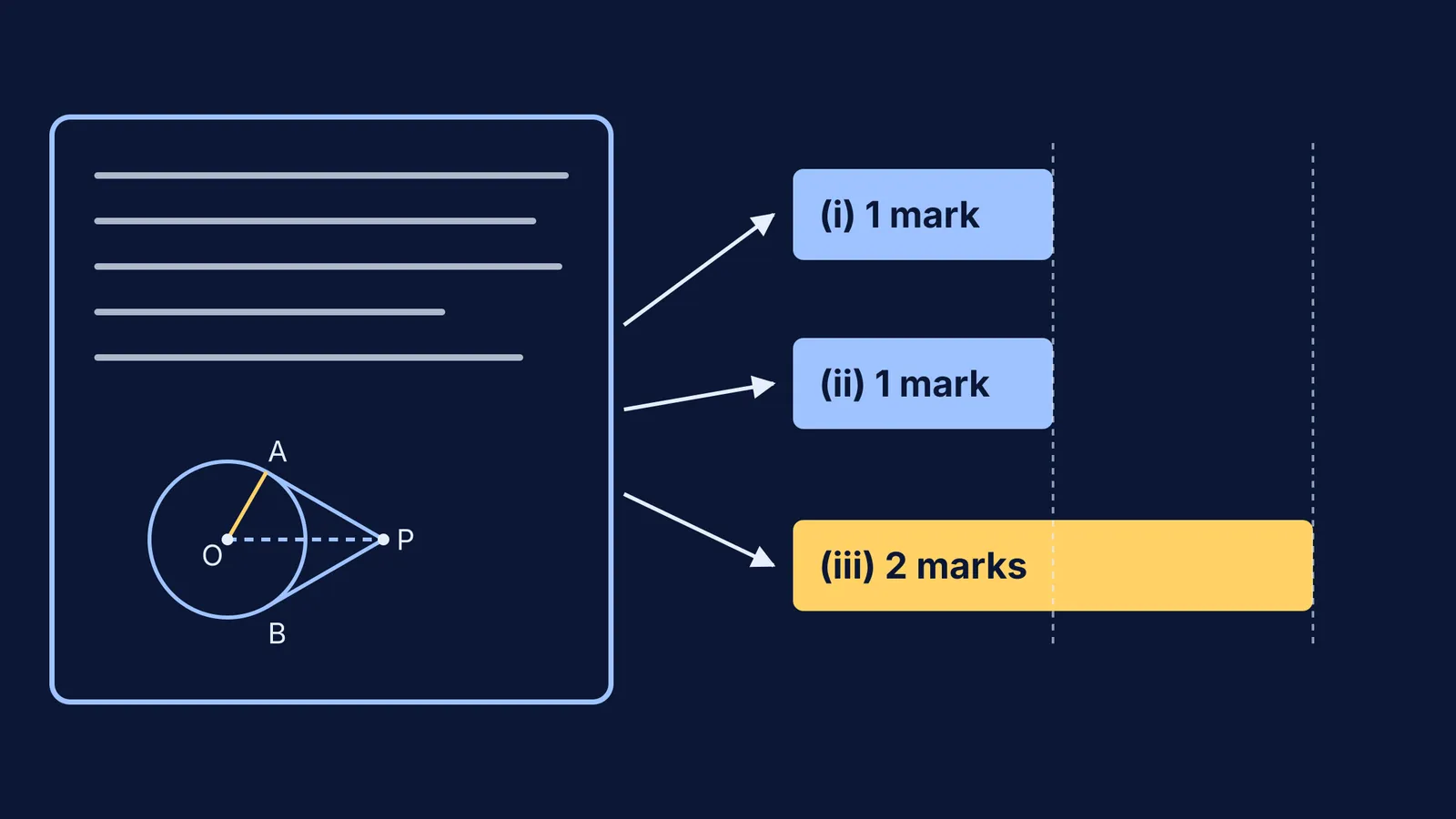
A ladder of sub-parts. In Class 10 Maths and Science the parts are worth 1, 1 and 2 marks, and the 2-mark part offers a choice of two options: (A) or (B) in Maths, C or D in Science.
A doorway into the chapter. In Class 12 Physics, Question 29 is a passage on flexible polymer semiconductors with four 1-mark parts.The answers come from your semiconductors chapter (band gaps, electrons and holes), not from the passage.
How do you answer case-based questions step by step?
Use this read-then-answer method on every case:
Read the sub-questions first. Note the marks beside each one.
Read the passage with a pen. Underline every number and unit. Circle condition words such as "equal length and thickness".
Name the chapter in the margin for each part: tangents means Circles, a grouped table means Statistics.
Match the verb to the depth. CBSE's suggestive verbs put state, name, identify and define under knowledge; calculate, explain and distinguish under application; and interpret, analyze, compare and evaluate under the analysis level. A 1-mark "identify" needs one line; a 2-mark "justify" needs a claim and a reason.
Reuse earlier answers. Part (iii) often builds on (i) or (ii).
What does a full-marks answer to a case look like?
Question 37 of the Class 10 Maths sample paper describes a circular garden of radius 9 m, with a point P 18 m from the centre O and tangents PA and PB.
(i) Angle OAP = 90°, because a tangent is perpendicular to the radius at the point of contact.
(ii) PA = √(18² − 9²) = √243 = 9√3 m.
(iii)(A) cos(angle AOP) = 9/18 = 1/2, so angle AOP = 60° and angle AOB = 120°.
In the official marking scheme, part (iii)(A) gives 1 mark for the cosine step, half a mark for 60° and half a mark for 120°. A bare "120°" earns only part of the 2 marks.
What do examiners look for in each subject?
Maths: write the theorem or formula, then substitute. In Question 38 (iii)(A) of the marking scheme, the correct frequency table alone earns 1 of the 2 marks.
Class 10 Science: read graphs from the axis. In Question 28 of the Science sample paper, the candle on the silver rod falls first, at 10 s, so silver conducts heat best. For "how and why" parts, the Science marking scheme answer states the effect (the time increases, the order stays the same) and the reason (heat travels a longer distance).
Class 12 Chemistry and Biology: the Chemistry paper does not allow log tables or calculators, so practise case arithmetic by hand. The Biology paper asks for neat, properly labelled diagrams wherever needed.
For more on reading schemes, see our guide to using CBSE marking schemes to write answers that earn marks. For physics practice, try these case-study questions on electrostatics.
How should you practise case-based questions before the boards?
The Class 10 Maths paper gives 3 hours for 80 marks, about 2¼ minutes a mark (sample paper), so aim for about 9 minutes per 4-mark case. A four-week plan:
Week 1: solve the sample-paper cases untimed with the five steps, then mark yourself with the official scheme.
Week 2: repeat with a 9-minute timer per case.
Week 3: turn an NCERT exercise into your own case with 1, 1 and 2-mark parts, and swap with a friend.
Week 4: full papers, plus an error log with three columns: misread data, wrong concept, lost steps.
If your log fills up with wrong methods, the Fermi Problem Library has worked problems with a step-by-step solver that explains the reasoning. If the column that grows is wrong concept, the Fermi Concept Library has a lesson for each concept in physics, chemistry, biology and mathematics.
For the wider picture, read our explainer on CBSE competency-based and case-based questions.