

On this page
A case-based question gives you a paragraph of physics and then short questions about it. In electrostatics, the paragraph is usually a capacitor being charged, a dielectric slab sliding in, or a charged metal sphere. The common slip is using the right formula for the wrong situation. The fix: work out the answer from the passage first, and only then look at the options.
What do case-based questions on electric charges and capacitors look like?
The CBSE Class 12 Physics sample question paper for 2026-27 has 33 questions for 70 marks in 3 hours. Its Section D contains two case study-based questions of four marks each. Each case has four 1-mark sub-parts, and not all are multiple choice: one asks "How will you use the concept of majority and minority carriers..." with no options at all, and two photoelectric sub-parts have none either. The paper notes no change in question paper design for 2026-27.
The two sample cases are on semiconductors and the photoelectric effect, but electrostatics appears elsewhere in the paper: a Gaussian flux question, capacitor combinations and a charged-sphere numerical. Any of these topics could be set as a case passage.
Why pick the formula before reading the options?
Wrong options are often not random. Many match the answer a common slip would produce, such as treating a disconnected capacitor as if the battery were still attached. Read them first and a familiar number can pull you in.
A meta-analysis of the generation effect by Bertsch and colleagues pooled 86 studies and found that material people generated was remembered better than material they only read, with an average effect size of .40, almost half a standard deviation. Predicting first makes practice an act of generation, not recognition. It is also why memorising physics formulas on their own tends to fail: a formula only helps when you know which situation it belongs to.
A four-step routine for any electrostatics passage
Name the object. Is it an isolated sphere, a parallel-plate capacitor, or a combination?
Find what is held fixed. Battery still connected means voltage V is fixed. Battery disconnected means charge Q is fixed.
Write the formula and predict the answer: a number, or just "increases, decreases, stays the same".
Now read the options. If none matches, recheck step 2 before your arithmetic.
For step 3, the formulas passages lean on most:
Isolated sphere of radius R: C = 4πε₀R and V = kQ/R, so the field just outside the surface is E = V/R.
Parallel plates with a dielectric of constant K filling the gap: C = Kε₀A/d.
Battery connected: Q = CV changes when C changes.
Battery disconnected: V = Q/C and U = Q²/2C, with Q unchanged.
Worked example: a capacitor passage answered before the options
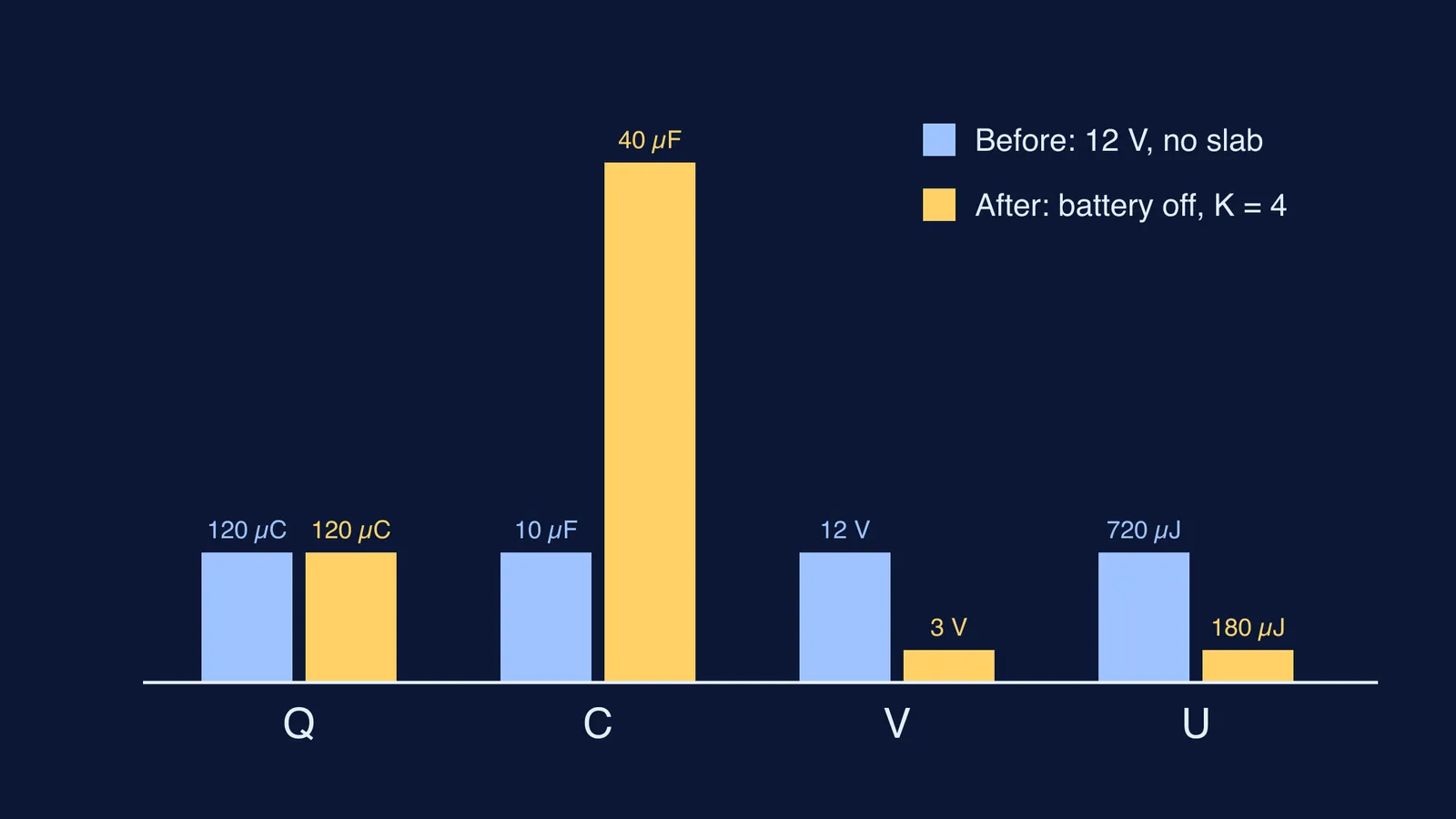
The passage: a 10 µF parallel-plate capacitor is charged by a 12 V battery. The battery is then disconnected, and a slab of dielectric constant 4 is slid in to fill the gap completely.
Charge stored: Q = CV = 10 µF × 12 V = 120 µC.
New voltage: C becomes 4 × 10 = 40 µF. The battery is gone, so Q stays 120 µC and V = Q/C = 3 V.
Energy: before, U = ½CV² = ½ × 10 µF × 144 = 720 µJ. After, U = Q²/2C = 180 µJ. It falls by the factor K.
Field: E = V/d, so E also falls to a quarter.
Now read the options. 48 V is what you get by multiplying by K instead of dividing. 2880 µJ is the energy if the battery had stayed connected (½ × 40 µF × 144). Our posts on why half the energy is lost when charging a capacitor and finding the charge that flows when a switch closes use the same Q-or-V reasoning. For more passages like this, the Fermi Problem Library has worked problems with a step-by-step solver that explains the reasoning rather than printing an answer.
How do you answer a charged-sphere sub-part?
In Section E of the 2026-27 sample paper, a small metallic sphere is charged in open air, air breaks down when the field at its surface reaches 2.5 × 10⁶ V/m, and the sphere may reach a maximum potential of 5 × 10⁵ V without discharge. What is its minimum radius? Name the object (isolated sphere), use E = V/R at the surface, and R = V/E = 0.2 m. The official marking scheme reaches 0.2 m in four lines worth half a mark each, so the written formula earns marks, not just the final number.
The same scheme explains why an isolated conductor cannot have a large capacitance: C = 4πε₀R, so a large C needs an impractically large sphere. If the idea itself is shaky, the Fermi Concept Library gives each physics concept its own lesson.
Once naming the fixed quantity becomes automatic, the options become checks on your answer, not guesses.


