On this page
If you have spent months on JEE mock tests, you have trained one habit very well: find the answer, mark the option, move on. Board papers pay for something else.
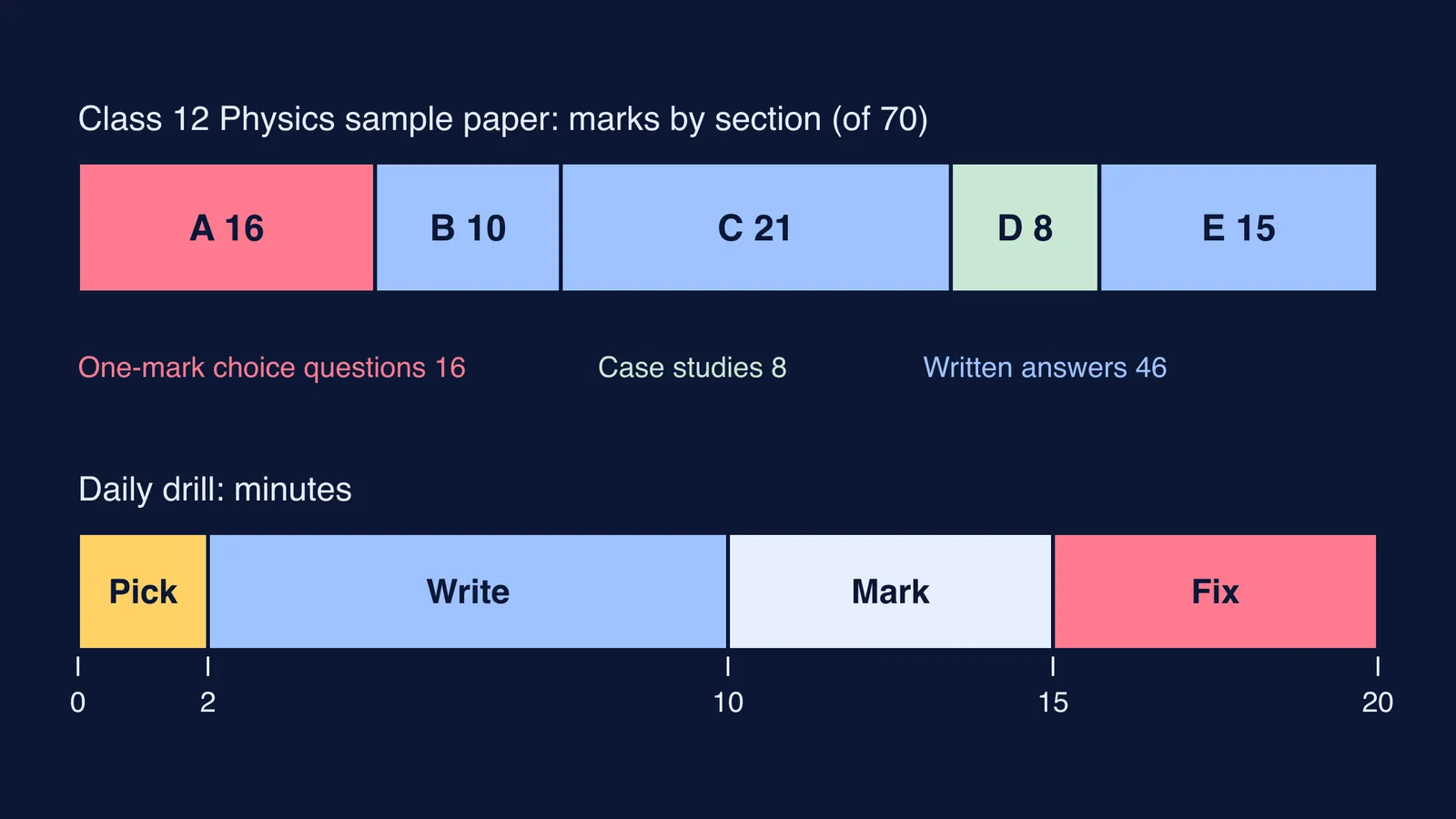
In the CBSE Class 12 Physics sample question paper for 2026-27, Section A has 16 one-mark questions (twelve MCQs and four assertion-reason). Sections B, C and E hold 15 questions that need fully written answers, worth 46 of the 70 marks. The two Section D case studies mix multiple-choice parts with short written ones.
Why does MCQ practice hurt board answer writing?
Three things fade when you only pick options. Each one shows up in the official marking scheme for that Physics paper.
Steps. In an MCQ, your working stays in your head or on rough paper. In the marking scheme, a 2-mark question on the work done to bring a charge from infinity to the midpoint between two charges is split into four half-marks, one for each line of working. The final line on its own carries half a mark.
Words. MCQ options do the explaining for you. The 2-mark question on Gauss's law for magnetism gives 1 mark for the statement and half a mark each for two points about its significance.
Pace. The sample paper allows 3 hours for 70 marks, which works out to about two and a half minutes per mark, reading and checking included. Out of practice, it is easy to rush long answers or overrun.
There is also a memory reason to practise by writing. In a 2007 study by Sean Kang, Kathleen McDermott and Henry Roediger, participants who took short-answer quizzes with corrective feedback did best on a final test three days later, ahead of those who took multiple-choice quizzes or simply read the facts again. Without feedback, the multiple-choice quiz did better than the short-answer one.
The lesson for you: writing helps most when you check it against something. The CBSE marking scheme is that something.
How should a JEE student practise writing answers for boards?
Use one 20-minute drill a day, after your JEE work rather than instead of it. You need a timer, blank sheets, and past papers or sample papers with marking schemes from CBSE Academic's sample paper page.
Minutes 0 to 2, pick and budget. Choose one 3-mark question. Write your time budget at the top: marks times two and a half minutes, so about 8 minutes.
Minutes 2 to 10, write with the book closed. Given data, formula, substitution, result with unit, and one line of reasoning. Label any diagram.
Minutes 10 to 15, mark yourself with the official scheme. Tick each half-mark you earned and circle each one you skipped. Total it honestly.
Minutes 15 to 20, fix. Rewrite only the circled steps. Then add one line to a missed-steps log: what you skipped and why, such as "no unit" or "jumped from formula to answer".
Rotate Physics, Chemistry and Maths through the week. Our guide on how to read and use a CBSE marking scheme shows how to spot the value points.
What does a board-style answer look like next to an MCQ answer?
Take that 2-mark question again: two charges of +q a distance d apart, and the work done to bring another charge +q from infinity to the point midway between them. In MCQ mode you write one line, W = 4kq²/d, and move on. In board mode you write four lines, each worth half a mark in the marking scheme:
Distance of each charge from the midpoint = d/2
Potential due to one charge, V₁ = kq/(d/2) = 2kq/d
Potential due to both charges, V = 2 × 2kq/d = 4kq/d
Work done, W = qV = 4kq²/d
Same physics, about a minute more, and under the scheme up to one and a half extra marks. For more on layout, see our board exam answer presentation tips.
If your circled steps keep showing the same wrong method rather than a skipped line, the Fermi Problem Library has worked problems with a step-by-step solver that explains the reasoning rather than printing an answer.
How do you fit this around JEE preparation?
Until December: one drill a day is enough, and it leaves most of your study time for JEE.
From January: add a second drill on 5-mark long answers (about 13 minutes of writing), and one full timed board paper a week.
Every Sunday: read your missed-steps log and pick one habit to fix next week.
Our plan for preparing for boards and JEE together covers the bigger timetable.
Start tonight with one 3-mark question from the sample paper, a timer set to 8 minutes, and the marking scheme face down until the timer rings.