

On this page
Many students know the material well but still lose marks in board exams because their answers are hard to read or skip crucial working steps. You do not need to be an expert in physics or maths to help your child fix this. By reviewing the physical presentation of their practice papers, you can help them secure all the marks they have earned.
Why does answer presentation affect board exam scores?
It is tempting to think that in a subject like science or mathematics, a correct answer is all that matters. However, research consistently shows that physical presentation strongly influences the examiner's judgement.
A 2011 review by Steve Graham and colleagues (Focus on Exceptional Children) found a significant grading bias against messy handwriting. Graders experience micro-frustrations when decoding messy text, leading them to subconsciously penalize the student's work regardless of the content's actual quality.
While your child cannot completely change their handwriting weeks before an exam, they can ensure their words are legible, spaced evenly and written without excessive scribbling.
How do step marking policies work in board exams?
The Central Board of Secondary Education (CBSE) and other state boards use a step-marking system. This means students are awarded partial marks for every correct logical step they write down, even if their final calculation is wrong (CBSE Academic).
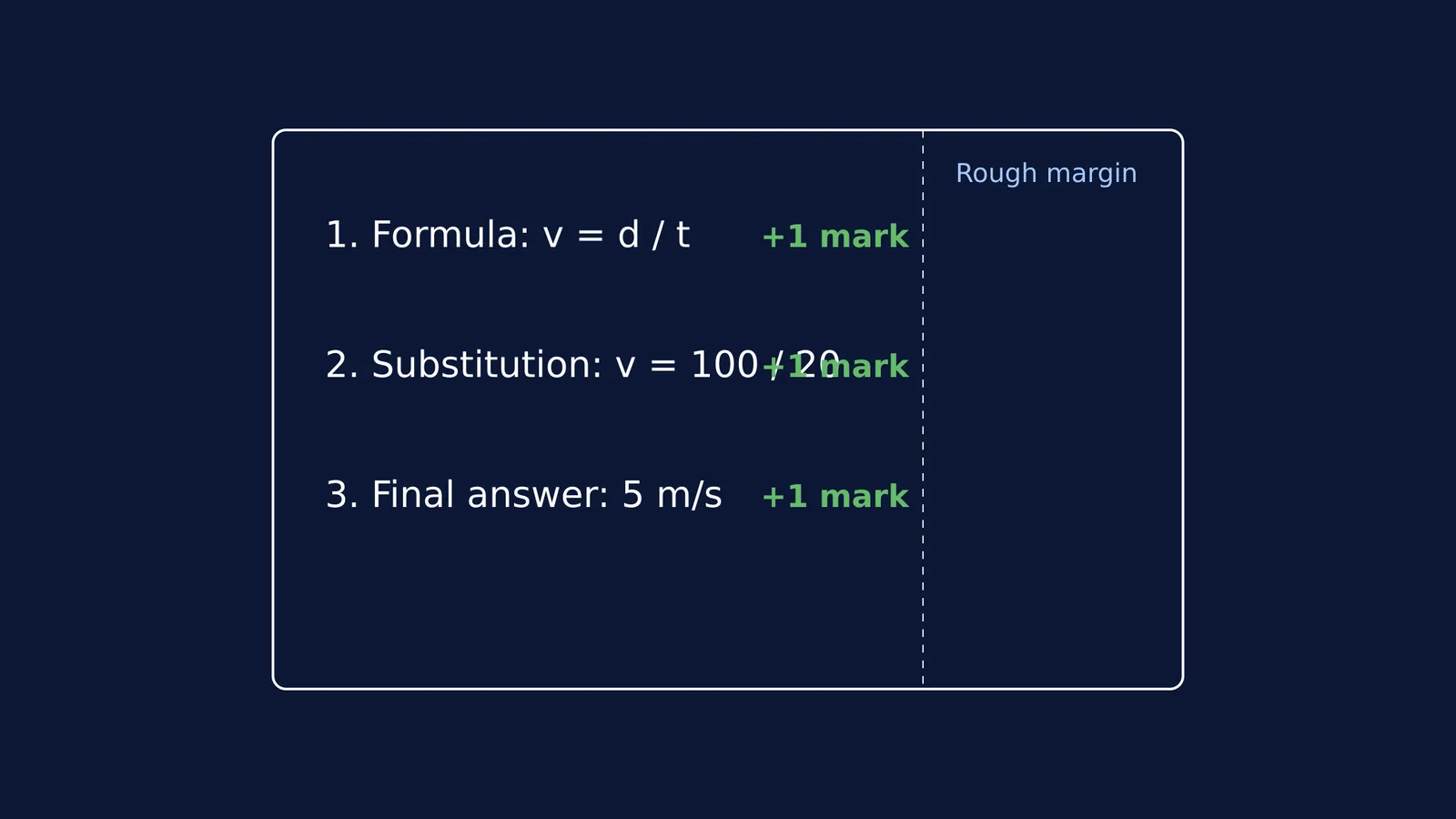
For example, in a 3-mark numerical question, the marking scheme typically awards 1 mark for stating the correct formula, 1 mark for substituting the values correctly, and 1 mark for the final calculation with the correct unit. If a student makes a simple arithmetic mistake at the very end, they still secure 2 marks—but only if the examiner can clearly see their working.
The most important rule for your child is to never leave a numerical question entirely blank. Simply writing down the given data and the relevant formula can often earn partial credit.
How can you review answer presentation at home?
You can review your child's practice tests without knowing the subject matter yourself. Look for these specific visual cues that make it easy for an examiner to award marks:
Headings and bullets: Long paragraphs hide the main points. Check if your child breaks their theory answers into bullet points and underlines the key terms with a pencil.
Diagram rules: Are diagrams drawn cleanly with a pencil and properly labelled? A neat diagram often earns marks even if the written description is weak, provided the labelling lines are straight.
Rough work margins: Is there a dedicated line on the right side of the page for rough calculations, or is the page a mess of scribbled numbers?
Correcting mistakes cleanly: If your child writes a wrong word or equation, they should simply draw a single horizontal line through it. Using correction fluid or scribbling heavily over the error draws unnecessary attention to it.
Spacing between answers: Check that they leave at least two blank lines between the end of one answer and the beginning of the next. Clear spacing ensures examiners do not accidentally skip marking a new answer.
How does Fermi help with step-by-step thinking?
If your child is stuck on how to lay out complex problems, they might need to see what a complete, structured answer looks like. The Fermi Problem Library has worked problems with a step-by-step solver that explains the reasoning rather than printing an answer.
Sometimes, the issue is not just writing down the steps, but thinking through them logically from the start. Fermi's AI tutor works out what they already know, builds a plan for the session, and teaches through it—writing on a board, drawing the figure, running the simulation, and checking understanding as it goes.
Different subjects have different formatting rules that examiners expect. For instance, you can read more about Class 10 CBSE maths: board answer mistakes and how to show working, or the standard way to lay out Physics derivations in CBSE boards: a structure that earns marks.


