On this page
Teachers mark a written answer against a list of points. If your answer contains those points, you get the marks. If it is long but vague, you don't. Class 8 exams are set by your school, not a board, so the details vary, but the habits that earn marks in a board paper work just as well in a school paper. Here they are, using a real question and its official marking scheme.
How do teachers mark a written answer?
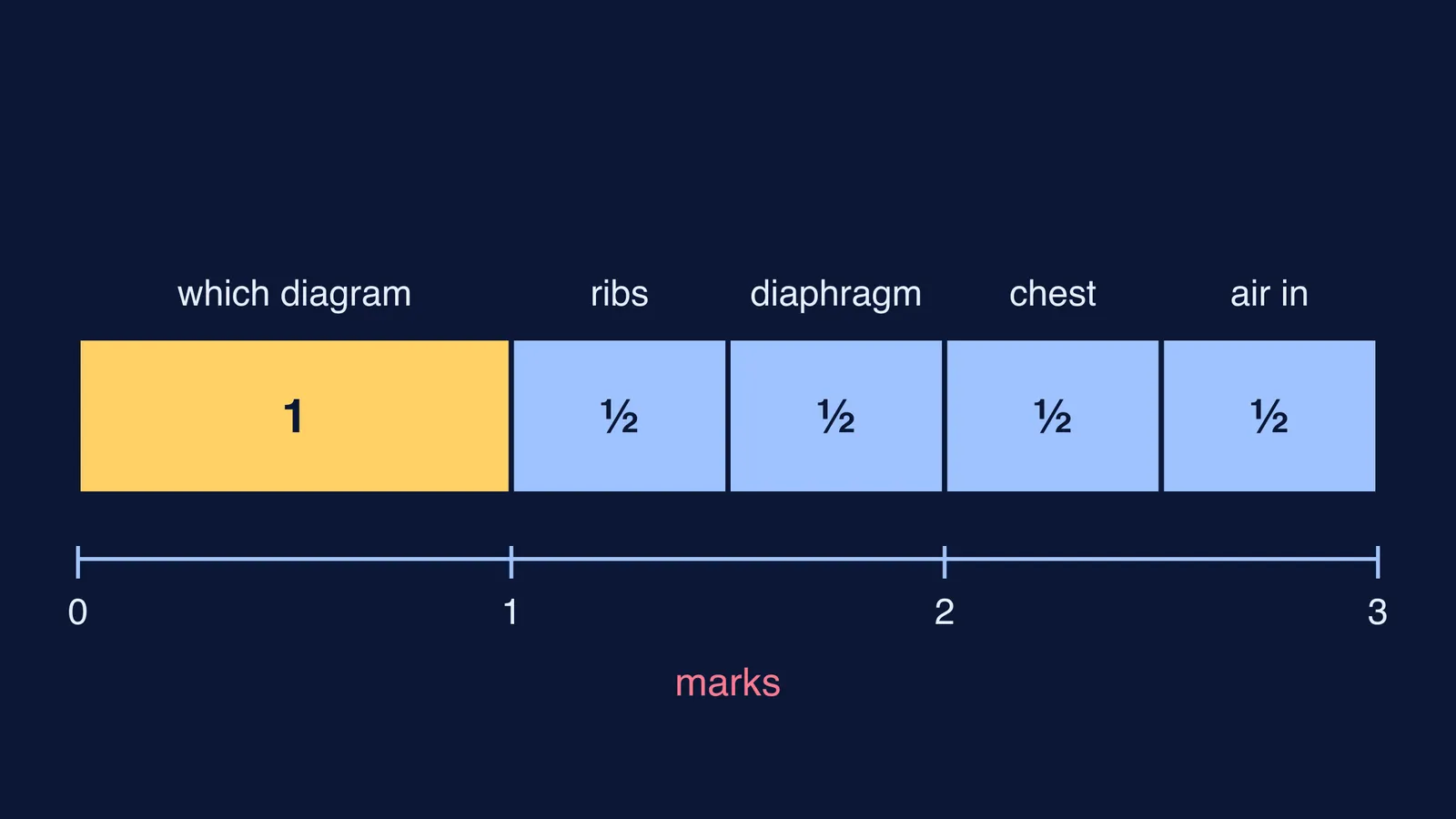
CBSE's published marking schemes show what an examiner looks for. Question 16B in the CBSE Class 10 Science sample paper for 2026-27 shows two diagrams of the chest and asks: "Which diagram indicates inhalation? Describe how it occurs."
The 2026-27 Science marking scheme gives this part 3 marks: 1 mark for "A depicts inhalation" and half a mark each for four points. The ribs get lifted, the diaphragm is flattened, the chest cavity becomes larger and air is sucked in.
Compare two answers:
Weak: "In inhalation we breathe in air and the lungs get filled with oxygen." It is true, but names no diagram, and "breathe in air" is at best a vague version of one point.
Better: "Diagram A shows inhalation. The ribs are lifted and the diaphragm flattens. This makes the chest cavity larger, so air is sucked into the lungs." It is one line longer and covers all five points.
Social Science is marked the same way. In the 2026-27 Class 10 Social Science marking scheme, the 5-mark answer on why wheat suits a region lists five separate points. For a 2-mark part on involving local communities in looking after forests, it lists sample examples, such as Joint Forest Management, and accepts "any other relevant example(s)".
How do you answer exactly what is asked?
Start with the command word. It tells you what kind of answer the teacher wants:
Name or identify: a word or phrase, not a paragraph.
Define: the textbook definition in one sentence.
Describe: the steps or features, in order.
Explain or give reasons: cause, then effect, joined by "because" or "so".
Draw and label: a neat diagram with every label the question asks for.
Then count the parts. Question 16B has two (which diagram, and how), and each part carries its own marks. Underline each part on the question paper and tick it once you have answered it.
Use the marks as a guide to length. In the CBSE schemes above, each point earns one mark or half a mark, so a 3-mark answer needs three to six clear points, not a page.
Why do textbook keywords matter?
Marking schemes are written in the textbook's language: "diaphragm is flattened" and "chest cavity becomes larger", not "the bottom part moves". A teacher checking a pile of answer sheets looks for those terms. If you use them, your points are easy to find.
Don't memorise whole paragraphs. For each topic, learn the few terms nobody can replace, such as diaphragm or chlorophyll, and practise using each in a sentence.
If a term is only a word to you, the Fermi Concept Library has a lesson for every concept in physics, chemistry, biology and mathematics, so you can learn what it means before you use it in an answer.
Layout helps too. Short headings and underlined key terms make your points quick to find; here is how to use headings in exam answers.
When should you add an example or a diagram?
If the question says "with examples" or "draw", you must add one. Otherwise, add one when it makes a point concrete. One line is enough, like Joint Forest Management in the Social Science scheme above.
In science, a labelled diagram often shows several points faster than sentences do. Drawing also helps you remember. Jeffrey Wammes, Melissa Meade and Myra Fernandes ran seven experiments in which people recalled words they had drawn better than words they had written out (Quarterly Journal of Experimental Psychology, 2016). That study is about memory, not exam marks, so the lesson is to practise drawing while you revise, not only on exam day. Start with the diagrams that come up every year, such as plant and animal cell diagrams.
A 4-step plan for your next exam
Read: underline the command word and number the parts of the question.
Plan: jot one keyword for each point the marks need in the margin before you write.
Write: answer in your first line, then one point per line, using the textbook's terms.
Check: tick every part of the question, and add a diagram or example where a point feels thin.
To practise at home, pick one 3-mark question from each chapter, write the answer in five minutes, then check it against the textbook paragraph. Parents can help with one question before they read the answer: "What is the question asking you to do?" If marks keep slipping on neatness, read what teachers look for in presentation.
If you don't know where to start with a chapter, Fermi's AI tutor works out what you already know and builds a plan for the session.
Try the four steps on your next class test.