

On this page
If your child's test came back with "improve presentation" and a few marks missing, take the note seriously. The fix is smaller than it sounds: not handwriting that looks like print, but answers a busy teacher can read easily.
Can a child really lose marks for untidy presentation?
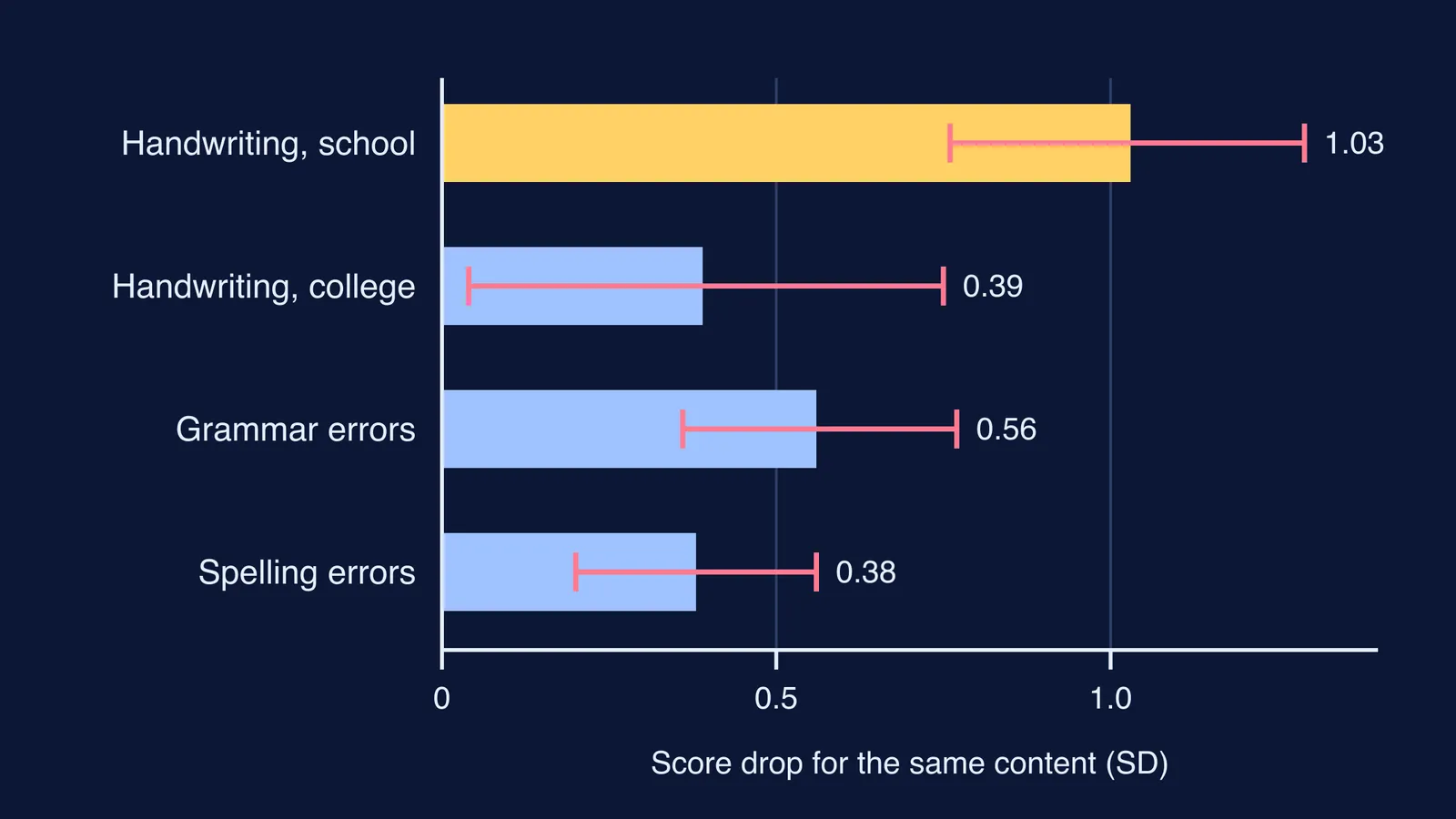
The research says yes, even when the content is identical. In a meta-analysis titled It Is More Than Just the Message, Steve Graham, Karen Harris and Michael Hebert pooled 9 effects from 8 papers in which teachers or teachers in training scored the same text in a more legible and a less legible version. Less legible versions were scored lower, with an average effect size of -0.76, and the drop was larger for school-age writers (-1.03) than for college writers (-0.39). The same review found smaller penalties for spelling errors (-0.38) and grammar errors (-0.56).
A separate study in the British Journal of Educational Psychology by Rainer Greifeneder and colleagues found the same "legibility bias" in two controlled experiments with university students as readers. Its authors conclude that the ease of reading legible handwriting biases how readers judge both the content and the writer's ability.
In board exams the loss is mostly indirect: marks go to content, but a point the examiner cannot find or read earns nothing. CBSE's 2025 Class 10 marking scheme instructions (here, for the Tamil paper) say the scheme carries only "suggested value points" and that students may use their own expression if it is correct. The same instructions ask each examiner to evaluate 20 answer books a day in main subjects.
What do teachers look for in a neat answer?
These habits make an answer quick to follow and mark:
The question number written clearly in the margin, exactly as printed (3(b), not just b).
Each new answer starting on a fresh line, with a blank line before it.
Long answers split into short paragraphs or points, each with its key term near the start.
Maths and physics steps written one per line: given, formula, substitution, answer.
The final answer with its unit, underlined or boxed.
Diagrams drawn in pencil, labelled, with enough space around them.
Mistakes crossed out with a single neat line, not scribbled over.
Rough work kept in one marked area; we explain where in our guide to doing rough work in the board exam answer sheet.
How much underlining and spacing is right?
Underlining is a signpost, not decoration. One or two underlines per short answer is plenty: the key term, the definition or the final result. If half the page is underlined, nothing stands out. Use one pen colour for underlining (a pencil and ruler work well), and check whether the school or board has any rules about colours.
For spacing, a simple rule works: one blank line between parts of an answer, two between questions, and a margin your child never writes into.
How can my child practise neat answers at home?
Keep it short and regular. Ten minutes, three times a week, beats a long Sunday rewrite.
Pick one question from that day's homework or a past test.
Your child writes the answer once, at normal exam speed. Neatness that only appears when writing slowly won't survive an exam.
Together, check it against the list above. Pick just one habit to improve, such as spacing or marking the final answer.
Your child rewrites only that answer with the one change.
Next session, keep that habit and add another.
Here is a worked example for a 2-mark physics question: a car goes from rest to 20 m/s in 5 s; find its acceleration. The untidy version is "a = 20/5 = 4", squeezed beside the question with no unit. The tidy version takes four short lines: Given: u = 0, v = 20 m/s, t = 5 s. Formula: a = (v - u)/t. Substitution: a = (20 - 0)/5. Answer: a = 4 m/s², underlined. Every step a marker might award is now visible. Our guide to writing maths steps in board exams goes further with this layout.
If the mess comes from not being sure of the method, so your child writes and crosses out, the Fermi Problem Library has worked problems with a step-by-step solver that explains the reasoning rather than printing an answer.
What should parents avoid?
Avoid making your child copy out a whole notebook as punishment; it ties neatness to shame. Avoid comparing their handwriting with a sibling's too. If writing is physically painful, very slow, or something your child avoids even when they know the answer, talk to the class teacher. They may suggest an assessment with a paediatrician or occupational therapist.
For board-year students, our guide to helping your child improve answer writing for boards covers timing and structure. Start with one answer tonight.


