

On this page
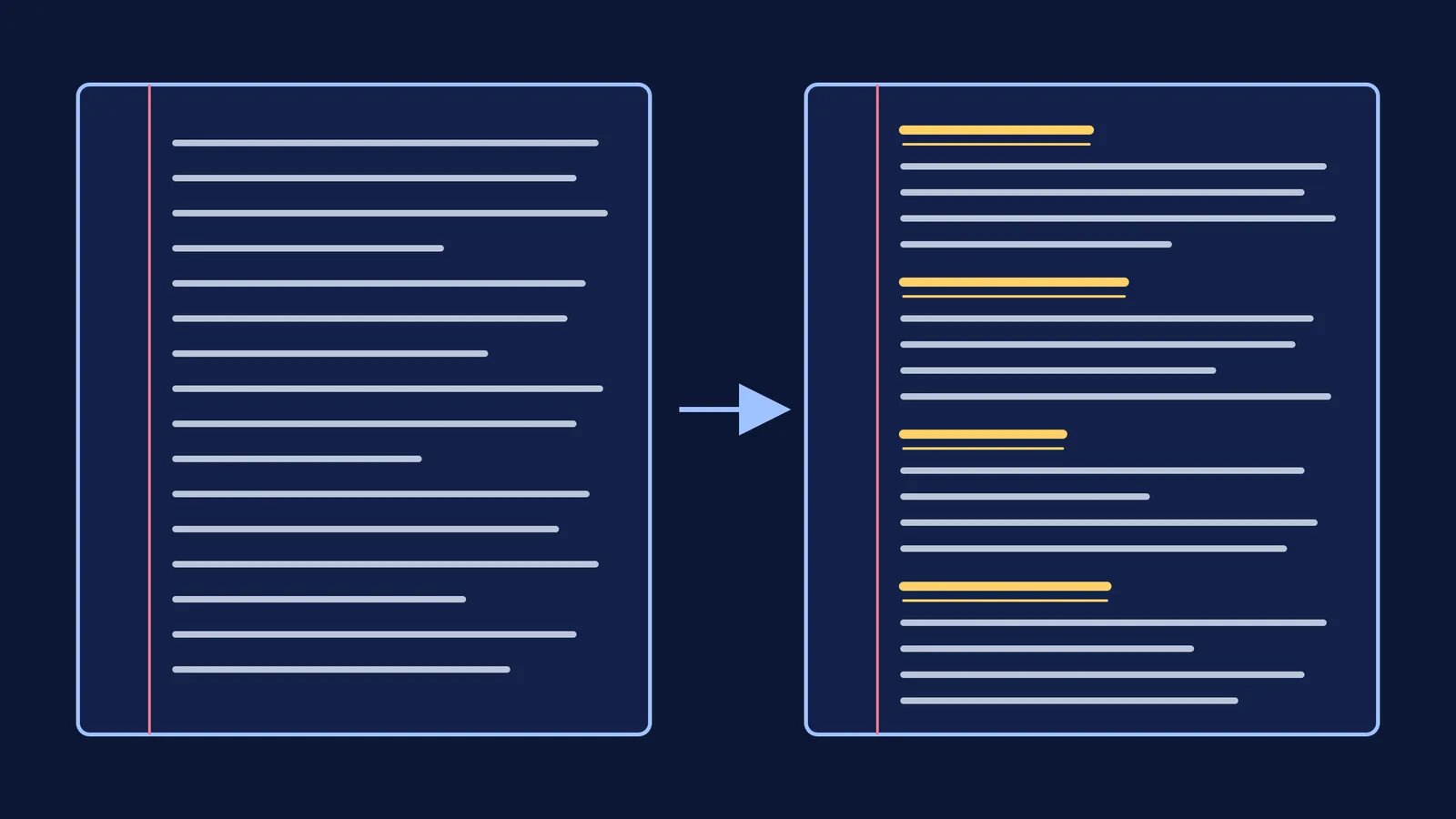
In a 4- or 5-mark CBSE board answer, a short heading for each point costs you a few words and saves the examiner from hunting through a paragraph for the points the marking scheme lists.
Should I use headings in board exam answers?
For long answers that ask you to explain, list or discuss several points: yes.
The general instructions in CBSE's 2025 Class 12 marking scheme for Business Administration remind examiners that evaluation must be carried out "strictly as per value points for each answer" given in the scheme (CBSE marking scheme, Class 12 Business Administration, 2025). The same document says the value points are guidelines, not the complete answer, and that students "can have their own expression". So headings are not compulsory; they just make each value point easy to see.
The examiner is also working at pace. The same instructions ask every examiner to work 8 hours a day and evaluate 20 answer books a day in main subjects and 25 in other subjects. That is about 24 minutes per answer book in a main subject.
Look at how the scheme itself is written. In the section of 4-mark questions to be answered in 50 to 80 words, the expected answer on the significance of leadership is a list of short points (motivating the employees, facilitating the process of change, building team spirit, confidence, maintaining discipline), followed by a note asking for an explanation of each. A heading-plus-explanation answer has the same shape as the page the examiner is holding.
Does the research say headings help readers?
The research is indirect. A 2017 meta-analysis in PLoS One by Xie and colleagues pooled studies of cues in multimedia learning material, such as arrows, colour coding and highlighting, that point learners to what matters. It found that cues improved retention and transfer and slightly lowered how mentally demanding learners found the material; its retention analysis included 25 articles with 2,910 participants (Xie et al., 2017).
That review did not test headings, and its studies looked at students learning from material, not examiners marking scripts. Treat it as a reason to make points easy to spot, not proof that headings raise marks.
Which answers need headings, and which don't?
Use headings: 4- and 5-mark "explain", "discuss" or "give reasons" answers in subjects such as social science, business studies, economics and biology theory.
Use headings: any answer that says "any three" or "any four", one heading per point, so the count is obvious.
Skip them: 1- and 2-mark answers. One clear sentence is enough.
Replace them with steps: numericals and derivations. Given, formula, substitution, answer with unit already shows the structure.
Follow the format instead: letters, notices and other language-paper tasks with a set format.
If a biology answer needs a process shown, a labelled flowchart often beats headings; see our guide to writing biology long answers with flowcharts and tables.
How do you write headings without wasting time?
Read the marks. A 4-mark "explain any four" means four headings. Decide this before you write.
Jot the points in the margin or rough area as single words, in the order you will use them.
Write each heading in two to four words, taken from the textbook's own term where you know it.
Underline it once, with the pen you are already using. No colours, no ruler.
Write one to three sentences of explanation under it, with an example if the question asks for one.
Leave a line between points so each block stands on its own.
Here is a worked 4-mark example.
Question: Explain any four points showing the significance of leadership.
Motivating employees (underlined): A leader links people's work to rewards and recognition, so they put in more effort.
Facilitating change (underlined): People resist new methods. A leader explains why the change helps them, which reduces resistance.
Building team spirit (underlined): A leader gets members to work towards a shared goal rather than only their own targets.
Maintaining discipline (underlined): By setting an example and applying rules fairly, a leader keeps the group following agreed standards.
Four headings and about 60 words of explanation, within the scheme's 50 to 80 words. The examiner sees all four points at a glance.
How can you practise this before the exam?
Take one long-answer question a day for a week from a past paper or sample paper and answer it with headings, timing yourself. Then compare your headings with the value points in that year's marking scheme on the CBSE website. If they don't match, the gap is usually content, not formatting.
If the gap is that you can't name the parts of a topic, the Fermi Concept Library gives every concept in physics, chemistry, biology, mathematics and computing its own lesson and its place in the map, which helps you see the sub-ideas that become your headings.
Two habits pair well with headings: numbering answers so none get missed, and knowing what to write when you don't know an answer. Try one headed answer tonight and time it.


