

On this page
A board answer book is read by a stranger who has never seen you and has a pile of other answer books waiting. Your question numbers are the map they use. If the map is vague, you are relying on the examiner to work it out. Here is how to label answers, sub-parts and internal choices using the format CBSE itself prints.
How do examiners find and mark your answers?
In CBSE's 2025 marking scheme for Class XII Information Technology, examiners are told that if a question has parts, they should award marks on the right-hand side for each part, then total them in the left-hand margin.
The same document sets the workload: 8 hours a day, with 20 answer books per day in main subjects and 25 in other subjects. It also lists mistakes examiners have made in the past, and the first one is "leaving answer or part thereof unassessed".
That is the real risk: a sub-part with no label, or a choice with no letter, is easy to overlook.
CBSE's On Screen Marking FAQ says Class XII answer books in the 2026 board exams were scanned and evaluated on a computer screen, with examiners entering marks question-wise online. On a screen, a clear number in your margin helps them match each part of your answer to the right question.
How should you write question numbers in the answer sheet?
Start by copying the paper's own numbering. In CBSE's Class X Mathematics Standard sample paper for 2026-27, the paper has 38 questions in five sections, internal choices are printed as 34(A) OR 34(B), and each case-study question has sub-parts (i), (ii) and (iii), where (iii) itself offers (A) OR (B).
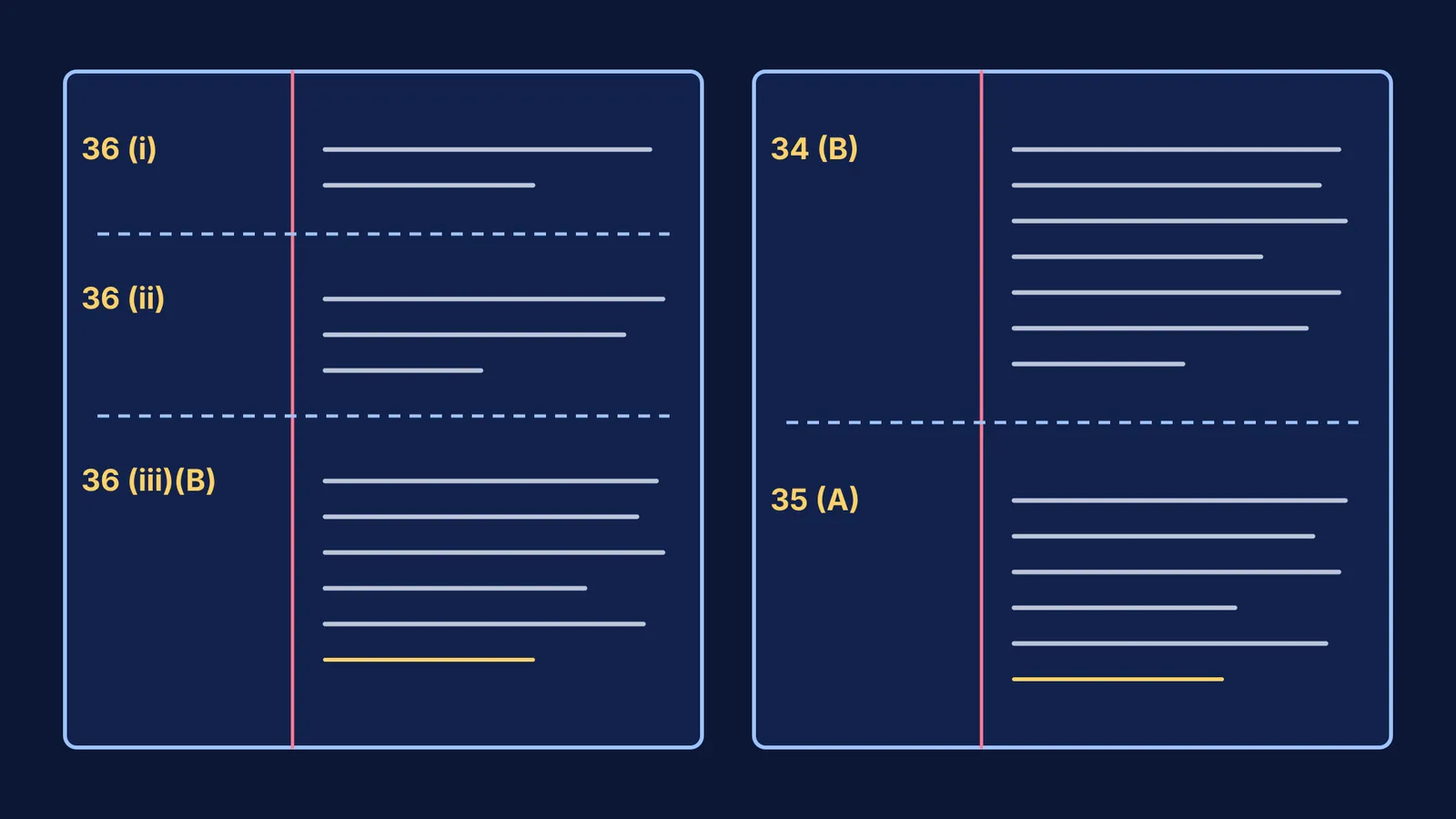
So your labels should look like this:
Full question with a choice: 34 (B), never just 34
Case-study sub-part: 36 (ii), never just (ii) on a new page
Sub-part with a choice: 36 (iii)(B)
MCQ: the number and the option letter, such as 1. (B)
Then follow five habits:
Write the number in the margin, before you write a single word of the answer.
Give every sub-part its own label and its own start, even if it is one line long.
Write the choice letter you picked, every time, even if the other option is obvious from your working.
Leave a blank line or draw a short line across after each answer, so the end of one is not the start of the next.
If you answer out of order or come back to finish something, write "36 (ii) continued" at the new spot.
The reading time at the start of a board exam is a good moment to decide which internal choices you will attempt, so you are not switching halfway through an answer.
Worked example: a four-mark case study
Take Question 36 from the CBSE 2026-27 Class X Mathematics Standard sample paper, a case study on a company selling sanitiser bottles. It has three sub-parts worth 1, 1 and 2 marks, and the last one is a choice. Here is how the page should read from top to bottom:
36 (i) in the margin, then the June equation.
A line across, then 36 (ii) in the margin and the July equation.
A line across, then 36 (iii)(B) in the margin, your working, and the final answer underlined.
An examiner can see at once that you chose (B) and mark it against the right line of the scheme. Write "36" once at the top with three blocks of working below, and they have to guess where (ii) ends and which option (iii) is.
When you practise case studies at home, check each sub-part on its own. The Fermi Problem Library has worked problems with a step-by-step solver that explains the reasoning rather than printing an answer, which makes it easier to see which part went wrong.
What if you attempt both internal choices?
The 2025 CBSE Information Technology marking scheme tells examiners that if a student attempts an extra question, the answer deserving more marks is kept and the other is scored out with the note "Extra Question". Under that rule, attempting both mainly costs you time, but check the instructions on your own paper.
If you change your mind, strike out the attempt you do not want with one neat line and label the new one clearly. Our guide to correcting a mistake in your answer sheet covers how to do that without making a mess.
What should you check before you hand in?
Every answer has a number in the margin.
Every sub-part has its own label: (i), (ii), (iii).
Every internal choice shows its letter: (A) or (B).
Any answer split across pages says "continued".
Nothing you meant to discard is left uncrossed.
For more on how the rest of the page should look, read our tips on board exam answer presentation.


