

On this page
You spot it halfway through the paper: a wrong sign, a 3 that should be a 5, or a whole answer built on the wrong formula. How you fix it matters almost as much as the fix itself. A clean correction shows a careful student changing their mind. Overwritten digits look like a guess, and the examiner may not be able to tell which number you meant.
What happens to a crossed-out answer in a CBSE board exam?
The marking scheme's instructions to examiners show why crossing out matters. CBSE's March 2015 Class 10 Mathematics marking scheme told examiners: "If a question is attempted twice and the candidate has not crossed any answer, only first attempt is to be evaluated." Examiners were told to write "EXTRA" next to the second attempt, which is not evaluated, even if it is the better one.
A related rule covers answering more questions than the paper asks for. The 2025 Class 12 Home Science marking scheme says that if a student has attempted an extra question, the answer deserving more marks is retained and the other is scored out with the note "Extra Question". Wording varies by subject and year, but the safe habit is the same: leave only one answer per question that is clearly meant to be marked.
Examiners also work quickly. The same 2025 scheme asks each examiner to work 8 hours a day and evaluate 20 answer books per day in main subjects (CBSE marking scheme, 2025). An answer that needs decoding is an answer at risk.
How do you strike out a wrong answer neatly?
Draw one straight horizontal line through the wrong words or numbers. Use a single diagonal line across a whole block or a full answer.
Keep the struck text readable underneath. Don't scribble it into a black patch.
Write the correct version right after it, on the same line or the next one.
If the new answer is on another page, write a short note at the old spot, such as "Q14 rewritten on page 11", and start the new answer with the question number.
Skip whitener, correction tape and erasable pens. Your school or admit card instructions may not allow them, and a single line does the job without that risk.
Why keep it readable? Some boards spell out what happens next. AQA, a UK exam board, tells its examiners in its A-level Chemistry mark scheme that crossed-out work which has not been replaced should be marked as if it were not crossed out, if possible, and that where it has been replaced, only the replacement is marked. The CBSE schemes we read don't address this, so don't rely on it, but a readable strike-through costs you nothing.
Why is overwriting worse than crossing out?
When you write a 5 on top of a 3, the examiner sees a shape that could be either, and nobody will guess in your favour. The same goes for a sign changed from minus to plus with one extra stroke.
Two answers left side by side cause a similar problem. AQA's mark scheme above uses a "right + wrong = wrong" principle for questions that ask for a set number of responses: once you give more answers than asked for, each wrong one cancels a right one (AQA, 2018).
Worked example: fixing a physics numerical mid-answer
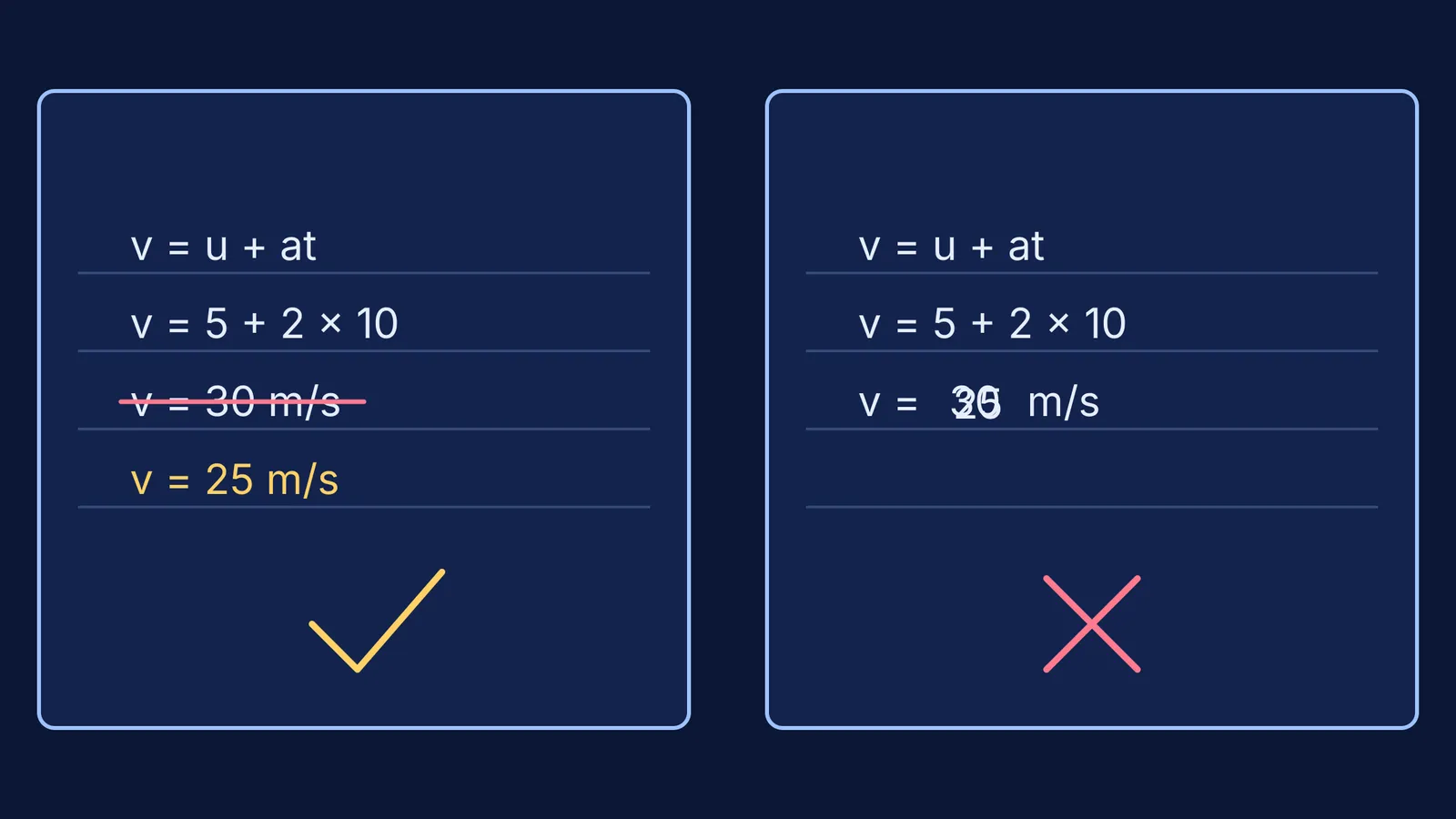
The question gives u = 5 m/s, a = 2 m/s² and t = 10 s and asks for the final velocity. You write v = u + at, then v = 5 + 2 × 10, then v = 30 m/s. On checking, you see that 5 + 20 is 25.
Wrong fix: turn the 3 into a 2 and the 0 into a 5. The result looks like neither number.
Clean fix: draw one line through "v = 30 m/s" and write "v = 25 m/s" on the next line. Your method lines stay untouched, so the formula and substitution can still earn their step marks.
If the method was wrong, cross out from the first wrong line onward and continue below. To make fewer wrong-method slips, practise with the Fermi Problem Library, which has worked problems with a step-by-step solver that explains the reasoning rather than printing an answer.
What should you do if a whole answer is wrong?
Enough time and you know the right method: one diagonal line across the old answer, then write the question number again and redo it.
Little time and only the final step is wrong: strike out that line and write the corrected result.
Not sure which version is right: check first, then keep one.
Our guide to checking your answers in the last 10 minutes of an exam gives a set order to follow. Fewer corrections start with a tidy page, which is what neat working with clear layout and units is about.
After results, CBSE lets candidates request a photocopy of their answer book on payment of a processing fee (CBSE marking scheme, 2025). If you think a clearly corrected answer was missed, the CBSE verification and revaluation steps explain what to do next.


