On this page
You are stuck on a 3-mark question and the page is blank. Leaving it empty guarantees zero. Writing the right pieces can still earn marks, because CBSE examiners mark against a list of steps, not only the last line.
Do you get marks for steps in CBSE board exams?
Yes. The general instructions to examiners printed in CBSE's published marking schemes say the scheme "carries only suggested value points for the answers", and that if a student's own expression is correct, due marks should be awarded (2025 Class 10 scheme, instructions 4 and 10). The same instructions say an error should be penalised only once, so a slip in one step should not cost you the marks for every step after it.
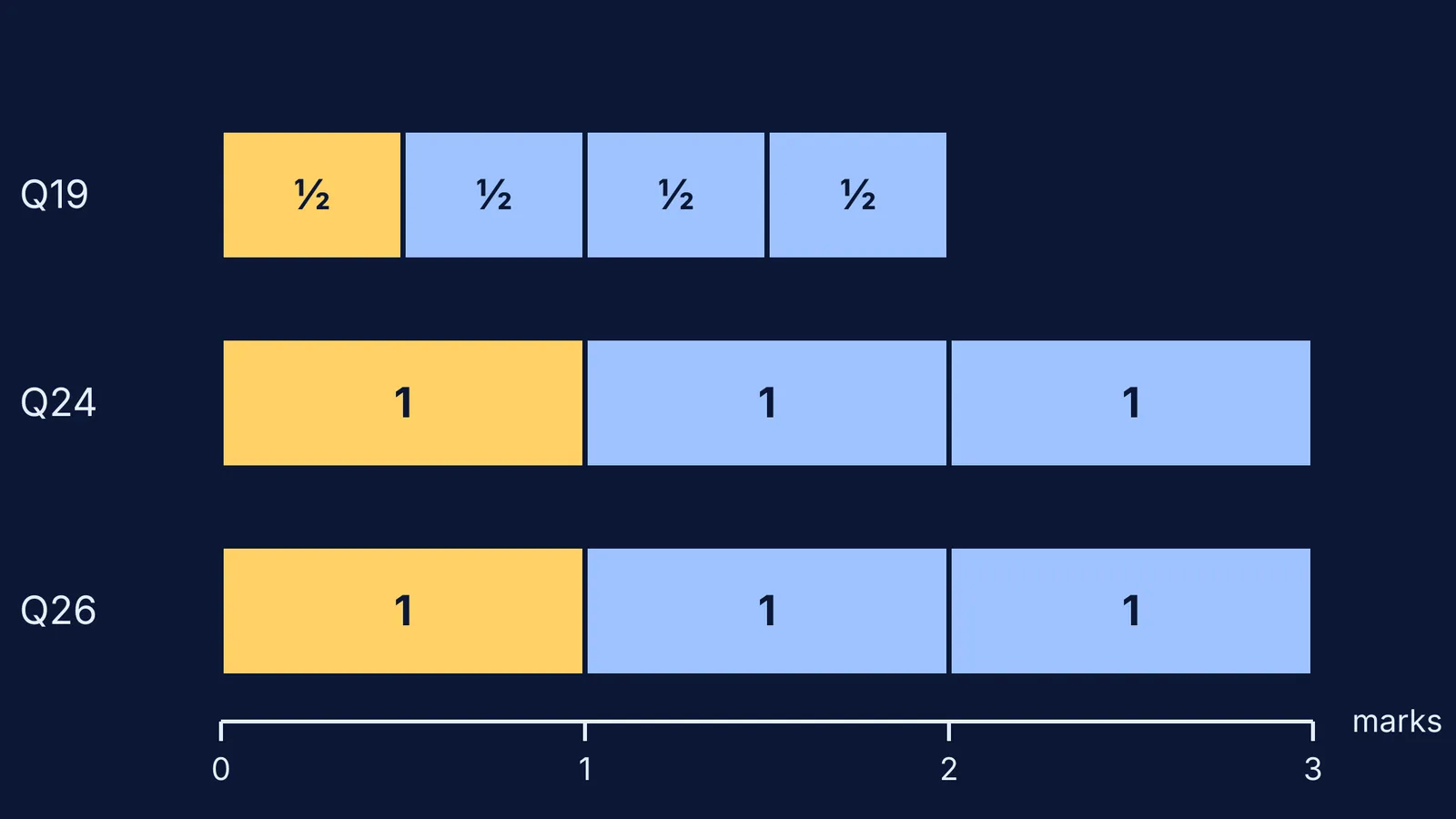
You can see the value points in CBSE's 2026-27 Class 12 Physics sample marking scheme:
Question 19, worth 2 marks, is split into four half-marks: the distance to the midpoint, the potential from one charge, the potential from both charges, and the work done.
Question 24, worth 3 marks, gives 1 mark for the nucleon masses and mass defect, 1 for the binding energy and 1 for the binding energy per nucleon.
Question 26, worth 3 marks, gives 1 mark for stating Huygens' principle, before any derivation.
What to write if you don't know the answer in a board exam?
Work down this list until you run out of things you are sure of.
Given and to find. List the quantities with units; it often reminds you of the method.
The law or formula that links them. Write the one that connects what is given to what is asked, with the symbols defined.
A definition. For a theory question, define the key term in one exact sentence, the way your NCERT book does.
A labelled diagram. If the question involves a ray, circuit, field or graph, draw it and label the axes, arrows and angles.
The first substitution. Put the numbers into the formula, even if you cannot finish the algebra.
What comes next, in words. For example: "Divide B by the mass number A to get the binding energy per nucleon."
What if you get stuck halfway through a numerical?
Take Question 24 from the 2026-27 sample marking scheme: the binding energy per nucleon of oxygen-16. Say you have forgotten that 1 u corresponds to 931.5 MeV. Write:
Z = 8, N = 8, so the total mass of the nucleons = 8(1.00727) + 8(1.00866) = 16.12744 u
Mass defect, Δm = 16.12744 − 15.99493 = 0.13251 u
Binding energy B = Δm c², and binding energy per nucleon = B/A, with A = 16
In the scheme, the first mark sits beside the nucleon masses and the mass defect, so these lines alone can earn 1 of the 3 marks. The other two marks go with the numbers (about 123.4 MeV and 7.71 MeV); the formula lines show your method but may not score on their own.
The Fermi Problem Library has worked problems with a step-by-step solver that explains the reasoning, so you can see exactly which step you would have stalled on.
What should you not waste time on?
Time is tight: the header of the 2026-27 Class 12 Physics sample marking scheme has 70 marks in 3 hours, which is about 2.5 minutes per mark.
Copying out the question. Write the given values, not the whole paragraph.
Every formula in the chapter. Examiners are told to evaluate "strictly as per value points" (instruction 18), so unrelated formulas earn nothing.
Both options of an internal choice, as insurance. If a student attempts an extra question, the same instructions say the answer deserving more marks is kept and the other is scored out (instruction 9), so the second answer adds nothing and costs time.
Rewriting messy work. Strike it through once and carry on; here is how to correct a mistake in your board exam answer sheet.
If panic is what empties your head, try a short routine to get the answer back when you blank out mid-exam, then return to the list above.
How do you build the habit before the exam?
Attempt a sample paper, then mark your answers line by line against its value points to see which steps you skip. CBSE topper answer sheets show what a fully stepped answer looks like on paper.
When a whole topic feels shaky, definitions are the cheapest marks to secure. The Fermi Concept Library covers every concept in physics, chemistry, biology, mathematics and computing, each with its own lesson.
Next time the page is blank, start with what is given. The marks are in the steps.