

On this page
CBSE scans answer books written by real candidates in its board exams, the sheets students call topper answer sheets, and posts them online. It is tempting to skim one, feel impressed, and try to memorise what the student wrote. That rarely helps, because next year's questions will be different. What carries over is how the answer is built.
Where do you find CBSE topper answer sheets?
CBSE's official Model Answer by Candidate for Examination page lists answer books by year and class, with Class 10 and Class 12 subjects for 2025, 2024, 2023, Term-II 2022, 2020 and 2019. The 2025 and 2024 files are ZIP downloads and the 2023 files are PDFs, one per subject.
Download from that page, not a forwarded copy, and start with your own subject. CBSE also posts each year's marking schemes, and you will need those later.
What should you look for in a topper's answer sheet?
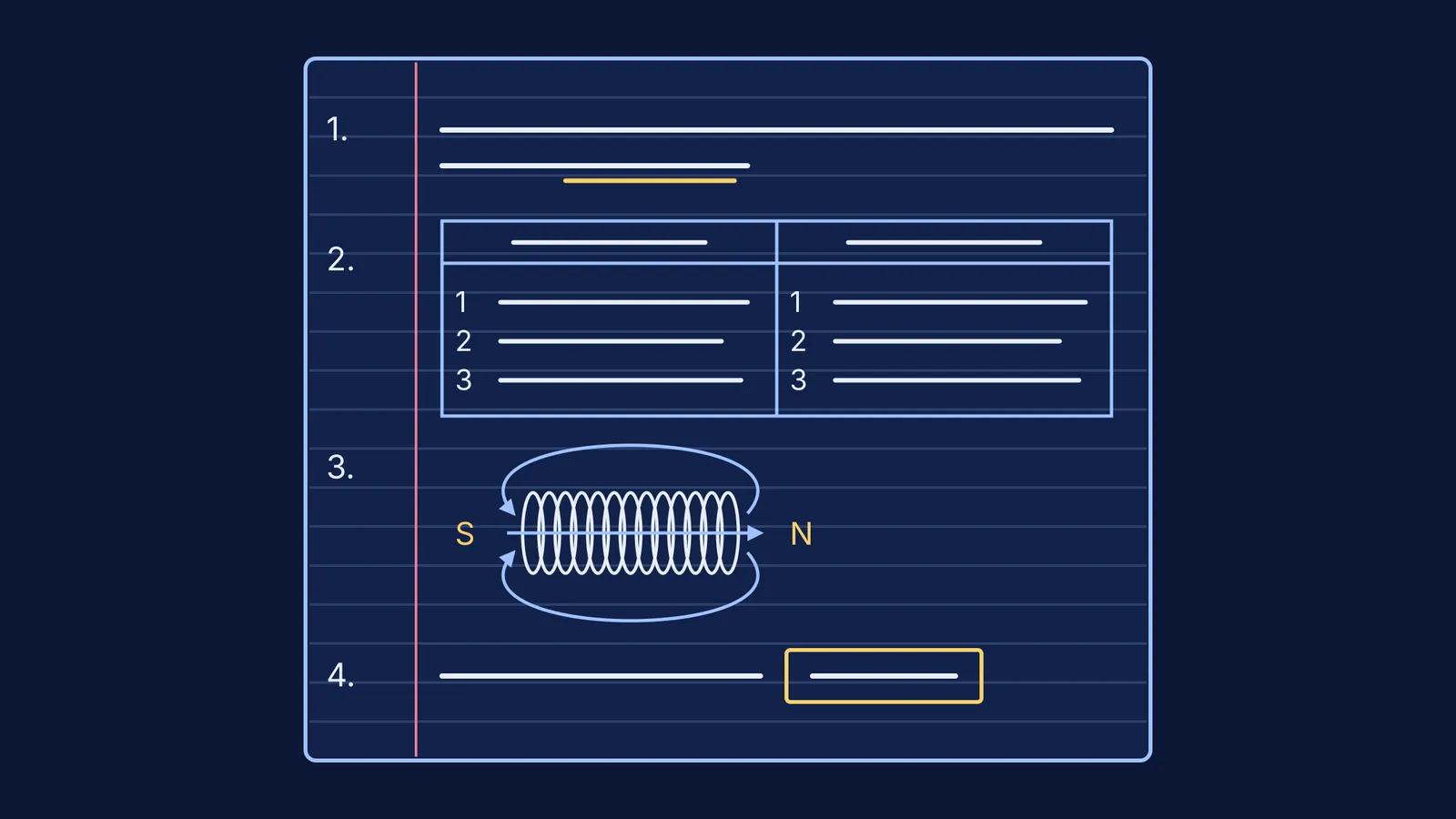
We read CBSE's 2023 Class 10 Science answer book page by page. Five habits showed up again and again.
Layout: the student writes the section name (Section A, Section B) as a heading, puts every question number in the margin, and starts each answer on a fresh line.
Keywords: technical terms are underlined. In the redox answer, the student underlined oxidation, reduction, reduced and oxidised. In the answer on blood circulation, pulmonary vein and left ventricle are underlined.
Structure: the answer comparing the movement of a sensitive plant's leaves with a shoot bending towards light is a two-column table with matching numbered points. The answer on the effects of adrenaline gets numbered points, not a paragraph.
Diagrams: simple sketches with labels. Myopia comes with a ray diagram labelled "concave lens of suitable power", the solenoid comes with its field lines, and blood flow is drawn as a flow chart.
Length and finish: objective questions get one line, with the option letter and the words. The redox answer ends with a closing sentence: "Thus, the given reaction is a redox reaction." The refractive-index answer shows the relation, then the speeds in the two media, then a marked [Ans].
How do you copy the habits, not the answers?
In a classic study of students learning mechanics from worked examples, Chi and colleagues (1989) found that the stronger students explained the steps of an example to themselves, while weaker students explained little and leaned heavily on the examples when they solved problems. A 2013 review of ten study techniques by Dunlosky and colleagues rated rereading and highlighting as low utility and practice testing as high utility. Just reading a topper's sheet is rereading. Writing your own answer and comparing is practice.
Try this routine with one long answer a day:
Cover: choose one question worth 3 or 5 marks and hide the topper's answer.
Write: answer it yourself, timed, as you would in the hall.
Compare: uncover the topper's answer and note one difference under each heading: layout, keywords, structure, diagram, length.
Explain: for each difference, write one line on why it earns marks. If you cannot explain a step, the gap is the concept, not the presentation.
Transfer: two days later, answer a different question from the same chapter using the habit, and check it against the marking scheme.
If step 4 keeps exposing a concept you do not understand, the Fermi Concept Library has a lesson for every concept in physics, chemistry, biology and mathematics, so you can fix the idea before you go back to how you present it.
What does a before-and-after answer look like?
Take Question 21 in the 2023 Science answer book, where the student shows that MnO2 + 4HCl → MnCl2 + 2H2O + Cl2 is a redox reaction.
Before (our example first attempt): "Redox means oxidation and reduction both happen. MnO2 is reduced and HCl is oxidised."
After (with the habits):
Write the equation first.
Define the term with keywords underlined: a redox reaction is one in which oxidation and reduction take place together.
Give the evidence: MnO2 loses oxygen, so it is reduced to MnCl2. HCl loses hydrogen, so it is oxidised to Cl2.
Close with one line: thus the given reaction is a redox reaction.
The second version shows the examiner each point the marking scheme is looking for. For numericals, the same habit of formula, substitution, answer applies, and the Fermi Problem Library has a step-by-step solver that explains the reasoning rather than printing an answer, so you can see why each line is there.
How often should you use topper sheets?
Use them while you practise, one long answer a day with the routine above, not as reading material. For physics, pair this with a clear structure for board-exam derivations. For why examples help only when you explain them, see our piece on learning from worked examples versus solving from scratch.
Open the latest answer book for your weakest subject tonight, cover one answer, and write your own first.


