On this page
Board examiners mark numericals against a scheme that gives marks to steps, so how your answer looks on the page decides how many of those marks you can collect.
How are numericals marked in CBSE board exams?
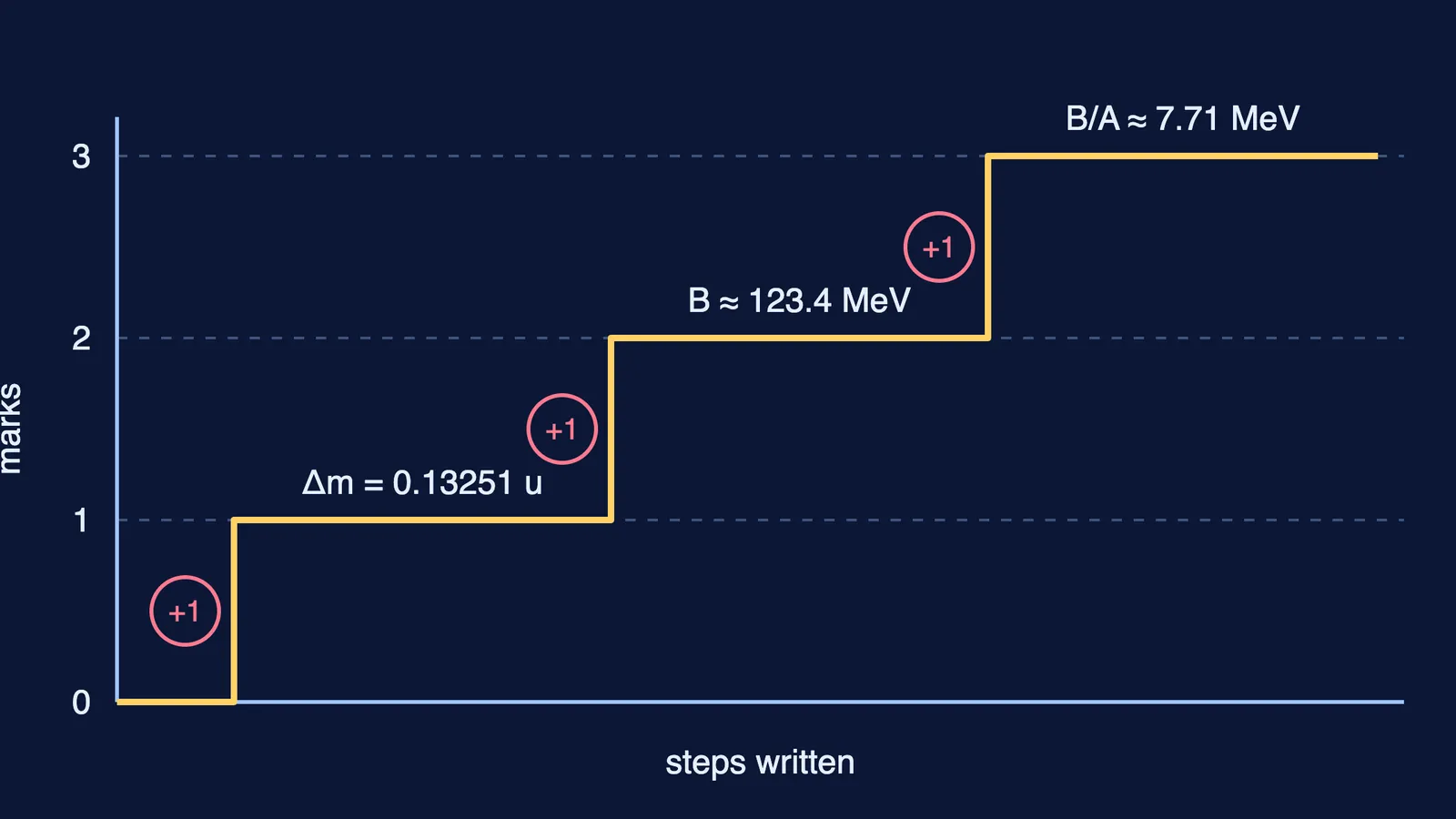
CBSE publishes a sample question paper and a marking scheme for each subject every year, and the marking scheme shows where the marks sit inside an answer. In the CBSE Class 12 Physics marking scheme for 2026–27, Question 24 (binding energy per nucleon of oxygen-16, 3 marks) gives 1 mark for the mass defect, 1 mark for the binding energy and 1 mark for the binding energy per nucleon.
The same scheme splits other answers into halves. In the shunt-resistance numerical (Question 27A), half a mark sits beside the formula S = IgG/(I − Ig) and another half beside the substitution that leads to 2 Ω. The 2-mark Question 19, on the work done in bringing a charge to the midpoint of two charges, carries four half-marks, one for each line of working.
The CBSE Class 12 Physics sample question paper for 2026–27 also states that calculators are not allowed, so your arithmetic is part of the working the examiner reads. A bare final answer gives the examiner nothing to award for the steps before it.
What should a numerical answer look like on the answer sheet?
Use the same five parts every time, in this order:
Given: each quantity with its symbol and unit, converted to SI on this line, and one line saying what you have to find.
Formula: the relation you are using, in symbols, before any numbers go in.
Substitution: the same formula with every value put in, in the same order as the symbols.
Unit: carry the unit through the working and check it matches the quantity you were asked for.
Answer: the final value with its unit, underlined or boxed so it cannot be missed.
For a multi-step problem, repeat formula, substitution and result for each intermediate quantity. Each intermediate result is a natural place for a step mark.
Worked example: the binding-energy question, written for step marks
Question 24 of the 2026–27 sample paper gives the atomic mass of oxygen-16 as 15.99493 u and asks for the binding energy per nucleon, with mp = 1.00727 u, mn = 1.00866 u and 1 u = 931.5 MeV/c². Here is the answer in the five-part layout:
Given: Z = 8, N = 8, M = 15.99493 u, mp = 1.00727 u, mn = 1.00866 u, 1 u = 931.5 MeV/c². To find: B/A.
Formula: Δm = Z·mp + N·mn − M
Substitution: Δm = 8(1.00727) + 8(1.00866) − 15.99493 = 16.12744 − 15.99493
Result: Δm = 0.13251 u (1 mark)
Formula and substitution: B = Δm × 931.5 MeV = 0.13251 × 931.5 MeV
Result: B ≈ 123.4 MeV (1 mark)
Formula and substitution: B/A = 123.4 MeV ÷ 16
Answer: B/A ≈ 7.71 MeV per nucleon (1 mark)
The marks in brackets follow the official 2026–27 marking scheme. Slip in the multiplication and write 124.3 MeV, and your correct mass-defect line is still on the page for the examiner to mark.
Which presentation mistakes cost step marks?
Jumping from formula to answer. The substitution line is where a half-mark often sits, as in Question 27A above.
Converting units in your head. Write 20 cm = 0.20 m in the Given line, so a wrong power of ten is out in the open where you can catch it.
Bare numbers. The CBSE marking scheme writes its final results as 123.4 MeV and 2 Ω, not 123.4 and 2. Write yours the same way.
Changing symbols halfway. If you call it Ig in the formula, keep Ig in the substitution.
Rounding too early. Keep extra digits until the last line; our guide to rounding to significant figures covers the rules.
A lost final answer. Underline or box it, so it does not disappear into the working.
How do you practise numerical presentation before the board exam?
A 15-minute drill, once a day in the last month:
Pick two numericals from the CBSE sample paper or your NCERT exercises.
Write each one in the five-part layout, about five minutes each.
Spend the last five minutes marking yourself against the official marking scheme, half-mark by half-mark, and note any step you skipped.
If you have been preparing mostly with JEE-style MCQs, writing out full working takes deliberate practice; our 20-minute board answer-writing drill after MCQ prep is built for that switch, and using short headings in board exam answers makes your theory answers just as easy to mark.
When a numerical goes wrong and you cannot see which step broke, the Fermi Problem Library has worked problems with a step-by-step solver that explains the reasoning rather than printing an answer, so you can find the step where yours went off.
Practise until the five lines come without thinking.