On this page
Your calculator shows 0.0045062 and the question says "give your answer to 3 significant figures". Rounding is the easy part. Many lost marks come from starting the count in the wrong place, or from counting decimal places when the question asked for significant figures.
Which zeros count as significant figures?
Significant figures are the digits that carry information about how precise a number is. Zeros that only hold the decimal point in place do not count. The US National Institute of Standards and Technology puts the starting rule plainly in its rounding guide, GLP 9 (2019): reading from left to right, the first non-zero digit is the first significant digit. Zeros after the decimal point, with only zeros in front of them, are not significant.
Chemistry LibreTexts/02:_Measurement_and_Problem_Solving/2.03:_Significant_Figures_-_Writing_Numbers_to_Reflect_Precision) sets out the rules for zeros, with these examples:
Leading zeros, in front of every non-zero digit, are never significant: 0.008 has one significant figure.
Zeros between non-zero digits are always significant: 5.02 has three.
Trailing zeros in a number with a decimal point are significant: 620.0 has four.
Trailing zeros in a whole number with no decimal point are ambiguous: 1400 could have two, three or four significant figures, so write it in scientific notation to show which you mean.
How do you round to significant figures, step by step?
Find the first non-zero digit and start counting there.
Count along to the last digit you are keeping. Zeros between digits count.
Look only at the next digit. If it is less than 5, leave the kept digit as it is. If it is 5 or more, add one.
Drop the rest. Before the decimal point, replace dropped digits with zeros so the number stays the same size. After the decimal point, just remove them.
NIST's own example: 2.541 becomes 2.5 to two significant figures, because the next digit, 4, is less than 5 (NIST GLP 9). LibreTexts/02:_Measurement_and_Problem_Solving/2.04:_Significant_Figures_in_Calculations) gives the school rule: if the first dropped digit is 5 or more, round up. NIST also describes a round-to-even option used in labs, where 3.450 becomes 3.4 but 3.550 becomes 3.6. Use that only if your textbook asks for it.
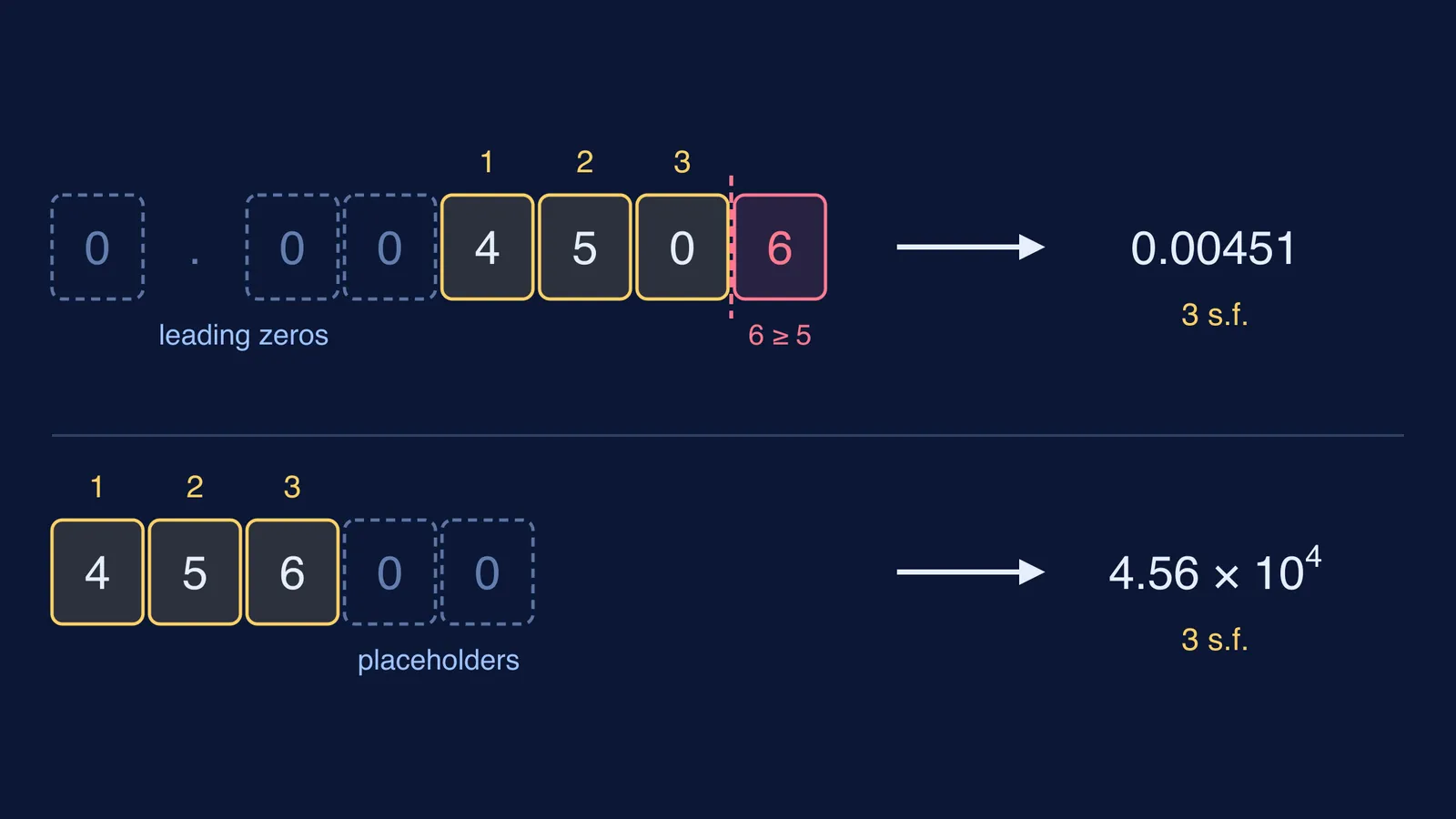
Worked example: 0.004506 to 3 significant figures
The first non-zero digit is 4. The zeros in 0.00 in front of it are leading zeros, so they do not count.
Count three: 4 is the first, 5 the second, and 0 the third. That 0 sits between the 5 and the 6, so it counts.
The next digit is 6. That is 5 or more, so the 0 rounds up to 1.
Answer: 0.00451, or 4.51 × 10⁻³ in standard form.
Two common wrong answers are 0.00450 (forgetting to round up) and 0.005 (rounding to 3 decimal places instead).
Worked example: 45,600 to 3 significant figures
The first three significant figures are 4, 5 and 6. The next digit is 0, which is less than 5, so the 6 stays.
The two zeros stay as placeholders, so the answer is still 45,600. Rounding keeps a number about the same size, so 456 is wrong.
On its own, 45,600 could have three, four or five significant figures. Write 4.56 × 10⁴ to show you mean three; our guide to writing numbers in standard form covers the notation.
To 2 significant figures, the next digit is 6, so the answer is 46,000.
What is the difference between significant figures and decimal places?
Decimal places count digits after the decimal point. Significant figures count from the first non-zero digit, wherever the decimal point is. The same number can give very different answers:
0.004506 to 3 decimal places is 0.005, which leaves only one significant figure.
0.004506 to 3 significant figures is 0.00451.
Significant figures keep the same level of detail for a tiny number and a large one, which is why physics and chemistry answers use them. They have their own twist with logarithms, explained in why pH 3.0 and 3.00 differ.
When should you round in a multi-step calculation?
Round once, at the end. NIST's laboratory guide says not to round intermediate values, because that can cause rounding errors in the final result (NIST GLP 9). In a two-step physics numerical, keep the full calculator value until the last line. If you are unsure where the decimal point lands when you multiply, start with why decimal places add up when you multiply decimals.
If a slip in the method rather than the rounding is costing you marks, the Fermi Problem Library has worked problems with a step-by-step solver that explains the reasoning rather than printing an answer. To revisit the idea itself, the Fermi Concept Library gives each mathematics concept its own lesson.
Try it now: round 0.0070349 and 309,500 to 3 significant figures. You should get 0.00703 and 310,000, written 3.10 × 10⁵.