

On this page
For [H⁺] = 2.5 × 10⁻³ M, your calculator says pH = 2.6020599913. The answer key says 2.60. Your friend wrote 2.6. Only one of these is right. The reason is a rule textbooks often state in one line: in a logarithm, only the digits after the decimal point count as significant figures.
How many significant figures should a pH value have?
The number of decimal places in a pH equals the number of significant figures in [H⁺]. In a log, the digits to the left of the decimal point (the characteristic) "simply reflect the integral power of 10" and are not counted, while the digits after it (the mantissa) carry the significance of your measured number, as the LibreTexts introductory chemistry chapter on pH calculations explains. Its example: [H₃O⁺] = 3.46 × 10⁻⁴ M, with three significant figures, gives pH = 3.461.
The University of Calgary chemistry textbook puts it in one line: a solution with [H⁺] of 0.0111 and a pH of 1.955 both have three significant figures.
Why does the first digit not count? Split the log:
pH = −log(3.46 × 10⁻⁴) = −(log 3.46 + log 10⁻⁴)
log 3.46 = 0.539, and log 10⁻⁴ = −4 exactly
pH = 4 − 0.539 = 3.461
The 3 in front comes from the exponent, an exact whole number that only places the decimal point. The .461 comes from 3.46, the part you measured. Three measured digits in, three decimal places out.
Why do pH 3.0 and 3.00 mean different things?
0.001 M HCl, written with one significant figure, has pH 3.0. Written as 0.0010 M, with two, it has pH 3.00. The extra zero tells the reader how precise the number is.
For a log, the absolute uncertainty in the result equals 0.4343 times the relative uncertainty in the number you took the log of, according to the table of uncertainty rules in Harvey's Analytical Chemistry 2.1 on LibreTexts. Going the other way, the relative uncertainty in [H⁺] is 2.303 times the uncertainty in pH; Harvey's worked example turns pH 3.72 ± 0.03 into [H⁺] = 1.9 (± 0.1) × 10⁻⁴ M.
Apply that to an uncertainty of one unit in the last decimal place:
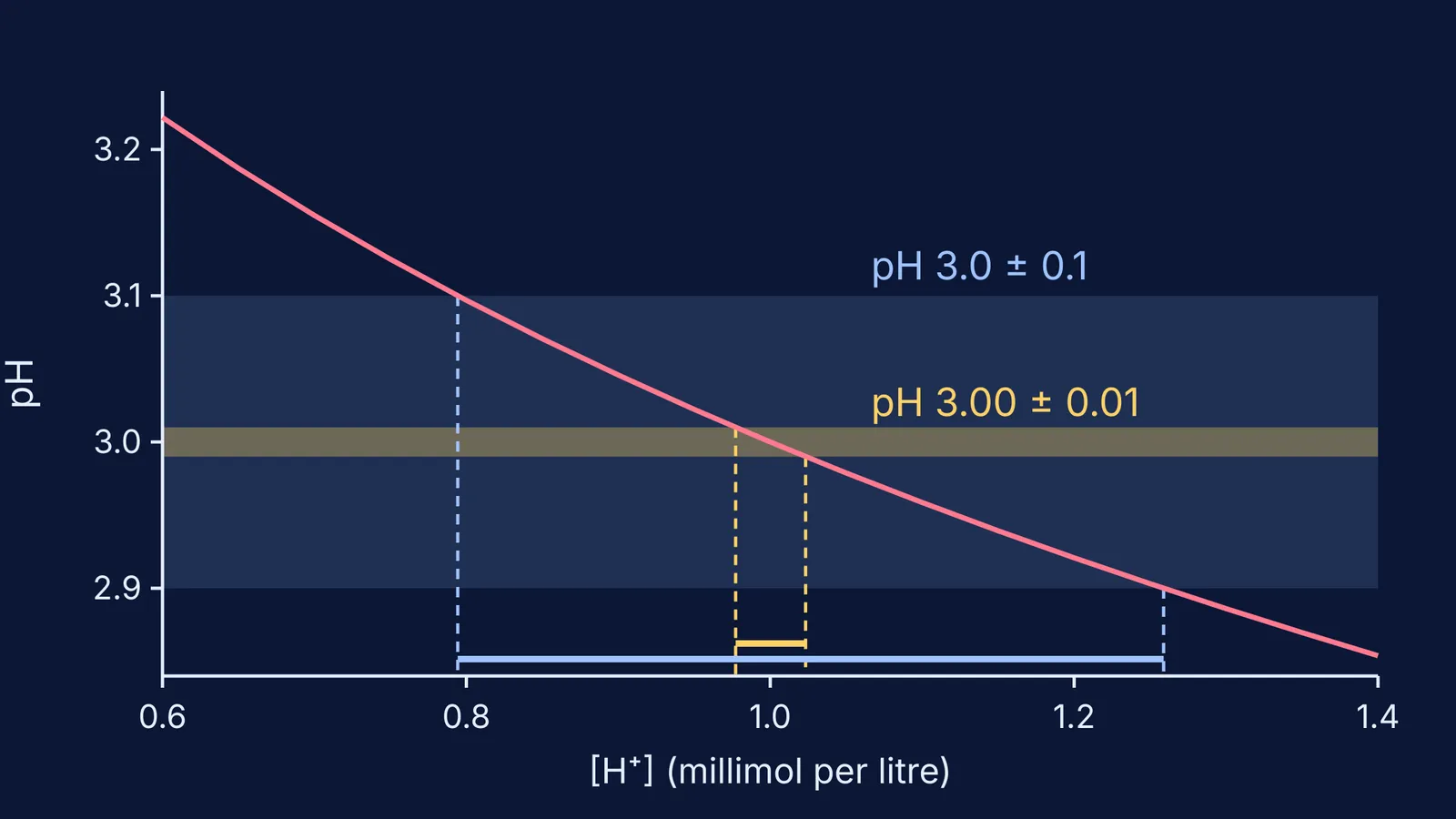
pH 3.0 (± 0.1) means [H⁺] lies somewhere between 0.79 and 1.26 mmol/L, roughly ± 23%.
pH 3.00 (± 0.01) means [H⁺] lies between 0.977 and 1.023 mmol/L, roughly ± 2.3%.
Writing 3.00 claims ten times the precision of 3.0, so add the zero only when your data supports it.
What is the rounding rule for logs and antilogs?
The rule works in both directions, as the LibreTexts pH chapter shows:
Taking a log (concentration to pH): significant figures in [H⁺] become decimal places in pH.
Taking an antilog (pH to concentration): decimal places in pH become significant figures in [H⁺]. Its example: pH 7.04 gives a calculator reading of 9.120108 × 10⁻⁸, which you report as 9.1 × 10⁻⁸ M.
The same rule applies to pOH, pKa and any other value that is the direct answer to a log calculation. When the digit you are dropping is exactly 5, use the even-odd rule for rounding off a 5. Keep every digit through the intermediate steps and round once, at the end.
Worked example: pH from [H⁺], and back again
Part A. A dilute HCl solution has [H⁺] = 2.5 × 10⁻³ M. Find the pH.
Count significant figures in [H⁺]: 2.5 has two.
log(2.5 × 10⁻³) = log 2.5 − 3 = 0.39794 − 3 = −2.60206.
pH = 2.60206. Keep two decimal places: pH = 2.60.
Common wrong answers: 2.6 drops a supported digit; 2.602 claims precision you never had.
Part B. A meter reads pH 4.75. Find [H⁺].
Count decimal places in the pH: two.
[H⁺] = 10⁻⁴·⁷⁵ = 1.778 × 10⁻⁵ M.
Keep two significant figures: [H⁺] = 1.8 × 10⁻⁵ M.
The same counting matters when you work out Ka from a measured pH, as in our guide to finding Ka from the pH of a weak acid. If you keep losing marks on steps like these, the Fermi Problem Library has worked problems with a step-by-step solver that explains the reasoning rather than printing an answer, so you can see where the rounding happens.
A 30-second check before you write a pH
Count the significant figures in [H⁺] (or [OH⁻] for pOH). Leading zeros do not count, so 0.0010 has two.
Ignore the digit before the decimal point in your answer.
Write exactly that many digits after the decimal point.
Going from pH back to concentration, turn decimal places into significant figures.
Round once, at the end.
If logs themselves feel shaky, the Fermi Concept Library gives each concept in chemistry and mathematics its own lesson, so you can revise logarithms before the next pH chapter. Calculators and chatbots both print more digits than your data supports; our piece on why AI gives eight decimal places for two-digit data covers the same habit in AI answers.


