

On this page
Why does AI give eight decimal places for simple numbers?
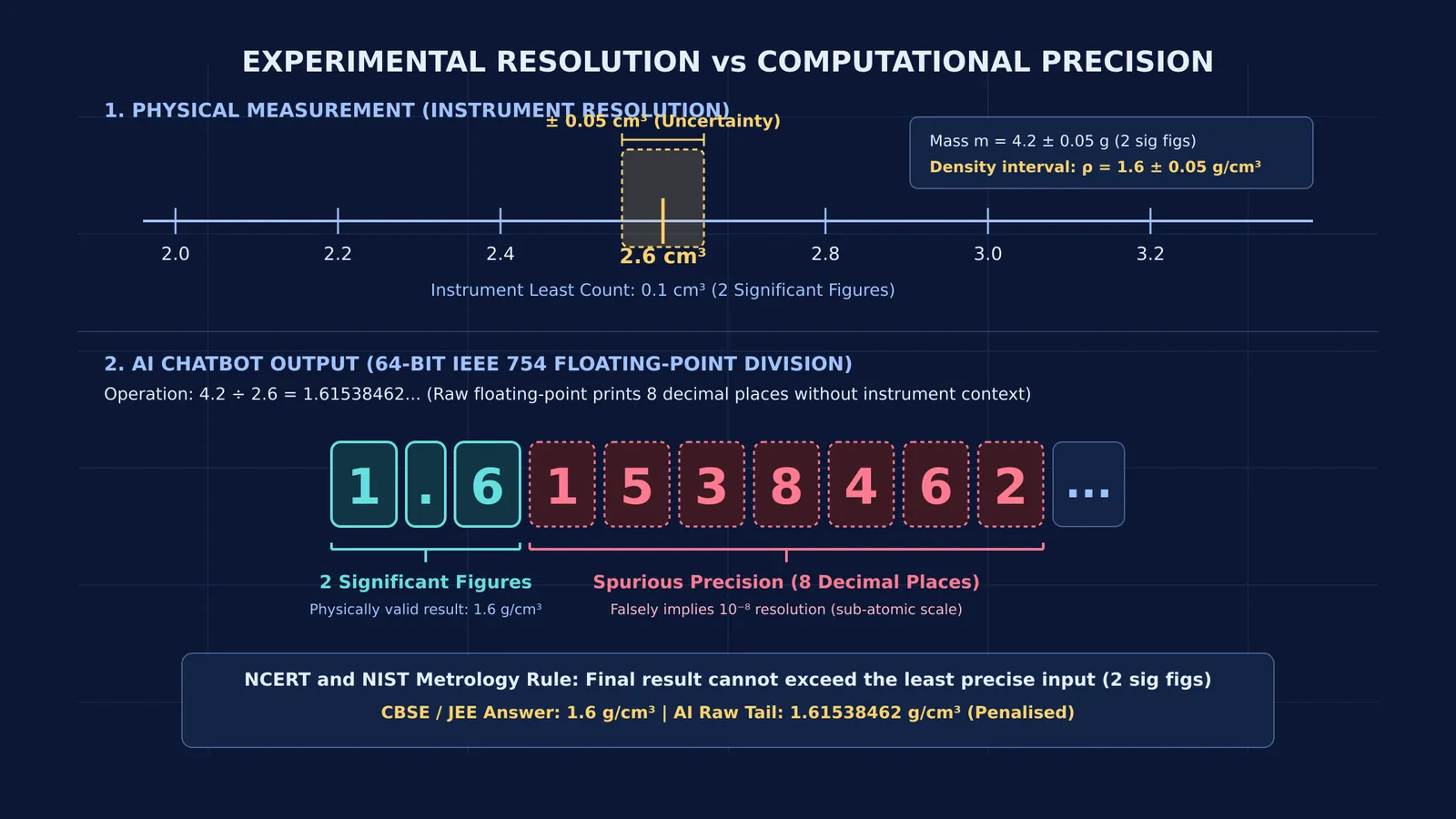
When you ask an AI chatbot to calculate density from a mass of 4.2 g and a volume of 2.6 cm³, it often replies with 1.61538462 g/cm³. To a student, eight decimal places look impressive. To a board examiner, those trailing digits are noise.
This phenomenon is known in measurement science as false precision or spurious precision. As documented in the NIST SI guide, computers execute arithmetic using floating-point standards like IEEE 754, where 64-bit binary numbers provide roughly 15 to 17 decimal digits of precision. When a chatbot evaluates 4.2 / 2.6 through an integrated Python interpreter, it calculates a raw floating-point ratio. The runtime does not know your numbers came from a school balance and cylinder; it simply prints the full string.
Even without code tools, language models mimic high-precision text from internet data. In a 2023 study published in the *Journal of Chemical Education* by Ted M. Clark, ChatGPT answered quantitative general chemistry exam questions with only 44% accuracy, compared to a class average of 69%. The model repeatedly failed to track significant figures through multi-step arithmetic, often generating arbitrary decimal tails. Understanding why AI chatbots get maths wrong starts with recognizing that models predict language tokens rather than physical instrument resolution.
Instead of spitting out raw numbers, Fermi's AI tutor teaches rather than answers: it holds a line of reasoning across a session, notices where a student is stuck, and checks understanding as it goes.
Why is false precision dangerous in board and entrance exams?
In physical science, every reported digit communicates measurement uncertainty. When you record a mass of 4.2 g as described in NIST measurement guidelines, you are stating that your scale measures to the tenths of a gram. Claiming the density is 1.61538462 g/cm³ implies your apparatus can measure dimensions down to atomic scales.
On CBSE board examinations, examiners follow step-wise marking as outlined in CBSE academic guidelines. Marking schemes allocate separate marks for the formula, the substitution, and the final evaluated answer with appropriate SI units. Writing eight decimal places signals that a student copied from an uncalibrated calculator or chatbot. In practical exams, values that contradict an instrument's least count lead to direct mark penalties.
Competitive exams enforce similar discipline. In numerical value questions in JEE Main, the National Testing Agency instructs candidates to enter final answers rounded off to the nearest integer. Entering unrounded decimal tails builds risky habits. Knowing when AI gets physics wrong prevents you from carrying algorithmic noise onto your answer sheet.
How do you round significant figures correctly for CBSE and JEE?
To convert raw calculations into valid scientific results, apply the standard rules codified in NCERT physics textbooks and NIST metrology guidelines:
Multiplication and division: Your final result must contain only as many significant figures as the input measurement with the fewest significant figures. Dividing 4.237 g (four significant figures) by 2.51 cm³ (three significant figures) produces 1.6880478... on a calculator. Round the final result to three significant figures: 1.69 g/cm³.
Addition and subtraction: Your final answer must retain only as many decimal places as the input quantity with the fewest decimal places. Adding 436.32 g, 227.2 g, and 0.301 g gives 663.821 g. Because 227.2 g has one decimal place, round to 663.8 g.
The odd-even rounding rule: When the digit to drop is exactly 5 followed by zeros, round to the nearest even number. If the preceding digit is even, leave it unchanged (2.745 becomes 2.74). If odd, increase it by one (2.735 becomes 2.74). This prevents systematic upward bias in scientific data.
Guard digits in intermediate steps: Never round intermediate numbers during multi-step derivations. Retain one or two extra digits, rounding only at the final step to avoid cumulative error.
When working through complex numerical problems, the Fermi Problem Library has worked problems with a step-by-step solver that explains the reasoning rather than printing an answer, making each intermediate step and rounding boundary transparent.
How can you prompt AI tools to respect significant figures?
When checking numericals with an AI chatbot, specify measurement constraints directly in your prompt:
"Solve this numerical step by step. Identify the significant figures in each given value, keep two guard digits during intermediate steps, and round the final answer according to NCERT rules with SI units."
A structured prompt forces the model to display its uncertainty reasoning rather than dumping raw floating-point output.


