

On this page
In Class 11 physics, the rules for rounding off numbers seem simple until you reach the number five. If the digit to be dropped is less than 5, you leave the preceding digit alone. If it is greater than 5, you increase the preceding digit by one.
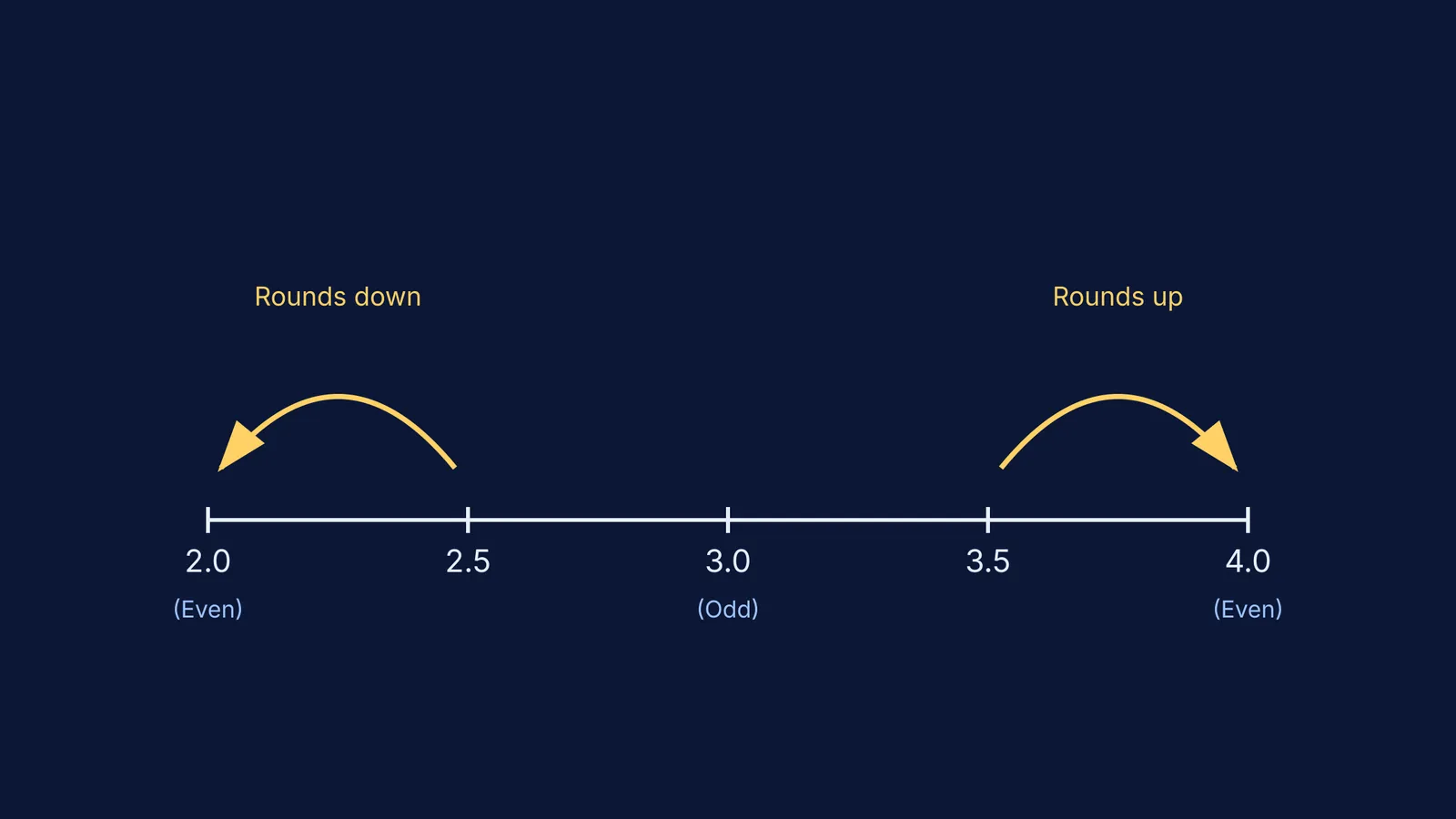
But what if the digit is exactly 5? The NCERT Physics textbook states a rule that often confuses students: you look at the preceding digit. If it is even, you leave it alone. If it is odd, you increase it by 1.
This is not just a textbook quirk designed to test your memory during exams. It is a strict mathematical convention designed to stop errors from building up when you add or average hundreds of different measurements.
Why does always rounding up create bias?
Most of us learn the standard "round half up" method in early maths classes. In that everyday system, 2.5 becomes 3, and 3.5 becomes 4. It is an easy rule to remember, but it comes with a hidden statistical flaw.
Think about the digits 0 to 9. If you are rounding to the nearest whole number:
Four digits round down: 1, 2, 3, 4.
Four digits round up: 6, 7, 8, 9.
The digit 5 is exactly in the middle. If you always round it up, you have five digits pushing your numbers higher and only four pushing them lower. Over a large set of experimental data, this consistent upward push creates a systematic positive bias. By always rounding 0.5 up, the average of your rounded numbers will be artificially higher than the true average of your original data. This upward bias was noted in early scientific computing, leading to the search for completely unbiased methods (Wikipedia).
How does round-to-even balance the scales?
To fix this bias, scientists, engineers, and statisticians use a method called "round to even", which is sometimes affectionately called banker's rounding. When a number sits exactly at the midpoint, you simply round it to the nearest even number (ASTM E29).
Under this rule, 2.5 rounds down to 2, because 2 is an even number. Meanwhile, 3.5 rounds up to 4, which is the next even number. Assuming your scientific measurements are randomly distributed, the digit before the 5 will be even roughly 50% of the time and odd the other 50% of the time. This means that exactly half of your midpoints will round down and half will round up. The small rounding errors beautifully cancel each other out, leaving a net systematic bias of exactly zero.
This convention is completely standard practice in modern science and computing. It is the official rule defined by the international measurement standard ASTM E29, and it is the default rounding method used in the IEEE 754 standard for floating-point arithmetic inside most modern computers and programming languages (IEEE 754).
How do you apply the NCERT rule in exams?
When applying this rule in your school exams or competitive tests, you must read the number carefully to check if it is exactly at the midpoint. The NCERT rule for dropping a 5 only applies if there are no non-zero digits after it.
If the number is 2.745, the 5 is the very last digit. The preceding digit (4) is even, so it simply rounds to 2.74. If the number is 2.735, the preceding digit (3) is odd, so it naturally rounds up to 2.74 to become even.
However, if the number is 2.7451, it is slightly more than exactly halfway. In this case, the even-odd rule does not apply. You must always round up to 2.75, regardless of whether the preceding digit is even or odd, because the number is closer to 2.75 than 2.74.
If you find yourself frequently losing marks to calculation mistakes rather than missing concepts, it is time to review your daily habits. Simple changes like neat working and proper layout can drastically cut down unforced errors on test day. You can also build a routine to systematically catch mole concept errors and check your error propagation math.
When you are ready to test your precision, the Fermi Problem Library offers worked numericals with a step-by-step solver. Instead of just printing the final answer, Fermi's AI tutor explains the reasoning behind each calculation step and checks your understanding as it goes, so you can see exactly where a rounding choice fundamentally changes the result. If you need a refresher on the rules of significant figures before tackling complex problems, you can find the complete interactive lesson in the Concept Library.


